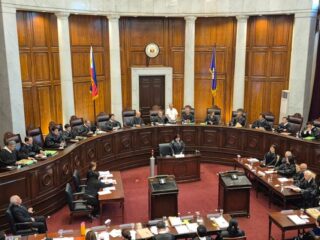
MANILA, Philippines—Without published rules, the Senate cannot compel members of the Cabinet and other executive branch officials to face its inquiries in aid of legislation and all its previous hearings may be regarded to have been "null and void," Malacañang said Sunday.
Citing Tuesday's Supreme Court decision on the petition of former Socioeconomic Planning Secretary Romulo Neri, Executive Secretary Eduardo Ermita said that members of the Cabinet and other executive officials could skip the Senate's inquiries.
He said the officials should be guided by the ruling that upheld Neri's right to invoke executive privilege and refuse to answer questions on his conversations with President Gloria Macapagal-Arroyo on the National Broadband Network (NBN) deal with China's ZTE Corp.
The tribunal's vote on the issue of executive privilege was 9-6, but it was 10-5 in the ruling nullifying the Senate's action to cite Neri in contempt and to order his arrest for refusing to answer questions on the President's reaction after he told Ms Arroyo of an alleged bribe offer for him to endorse the $329-million NBN-ZTE deal, which was later scrapped.
Ermita said that it would be an "abuse of authority" for the Senate to summon executive branch officials to inquiries without published rules as stipulated in the court ruling.
Asked if Cabinet members then could ignore Senate subpoenas, Ermita said: "Of course, they can invoke the ruling."
He said the senators could always go to court for relief.
Ermita cited the court ruling in Tañada v Tuvera and again in Neri v Senate on the "constitutional infirmity of an inquiry conducted without published rules."
Constitutionally infirm
"The Cabinet will invoke the ruling. All along the Senate has been conducting its hearings but it turns out they have yet to publish their rules of procedures," Ermita said.
"So, it turns out all their hearings can be considered constitutionally infirm," he added.
Ermita read a three-page opinion by his legal team which said that unless the Senate complied with the constitutional requirement of publishing its rules of procedure, all its inquiries could be considered "invalid."
The Supreme Court, voting 10-5, reminded the Senate of the need to publish the rules of procedure enshrined in Section 21, Article VI, of the Constitution.
"The rationale for publishing rules is to inform the public of rules which may have an impact on their person, property or liberty. It is basically a requirement of due process," Ermita said, reading from the opinion.
"Before one is declared in contempt, fairness dictates that the person is informed of the rules and the only way for the public to be informed of said rules is by publication," he said.
Null and void
Ermita said this ruling meant that "all the proceedings of the 14th Congress in relation to the (NBN) hearing, as well as other hearings, are constitutionally infirm. They are null and void."
Ermita took the Senate to task for issuing an arrest warrant against Neri.
He explained that based on the tribunal's ruling, "only the courts can issue a warrant of arrest."
"If there is a warrant of arrest, then there should be a preliminary investigation to determine probable cause. There is no such procedure in the Senate," he said.
The Senate has announced it would file a motion for reconsideration of the court decision, which critics said diluted the legislature's constitutional mandate of check and balance and its ability to prevent presidential abuse.
Senate a continuing body
Senate Minority Leader Aquilino Pimentel Jr. questioned the court decision on the purported absence of Senate rules for this current session, which include the power to cite persons in contempt and to order arrests.
Pimentel said that the rules had long been published in national newspapers and that there was no need to republish them every time a new set of 12 senators was elected to the 24-member upper chamber.
The Senate is unlike the House of Representatives whose members are elected every three years, Pimentel said. He said the Senate was a continuing body.
"The rules of the Senate continue for as long as the Senate is in place," Pimentel said.
"The SC ruling has opened doors to erroneous conclusions like Ermita's. That is why we need to file a motion for reconsideration to clarify the SC ruling," Pimentel said in a text message Sunday.
Acting like bandits
Pimentel dismissed the Palace view that the Senate's investigations were illegal due to its failure to publish its rules.
"The Senate rules have been published and were not required to be published again unless there have been changes made," said Pimentel.
Sen. Alan Peter Cayetano, chair of the Senate blue ribbon committee, said that Malacañang's "distorted interpretation" merely reinforced the view that the "Palace has been acting like bandits in the wild, wild West and accountable to no one."
"What is worse is that the bandits have the sheriff star or the badge and are the ones calling for the rule of law and taking everything to court. This is precisely why the Senate will file a motion for reconsideration," Cayetano said.
He stressed that the court decision was not yet final and the Senate could still operate under its existing rules.
Cayetano, however, would not say whether the Senate would continue to suspend its hearings until the tribunal decides on its motion for reconsideration.
Loss to publicity seekers
Sen. Juan Ponce Enrile cautioned his peers against "blowing up" the implications of the court ruling and "imputing malice and bias" to the Arroyo-appointed justices.
"This is not only a slur to members of the court, it also erodes the democratic system of government by destroying its institutions," he said.
Enrile disputed opposition claims that the court decision had curtailed the Senate's investigative power.
"We can still invite them to our hearings, we can deliver privilege speeches exposing corruption in government and we will not be questioned about it. The only thing that will probably be reduced is the eagerness of those who want to gain more publicity or hog the headlines," Enrile said.