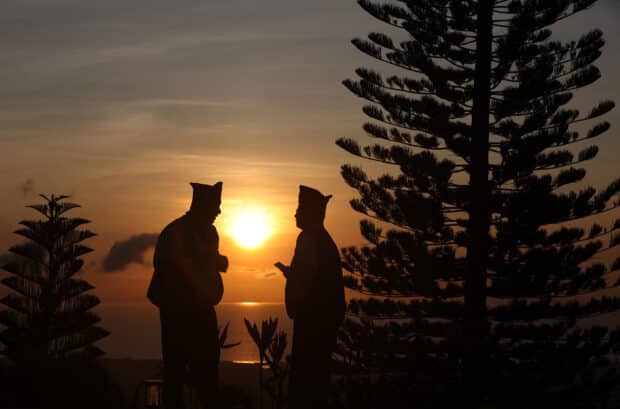
IT WAS 5 a.m. and, while the sun was still asleep in the horizon, the
Kilauea?the world?s most active volcano?continued to emit a grey sulfuric miasma.
As part of native Hawaiian protocol, we poured on the a?a lava an herbal extract as an offering to Pele, the volcano goddess, to seek her permission to enter the crater. We sang a song chronicling the birth of the eight major Hawaiian islands, a hymn that seemed to please the deity. We also chanted E ala e to the sun until it ?woke up? and emerged from behind the clouds.
Two days before that, we snorkeled in the pristine waters of Mauna Kea beach, the coast where Kamehameha I, the mighty unifier of the Kingdom of Hawaii, built a sacrificial temple in order to gain the favor of the war god Kûka?ilimoku. That was my first time to snorkel, and to see a live green turtle at a distance of six feet. I thought I even saw the
humuhumunukunukuâpua?a, the fish with a name longer than itself (it?s the reef triggerfish, official fish of the state of Hawaii), playing among the corals and anemones.
These were scenes from my mauka (towards the mountains) and makai (towards the seas) summer in Hawaii, a group of islands in the center of the Pacific Ocean that is the 50th state of the United States.
Thanks to the Study of the United States Institute for Student Leaders on Global Environmental Issues (SUSI), 20 Asian students had the opportunity to learn about the global environment and reflect on their own countries? environment, culture, history, and other aspects.
I was among five Filipinos chosen by the US Embassy through a competitive process to participate in the program funded by the US State Department. We joined students from Burma (Myanmar), Malaysia, and Thailand, who were also selected by the American embassies there.
SUSI aims ?to develop young leaders with the ability to build and maintain resilient communities in light of global environmental challenges.? It is organized by the Hawaii-based East-West Center, an education and research institution that aims to strengthen relations and understanding among peoples and nations of Asia, the Pacific and the US.
The other Filipinos in the group were John Dale Dianala, geology major, University of the Philippines-Diliman; Romecito Madronio Jr., special education major, Xavier University, Cagayan de Oro City; Ronald Ringor, chemical engineering student, Saint Louis University, Baguio City; and Robert William Yasi, physics major, Silliman University, Dumaguete City.
Everyone has a role
For five weeks, we listened to lectures, engaged in debates, wrote essays, talked about our countries, and visited various sites in Oahu and the Big Island such as the Volcanoes National Park, State Capitol, and Honolulu?s waste-to-energy plant, as well as government agencies like the US Environmental Protection Agency and the US Capitol in Washington D.C. during the final week.
?I?ve realized we chemical engineers also have a role in protecting the environment,? Ronald said when we discussed how engineers could protect, or sometimes destroy, the environment.
The composition of the class was testament to the interdisciplinary nature of environment work. Most of us were environmental science majors, but there were also students of history, education, information technology, and other fields.
Malaysian Ben was a photographer, writer, painter, and ecologist while 19-year-old Tess from Burma trained teachers twice her age in English and the environment.
Piao worked in an elephant hospital in Thailand, so we teasingly called her our beloved Elephant Mother. The young mother made us all cry during one session when she asked, ?Why don?t we eat bananas like the elephant?? The question made us realize how badly we had manipulated, or worse, exploited and destroyed nature.
The two medical students?Ploi from Thailand and myself?seemed proof that human health and the environment were interconnected and inseparable. Aware of the impact of environmental problems on health, I said it was vital to tell people how pollution and climate change could affect their lives.
The rock music-loving John Dale said the program sparked his interest in energy policy. ?We studied petroleum and coal in geology class, but now I understand how important policy-making is in pushing for a shift to renewables like solar or geothermal (energy).?
From one of our book assignments, ?Plan B 4.0? by eminent sustainable development advocate Lester Brown, we learned that we needed just one-eighth of the world?s total annual military budget to address global environmental, health, and education issues.
Connections
We saw in Hawaii the undeniable connections among nature and culture, environment and humanity. For the Hawaiians, as revealed in their legends and chants, the environment was a father with many wives, one of whom gave birth to the islands. In short, as Lilo told Stitch in the Disney movie, they all belonged to an ohana (family).
We realized one could not protect nature without understanding the culture. To maintain the heiau (temple) meant to preserve the mana (essence). To appreciate the Kilauea was to worship Pele. To conserve the lama trees was to honor the kupuna (ancestors).
From one speaker I learned two words that captured this principle: bio-cultural conservation.
I thought about our history and realized our ancestors regarded the environment in the same way as Hawaiians did. Maybe Filipinos should revive this attitude towards the environment?one that did not defile and destroy but rather respected and protected.
?And it starts with massive education at the grassroots,? Romcy, the educator, kept repeating.
After four weeks in Hawaii and one week in Washington D.C., I could say SUSI lived up to expectations. It was a holistic introduction to the culture and society of the US, in general, and Hawaii in particular; a unique program to hone leadership skills, and an informative and enlightening survey and analysis of the myriad challenges faced by our planet, as well as a sharing of ideas for possible solutions.
Now more than ever, I am inspired and committed to work and speak for the conservation of our environment.
Although we were sad to leave Hawaii, we were also filled with hope, eager to share the lessons we learned from mauka to makai, from the mountains to the seas, of Hawaii with our own people back home.
(The author, a sixth year medical student at the University of the Philippines Manila-Philippine General Hospital, is the founder of UP One Earth)