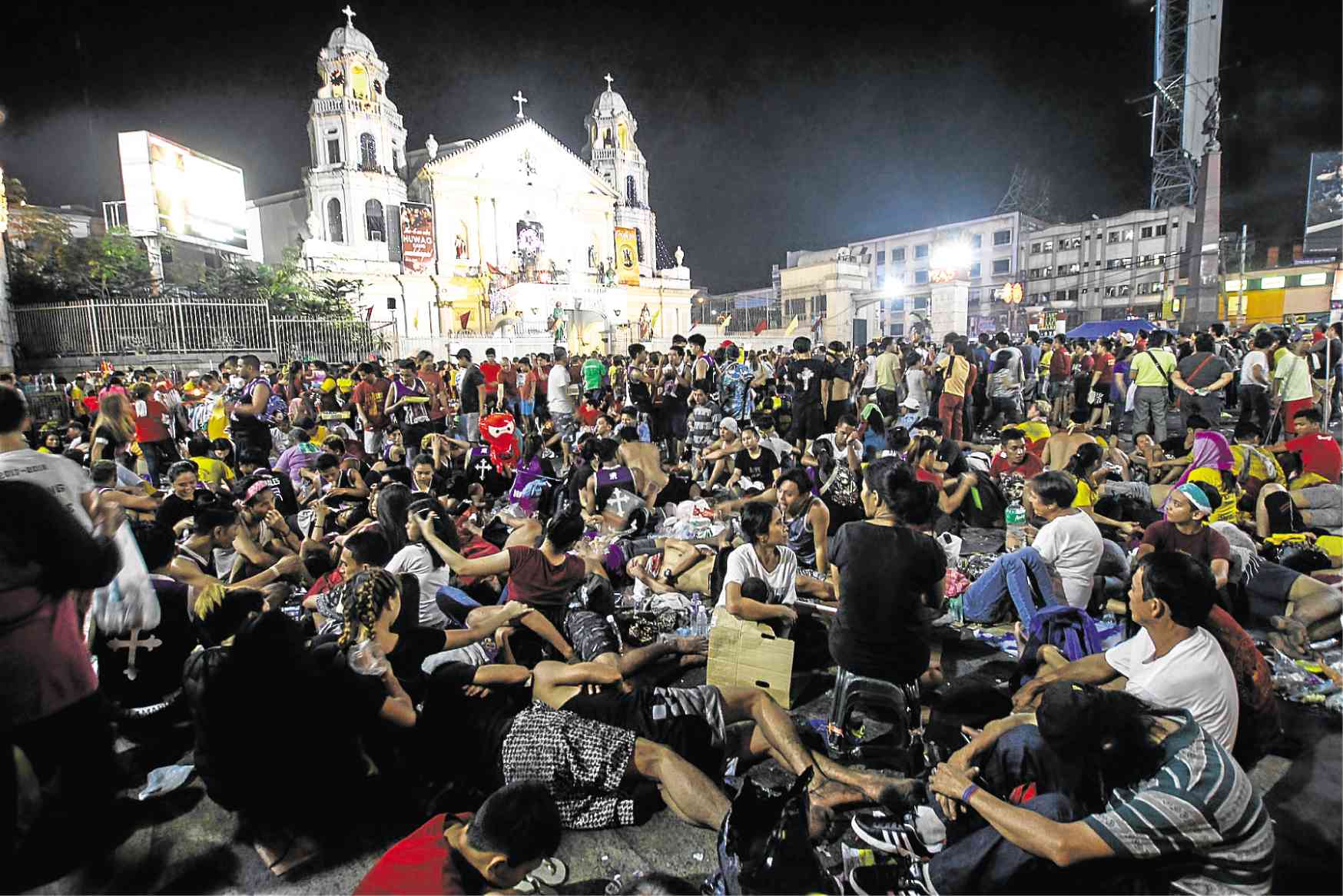
MANILA, Philippines—(UPDATE 8) After a 13-hour procession joined by tens of thousands Catholic devotees, the statue of the Black Nazarene was returned to Quiapo Church Friday evening.
It took almost an hour before the gate of the Catholic church could be opened as devotees made last-ditch attempts to get near the black icon of Jesus Christ to rub it with their handkerchiefs, believing this would bestow miraculous powers of healing and bring good luck.
Thanks to the giant video screen overlooking Plaza Miranda, which flashed the live camera feed of the procession as soon as the carriage entered Plaza Miranda, devotees who could not get through the thick crowd still managed to see the image.
Devotees on the other side of the road or those standing on the center island cheered when the camera zoomed into the face of the Black Nazarene. They clapped on seeing a woman jumped into the carriage.
Seven persons were seen on stretchers during the commotion, one of them bloodied.
Despite a moderate earthquake that struck north of Manila in mid-afternoon the five-kilometer procession began in Rizal Park and culminated in downtown Quiapo Church, in a colorful display of Catholicism's enduring popularity in the former Spanish colony.
The devotees shed their footwear to follow the icon. The devotees, many wearing scarlet shirts and waving white handkerchiefs and towels, took turns to pull a pair of ropes that hauled the centuries-old Black Nazarene through the narrow streets of central Manila.
The procession was diverted to its old route after devotees forced the image’s carriage to go into one of the side streets leading to Quiapo Church, Chief Superintendent Roberto Rosales said.
Rosales said the change happened after the Black Nazarene’s carriage got to McArthur Bridge and the “old” devotees pulled the rope around the image towards Quinta Market.
Rosales said rather than risk a stampede, they decided to let the people have their way.
“We did our best to make it orderly,” said Rosales.
Jojo Sanding, one of the Black Nazarene volunteers, blamed residents from Quiapo for snatching the rope that forced the carriage to change its route.
The image left the Quirino Grandstand at 8:30 a.m. after a mass celebrated by Archbishop Gaudencio Rosales, a break from the tradition of holding the ceremony in Quiapo Church.
The open-air mass was interrupted 20 times as devotees stampeded towards the float carrying the icon, an Agence France-Presse reporter saw.
No serious injuries were reported.
"The small group that fanatically climbed to get to the Lord, that's the example of what it should not be. That part has to be purified," Rosales later told reporters.
"There are excesses in the devotion and beliefs that we need to change," said Monsignor Clemente Ignacio, the parish priest of Quiapo.
Devotees noted the increase in the number of participants who joined the procession this year.
“Hindi nababawasan, taon-taon dumadami. Dumadami mga naniniwala [The numbers are not dwindling, they are increasing every year],” said Edgar Apable, 45.
He has been a devotee of the Black Nazarene since he was a kid.
Apable has been joining the procession for the last 30 years, traveling all the way from his home in Meycauayan, Bulacan, although a foot injury this year prevented him from making the walk.
Another devotee echoed Apable.
“A lot of people joined this year. A lot of impulsive youths were guided by the Father to change,” said Alex Morales, a devotee of the Nazarene for the last six years.
Major Bert Esusan of the Civil Disturbance Management Unit of the Manila Police District said about 1,000 policemen were deployed in all the major roads in Manila.
He said that the Metro Manila Development Authority also sent personnel aside from the traffic and non-government organization volunteers assisting the police but did not give the exact number.
The Red Cross Manila Chapter deployed some 300 volunteers to provide first aid treatment.
Minor foot injuries are also common since devotees who join the procession walk barefoot, said Alfa Dorothy Galit from Red Cross Manila.
The life-sized wooden sculpture of a black Jesus bearing a cross is said to have been carved in Mexico and brought to the Philippines by Augustinian missionaries in the early 17th century during Spain's galleon trade. With a report from Tetch Torres