





Former SC justices dissect landmark ruling on Sara Duterte trial


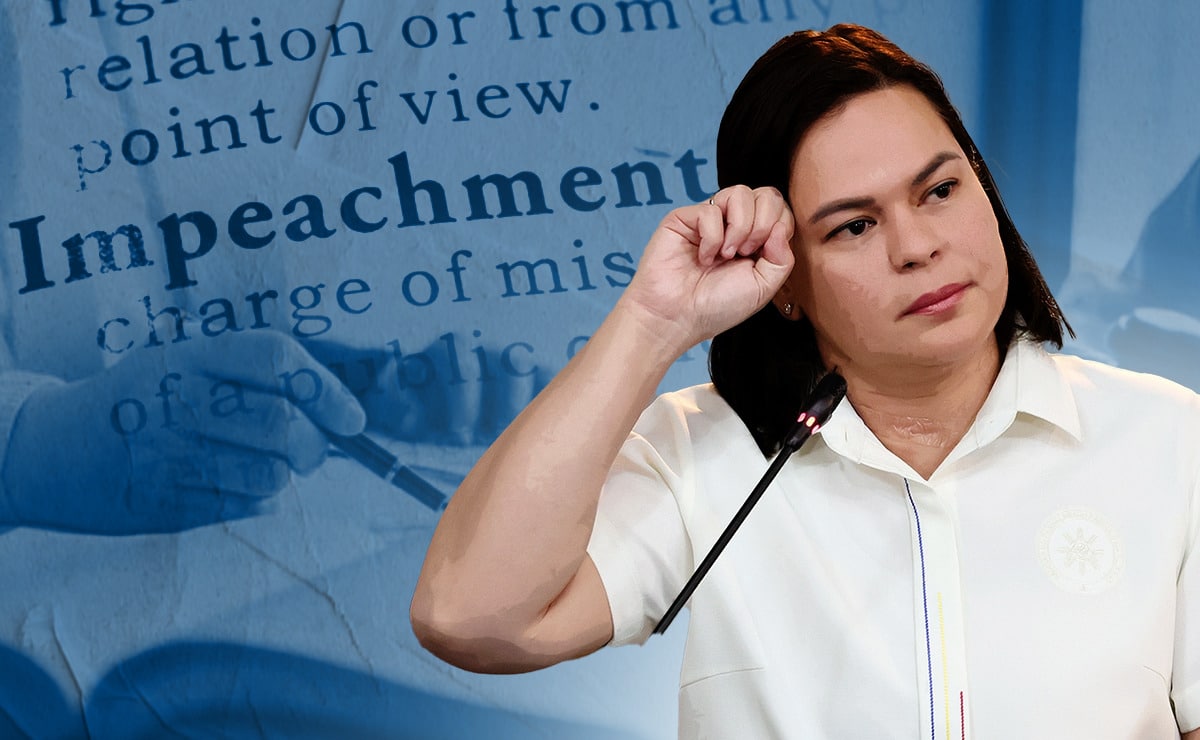
VP Sara Duterte impeachment composite image from Inquirer files
MANILA, Philippines—Just days before the Senate was set to try Vice President Sara Duterte, the Supreme Court delivered a ruling that, according to legal analysts and observers, could have far-reaching implications for the country’s impeachment process.
The high tribunal declared the impeachment complaint against Duterte unconstitutional, citing a technical violation of the Constitution’s one-year bar on such proceedings, as well as a failure to observe due process.
The ruling—thirteen justices for, none against, two not voting—sent shockwaves through the country’s political and legal communities.
READ: Supreme Court: Impeachment complaint vs Sara Duterte unconstitutional
“Our fundamental law is clear: The end does not justify the means,” wrote Senior Associate Justice Marvic Leonen, who penned the decision.
“There is a right way to do the right thing at the right time. This is what the Rule of Just Law means. This is what fairness or due process of law means, even for impeachment,” Leonen added.
But while the Court’s language seemed unambiguous, some of the country’s most respected legal minds saw new complexities and new risks lurking beneath the surface.
READ: Solons hit SC order on Sara Duterte impeachment: Loss for the masses
Four complaints, one constitutional puzzle
Between December 2024 and February 2025, four impeachment complaints were filed against Vice President Duterte. Three came from private citizens and groups; the fourth was initiated by more than a third of House members.
On February 5, the fourth complaint was transmitted to the Senate, triggering petitions before the Supreme Court that would change the nation’s legal landscape.
READ: First impeachment complaint vs VP Sara filed at House
READ: VP Sara Duterte faces 2nd impeachment rap
READ: VP Sara Duterte slapped with 3rd impeachment complaint
At the heart of the decision: Article XI, Section 3(5) of the Constitution, which prohibits the initiation of impeachment proceedings against the same official “more than once within a period of one year.”
The Court held that the House of Representatives’ handling of the first three complaints—specifically, leaving them without referral to a committee—did not mean those complaints were never initiated. In its decision, the Supreme Court stated:
“The three impeachment complaints were archived and therefore deemed terminated or dismissed on February 5, 2025.”
As the decision further explained, this action triggered the one-year bar on new impeachment complaints. The ruling stated:
“[N]o new impeachment complaint, if any, may be commenced earlier than February 6, 2026.”
READ: Full Supreme Court ruling junking Sara Duterte impeachment
Redefining ‘initiated’
In a shift from its 2003 ruling in Francisco v. House of Representatives, which stemmed from the impeachment proceedings against then-Chief Justice Hilario Davide Jr., the Supreme Court departed from its earlier interpretation of when an impeachment complaint is considered “initiated.”
In Francisco, the Court held that initiation occurs only when a complaint is included in the Order of Business and referred to the proper committee. But in its ruling on the Duterte case, the Court clarified that complaints may be considered initiated once filed, even if they are later archived without committee referral.
The Court said this clarification was meant to prevent constitutional limits from being undermined through procedural delays or inaction. Some legal analysts have noted that this stricter interpretation is intended to ensure that the one-year bar on impeachment cannot be sidestepped through technicalities.
Due process, reimagined
The decision did not stop at the one-year bar. Court spokesperson Camille Ting emphasized that “due process applies during all stages of the impeachment process,” even in cases that were fast-tracked under the one‑third rule.
The justices listed specific due process requirements:
- The Articles of Impeachment and supporting evidence must be included when shared with House members for endorsement.
- The evidence must be sufficient to support the charges.
- The Articles and evidence must be made available to all members of the House of Representatives.
- The respondent must be given an opportunity to respond to the charges and evidence before transmittal to the Senate, regardless of the number of endorsements.
- The House must be allowed reasonable time for independent deliberation.
- The charges must involve impeachable offenses committed in relation to the respondent’s official duties and within the current term, and must be of sufficient gravity.
- For complaints filed under Article XI, Section 3(4) of the Constitution, the House must provide the respondent with a copy of the Articles and evidence, allow a reasonable period to respond, and circulate both the evidence and the respondent’s comment to all members prior to the one-third vote for transmittal to the Senate.
READ: SC: Impeachment raps broke 1-year ban; no due process
‘Not our duty to favor any political result’
In a powerful closing note, the Court reflected on the history of Philippine politics and its mandate to uphold the rule of law even when passions run high.
“We understand our history. We have learned that in the past, momentary desires to do what is convenient and concede means to ends have inadvertently created precedents that weaken the succor of law for those who dissent, or those at our society’s margins, or those who may have fallen out of grace from the powers that be,” the decision noted.
“We have learned that the clash of political interests in the past, often disguised by noble intentions, has obscured the need to address the real problems of corruption, inequality, poverty, and disempowerment faced by our people,” it continued.
“We will not allow that to happen again. We will not hesitate to declare what is legal, just, and right for our people.”
The decision is immediately executory, but is still open to a possible motion for reconsideration from the House of Representatives.
Former justices respond: “Correct,” “unfair,” “unusual,” and “rushed”
As politicians and legal analysts pored over the ruling, three former Supreme Court justices—Adolfo Azcuna, Artemio Panganiban, and Antonio Carpio—offered their own deep dives into the implications, fairness, and timing of the decision.
In a TV interview, retired Associate Justice Adolfo Azcuna laid out the core consequence of the ruling:
“That means that the articles [of impeachment] are invalidated and the Senate has no jurisdiction over it. The trial will not proceed. They did not refer it to the committee, so they thought it wasn’t initiated—so they could initiate a fourth one, and that is what they did,” he said.
“But the Supreme Court said that it is deemed initiated because they are supposed to refer it to a committee within ten session days. So if you fail to refer it to the committee, as required by the Constitution, that already counts as an initiated complaint,” he added.
But while Azcuna agreed with the legal reasoning, he warned that the Court had changed the rules after the fact, penalizing actors who had relied on the old definition of “initiated.”
“The 97-page Decision… may be legally correct, but it strikes me as rather unfair… It rules the Articles of Impeachment adopted by the [House of Representatives] as violating the only one complaint within one year rule by crafting a new definition of what constitutes being ‘initiated’ and applying it to a complaint adopted in reliance on its previous and then prevailing definition,” he explained in a statement.
READ: Spox: House respects SC order, but check and balance principle at risk
Azcuna invoked the Doctrine of Operative Facts, urging the Court to avoid retroactive application:
“I respectfully appeal that the High Court, by way of a Supplemental Resolution, apply to this case the Doctrine of Operative Facts, which it has applied before in similar cases, stating that where actions were taken and things done in reliance on its former and then prevailing definition (or in the absence of one), the action and things done will be treated as valid, and the new definition will be applied prospectively, i e, to future cases,” Azcuna said.
“In this way, I respectfully submit, the people’s unwavering demand for accountability now will be served, and the trial in the Senate can still, and finally, proceed forthwith,” he added.
‘Respect the rule of law… but why no oral argument?’
Retired Chief Justice Artemio Panganiban took a measured tone, emphasizing both deference to the Supreme Court and concern over the speed of its decision.
“First, regardless of whether we are for or against the decision, let us respect it. We must observe the rule of law. Note that the decision is not final yet. It is still subject to a motion for reconsideration (or for clarification) by the [House of Representatives], if it so wants to file one.”
Panganiban argued that the Court could have opted for a “Status Quo Ante” order—freezing the process while giving both the justices and the public a fuller picture of the issues at stake:
“Instead of issuing a rather rushed decision, I would have favored—if I were still an incumbent—the issuance of a Status Quo Ante order requiring the parties to maintain the current situation, that is, for the Senate to stop any trial while the Court is deliberating on the petition,” he explained.
“In this way, both the justices and the public would have had a better grasp of the facts and the law involved. After all, this case has transcendental importance to the nation and to our people,” he added.
And while the Court has held oral arguments on “less important problems,” Panganiban noted, it did not do so here:
“‘[W]ith malice towards none, with charity for all’ (to quote a famous speech of a revered American President) and as part of due process, I would have asked for Oral Argument before promulgating any decision. If the Court had patiently heard Oral Argument on less important problems like the recognition of foreign divorces and the PhilHealth petitions, why not on this monumental case?”
“[At] the least, if only to accord respect to a coequal branch of the government, the [House of Representatives], I would have called for Oral Argument before making up my mind and casting my vote,” he said.
Carpio flags ‘unusual’ timing, technical questions in SC ruling
In an interview with journalist Christian Esguerra, retired Senior Associate Justice Antonio Carpio went further, calling the Supreme Court’s timing “unusual” and highlighting fresh legal hurdles for impeachment.
“It’s obvious that they wanted to come out with a decision before the impeachment trial could start because their decision is to declare the articles of impeachment unconstitutional,” Carpio said.
“So to prevent the trial from proceeding, linabas nila, which is unusual because the House was not even required to comment, pinadalan lang sila ng specific answers,” he added.
Carpio carefully dissected the technical core of the ruling: when does the one-year bar rule start? Citing time stamps in the records, Carpio noted that the Senate received the articles of impeachment at about 4:57 p.m. on February 5, but the House did not adjourn until after 7 p.m.
“So if we follow the decision that the one-year bar rule starts to run when the first three complaints were dismissed or terminated, and this was terminated or dismissed upon adjournment of the House. Before the adjournment, the fourth impeachment complaint was already filed,” he explained.
“So the one-year bar rule had not yet begun to run. So, pasok pa (it was still within the allowable period), it could still be filed. But this has to be verified, of course, because these are based on the records,” he stressed.
READ: Carpio: SC’s Sara Duterte impeachment order hinges on session days
If this technicality stands, Carpio suggested, a motion for reconsideration could hinge on this “two-hour window”—a factual matter easily resolved by looking at the records.
Even before the Supreme Court handed down its decision, Carpio publicly defended the House of Representatives’ handling of the impeachment process.
In a previous statement, the former senior associate justice argued that the House “followed the Constitution to the letter” when it came to the timing and submission of the impeachment complaints.
He noted that the first three complaints were included in the Order of Business on the required session days, while the verified resolution backed by more than a third of House members was submitted within the period set by House rules.
Carpio emphasized that, as provided by the Constitution, once the threshold of one-third support was reached, the resolution should be considered the articles of impeachment and transmitted to the Senate.
He warned that the Supreme Court’s intervention in the matter risked encroaching on a process that is fundamentally political, not judicial.
“The Constitution was followed. The threshold was met. The process was legal and complete. That should be the end of it,” Carpio said.
More rigid application of impeachment rules
Carpio also questioned the Court’s sweeping new due process requirements, warning they could nullify past impeachments and raise the bar for future ones:
“Now, of course, the decision cites another ground that there was a violation of the right to due process because VP Sara was not given the opportunity to be heard. She was not given a copy of the articles before it was sent to the Senate…”
“If you apply this rule to the Estrada impeachment and to the Corona impeachment, then those impeachments will be void because the person being impeached was not given an opportunity to be heard in the House because it was a direct filing of the resolution by one-third,” he said.
He explained that the direct-filing method used to mean “you skip all the process in the House,” as the Constitution’s text provides:
“The understanding was that since it’s a direct filing by one-third, you skip all the process in the House. The Constitution says, the same shall constitute the articles of impeachment,” Carpio said in a mix of Filipino and English.
But this time, he said, the Court introduced a new requirement:
“This decision said, no, you cannot do that. You have to have a hearing at least. That means the plenary will hold a hearing, which is something new. So there are two things there.”
First, he noted, whether the fourth complaint was filed before or after adjournment is a factual issue that can easily be verified: “That’s simple. You just look at the records.”
Second, and more significantly, the ruling added a new procedural safeguard: the respondent must be given a chance to be heard at the plenary.
“[That’s] not in the House rules, and it’s not in the Constitution. Because the Constitution says that once you have one-third, that becomes the articles of impeachment—the resolution signed by a third of House members.”
“So that’s the situation now. I think it will be very difficult for anyone to file an impeachment case because it’s very strict now,” Carpio concluded.
What’s next? Guardrails, roadblocks, or both?
For now, the Supreme Court’s decision is immediately executory.
But with the possibility of a House motion for reconsideration, and mounting debate about the meaning of “due process” in impeachment, legal scholars, lawmakers, and ordinary citizens are left asking: Did the Court strengthen constitutional safeguards—or raise new barriers for holding the powerful accountable?
As the ruling itself reminds the public:
“We cannot concede the sobriety of fairness inherent in due process of law to the passions of a political moment. Our fundamental law is clear: The end does not justify the means,” it said.
“There is a right way to do the right thing at the right time. This is what the Rule of Just Law means. This is what fairness or due process of law means, even for impeachment,” it added.
RELATED STORIES:
Palace on impeachment’s unconstitutionality: ‘Respect Supreme Court’ Sara Duterte defense team welcomes SC decision on impeachment raps
Lawyers’ group: SC departed from Constitution on impeach ruling


