


Women’s groups demand accountability, file raps vs Suntay


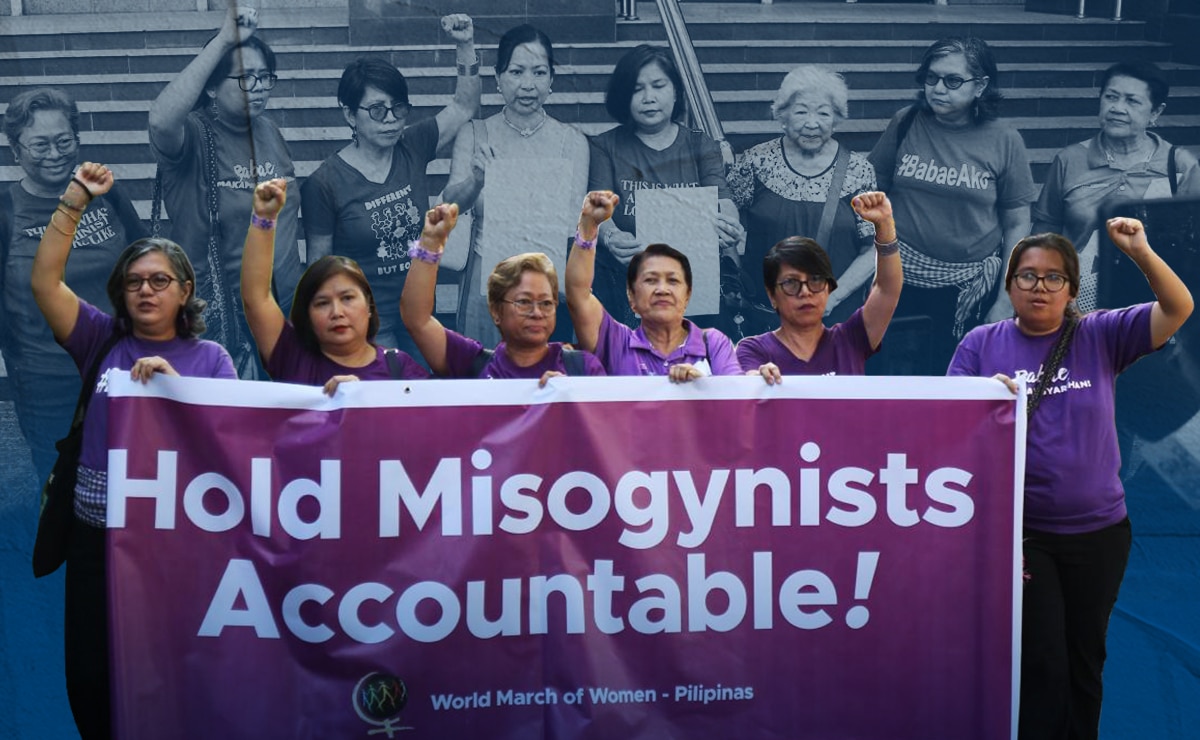
Women’s groups demand accountability on International Women’s Day composite image from Sentro ng mga Nagkakaisa at Progresibong Manggagawa (SENTRO)
MANILA, Philippines — Women’s groups marked this year’s International Women’s Day with a clear message: Justice for victims of sexual violence can only be achieved when perpetrators — especially those in positions of power — are held accountable.
The call came as advocates staged a symbolic protest in front of the Office of the Ombudsman on Friday, March 6. Members of World March of Women-Pilipinas placed mock “perpetrators” inside a makeshift jail to dramatize their demand for accountability.
For the coalition, the action highlighted how impunity allows violence against women to persist in society and politics.
“Justice can be gained only when perpetrators of sexual violence against women are held accountable,” the group said, adding that the issue affects women and children from all walks of life, particularly those from marginalized sectors.
READ: Femicide: Targeting women because they’re women
According to the group, without accountability, the cycle of violence continues — especially when those accused hold powerful positions. They also pointed to global developments, including the release of documents linked to the Jeffrey Epstein case, which advocates said exposed how networks of influence can shield perpetrators.
Complaint vs lawmaker
Women leaders used the occasion to file administrative and criminal complaints against Rep. Jesus “Bong” Suntay, citing what they described as sexually objectifying remarks directed at an actress.
The complaints stem from a statement the Quezon City lawmaker made during a House justice committee hearing on impeachment complaints against Vice President Sara Duterte earlier this week.
During the proceedings, Suntay invoked the name of actress Anne Curtis while defending Duterte’s remarks about being a “designated survivor,” telling fellow lawmakers that imagining something about a woman was not illegal.
He said that after seeing Curtis at a hotel, he imagined what could happen between them, adding that the thought “remained only in the imagination.” The remark prompted immediate objections from lawmakers during the hearing, with the committee chair later moving to strike the statement from the official record.
Several legislators present at the hearing said the comment was unnecessary and inappropriate in the context of a congressional proceeding, especially at the start of National Women’s Month.
Women’s rights advocates and lawmakers also criticized the statement for reducing women to objects of sexual imagination. Critics noted that public officials have a duty to uphold respect and professionalism in official proceedings, warning that such remarks reinforce sexist attitudes within institutions of power.
Labor leader Nicey Coronacion of Sentro ng mga Nagkakaisa at Progresibong Manggagawa-Women (SENTRO Women) said the issue underscores the need for stronger accountability among those in power.
“It is critical that women of the world and their allies unify and hold the elite and the patriarchs in power accountable for sexual violence. The Sentro ng mga Nagkakaisa at Progresibong Manggagawa-Women (SENTRO Women) joins World March of Women-Pilipinas, fellow feminists and social movements to demand the imprisonment of all who perpetuate violence against both women and children,” Coronacion said.
She added that advocates will continue pushing for justice and systemic change.
“[We] will continue to be part of global movements for women’s liberation and empowerment and persevere until the abusers are punished, and until systems are changed for women’s liberation,” she said.
Ana Maria Nemenzo, national coordinator of WomanHealth Philippines, also linked the issue to women’s reproductive rights.
READ: EXPLAINER: Your body, your choice: Why is bodily autonomy so important?
“Perpetrators of misogyny, sexual violence and commodification of women that strike at the core of women’s bodily autonomy and integrity become all the more reprehensible when perpetuated no less by men in power and government officials,” Nemenzo said.
She added that there must be no tolerance for such acts.
Power without parity?
The controversy also highlights a deeper structural issue in Philippine politics, according to Dr. Rogelio Alicor Panao, an associate professor at the University of the Philippines Diliman and an Inquirer data scientist.
“In a recent House hearing, a senior legislator’s remark that invoked a female celebrity in a way many deemed inappropriate drew flak from colleagues and the public alike. The episode was not simply about rhetoric. It underscored who dominates deliberative spaces and how institutional culture often reflects numerical imbalance,” Panao wrote in an analysis examining the broader implications of the incident.
Panao, citing the United Nations Development Programme (UNDP), noted that women remain underrepresented in legislative institutions despite the Philippines’ reputation for female leadership.
“According to UNDP data, women held only 27.46% of seats in the Philippine House of Representatives in 2023. For a country that has had two female presidents, that figure reveals a persistent paradox — breakthrough leadership at the top, but uneven representation in the chamber where laws are crafted.”
He added that the Philippines performs unevenly even when compared with other countries in the region.
“Though the Philippines performs better than Japan (15.7%) and Thailand (16.0%), it trails Timor-Leste (36.9%) and Nepal (33.2%), and even slightly behind Singapore (29.1%).”
READ: Suntay’s Anne Curtis remark highlights lingering sexism in Congress
Panao also pointed to structural barriers that limit broader participation of women in politics.
“A recent study notes that while electoral access has widened for women, many who make it come from established political dynasties, limiting the breadth of representation,” he said.
“This suggests that achieving true parity remains a long haul — one that demands not only expanding women’s presence in Congress, but also confronting the institutional barriers and cultural mindsets that continue to define politics as a predominantly male domain.”
‘Enough with the evasion of accountability’
Jean Enriquez, national coordinator of World March of Women-Pilipinas, said the group chose to highlight accountability amid what she described as attempts by perpetrators to evade responsibility.
“Enough with the evasion of accountability by male politicians,” Enriquez said, adding that their protest was held “in the face of noise that male perpetrators of sexual violence create to cover up their sexual crimes.”
She also drew parallels between violence and abuses of power globally and locally.
“Trump created wars against Iran and Lebanon, while Duterte had his war on drugs. And up to now, Duterte’s clones in the Philippines fabricate charges against progressive legislators and demonize the witnesses to and victims of extrajudicial killings,” she said.
Enriquez added that the movement aims to challenge both corruption and violence against women.
“We march today to hold male power accountable not only in the face of widespread corruption but in the face of sexual violence in the Philippines, as Duterte normalized it,” she said.
Violence in the digital age
Advocates also warned that gender-based violence is increasingly manifesting in online spaces.
Thina Lopez, program officer of the Foundation for Media Alternatives (FMA), said digital platforms have become extensions of the same social inequalities women face offline.
“On this National Women’s Month, we are reminded that digital spaces are not separate from real life; they are extensions of it,” Lopez said.
“The rise of platforms such as OnlyFans, the banning or restriction of secure messaging applications, and the increasing cases of technology-facilitated gender-based violence all highlight the urgent need to examine how gender and power operate in digital spaces, and hold perpetrators of digital-based abuse accountable, as seen in the case of Jeffrey Epstein that further exposed how systems of power, exploitation, and silence can enable abuse, both offline and online,” she added.
READ: When silence speaks: Confronting abuse in everyday, digital spaces
FMA added that the rapid expansion of technology requires policies that center on women’s safety.
“As technology continues to shape relationships, livelihoods, and expression, it is crucial that policies and platforms center women’s safety, agency, and digital rights — ensuring that the internet becomes a space of empowerment, not harm,” the group said.
Rural and Indigenous women at risk
Other advocates highlighted how sexual violence intersects with economic and social inequalities.
Amparo Miciano of Pambansang Koalisyon ng Kababaihan sa Kanayunan (PKKK) said rural women continue to face multiple burdens.
“As we commemorate International Women’s Day, we lament that rural women continue to carry the weight of multiple-burden crises created by powerful men who wage war on gender equality: the unpaid labor, the unequal pay, the land and water grabbing and silenced voices, and the leadership structures that exclude us,” Miciano said.
“These are not accidents but a result of a system of greed and disempowerment that must be dismantled,” she said, adding that “the real struggle for women’s liberation is the fight to eliminate these systems, not reinforce them.”
Jelen Paclarin, executive director of the Women’s Legal and Human Rights Bureau (WLB), said the issue remains deeply entrenched.
“From the revelations in the Epstein case to the incident involving Bong Suntay, acts of sexual violence and sexist behavior against women and girls continue to be normalized, as though they are an inevitable part of women’s daily lives,” Paclarin said.
“We refuse to accept this reality — we will not be silenced, and we demand accountability,” she added.
Paclarin said public officials must meet higher standards of conduct.
“Public office demands the highest standards of accountability, and any conduct that demeans women must be addressed under Philippine law, therefore, Bong Suntay must be held accountable before the Philippine court,” she said.
For Judith A. Pasimio, coordinator of LILAK (Purple Action for Indigenous Women’s Rights), sexual violence also affects Indigenous communities where women’s voices are often excluded.
“Sexism and sexual violence permeate the halls of Congress, all the way through the rural and Indigenous communities. For Indigenous women, male power is exerted and perpetuated through the land encroachment of mining companies, ignoring women in consultations, if any. It is this objectification of women that brings about sexual violence against Indigenous women and girls at home, and in areas where so-called development projects, such as mining, are implemented,” Pasimio said.
“We have to stand up against sexual violence against all women, in all of its forms,” she added.
A broader fight for equality
The protest was joined by various organizations, including Bagong Kamalayan Prostitution Survivors’ Collective, Center for Media Advocacy, Youth and Students Advancing Gender Equality (YSAGE), and several human rights groups.
During the program, participants also performed a ritual symbolizing sisterhood and collective resistance, invoking the strength of ancestors and grandmothers in line with the Philippine Commission on Women’s call to let the “Babaylanes lead.”
The protest comes amid continuing debates about gender equality in the Philippines.
According to Panao, the country’s latest ranking in the United Nations Development Programme’s Gender Inequality Index (GII) shows both progress and persistent gaps.
The Philippines posted a GII score of 0.351, placing 86th globally. The index measures losses in human development due to gender disparities in reproductive health, empowerment and labor participation.
Panao noted that Filipino women now attain secondary education at higher rates than men do, but that educational progress has not translated into equal labor-market participation.
Across Asia, the Philippines occupies what Panao described as a paradoxical position. While it leads the region in female educational attainment, it lags behind several neighbors in women’s labor participation and continues to face reproductive health challenges.
The country’s ranking also trails several Asian neighbors — China (41st), Thailand (73rd) and Vietnam (78th) — even as it performs better than Indonesia (108th).
Labor participation rates illustrate the gap: 60.6% in Thailand and 67.9% in Vietnam, compared with the Philippines’ 53.4%.
For women’s groups marking International Women’s Day, these structural gaps — and the persistence of violence — underscore the urgency of their call.
Accountability, they said, remains central to the broader struggle for women’s liberation. /dm


