MANILA, Philippines—The well-kept secret of the house on Shaw Boulevard can now be told.
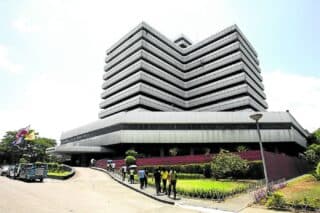
Senate President Manuel Villar and his wife, Cynthia, the Las Piñas representative, have taken possession of the imposing, three-story 51-year-old mansion built by Jose P. Laurel, the president of the Japanese-sponsored Second Philippine Republic, that stands on 6,000 square meters of prime land in Mandaluyong.
The heirs of the Laurel patriarch have, for "practical reasons," let go of the storied property, once the center of political power because of the people who lived there. It has remained unoccupied for the past seven years.
"No one among us could afford to live in this house anymore, it is so big for us," said former Batangas Rep. Macario Laurel, the eldest son of the late President's eldest son, former Speaker Jose B. Laurel.
Both the Laurels and the billionaire Villars have refused to talk about the amount of money that changed hands. They dismissed rumors that the negotiation for the purchase of the property for a few hundred million was conducted "without haggling." Half of the purchase price was reportedly paid during the sale last December, with the balance to be paid in 12 to 24 monthly installments.
The Senate President's wife, a property developer before she went into politics, said she was very pleased with the deal, which she found "reasonable." She said she was fully aware that they had bought a historic site that "ought to be preserved."
First offer
The Laurels first offered to sell the white-and-green mansion to the Villars sometime in 2003, some months after Villar accepted the presidency of the Nacionalista Party, long dominated by the Laurel family, from the late former Vice President Salvador "Doy" Laurel, a younger son of the late President.
According to Macario, the family rejected an offer from a group of Korean businessmen because they proposed to destroy the mansion to put up either a gasoline station or a restaurant. "We wanted to preserve the history and dignity of the house," he said.
The Villars were initially not too keen to buy the property as they did not want to leave their Las Piñas residence.
According to Cynthia, when they first looked at the property early last year, what they found was a huge "bodega" in total disarray, with dozens of huge boxes containing photos, paintings and other memorabilia of the Laurel patriarch, his children and grandchildren.
Parts of the ceiling were falling. Some of the lamps were not working. The walls and flooring, though made of durable tiles, were dirty. There was no furniture at all.
After the Villars agreed to buy the property, Macario said the clan made only one condition: That they preserve the mansion's two historical markers. The first notes the date when the Laurel patriarch built the property in 1957. The second commemorates the visit of Indonesian President Sukarno, who twice slept at the mansion.
Golf enthusiast
A native of Tanauan, Batangas, Jose P. Laurel built the house on No. 515 Shaw Blvd. several years after he stepped down as President. He loved golf and wanted to have a house near the Wack-Wack Golf and Country Club, where he was wounded in an assassination attempt while playing golf in 1943. The mansion occupies 1,000 square meters of the land that was once overrun with cogon.
Called Villa Pacienca in honor of the late President's wife, Pacienca Hidalgo, the Shaw Boulevard house is the biggest of the three residences that Laurel built. He built a house in Tanauan, which the Laurels consider their ancestral home, and another in Paco, Manila, called the Villa Peñafrancia.
The construction of the Shaw Boulevard house was reportedly rushed in time for the arrival of the New Hampshire newspaper publisher, James Langley. Laurel and Langley headed a group that forged what would be known as the Laurel-Langley Agreement of 1956, which extended parity rights to Americans. When Langley came in 1957, Laurel hosted a luncheon in his honor at the mansion.
The entrance to the property was originally on Laurel Street to the left of Shaw Boulevard. An imposing 15-foot tall gate is topped by an arbor inscribed with the words "Villa Paciencia." A long driveway leads to a fountain. The mansion is surrounded on all four sides by old balete and royal palm trees. At the back is a patio where the Laurel patriarch would sometimes make important announcements.
Succession
The mansion has a large receiving room and two dining rooms, a large one for big gatherings and a smaller one for private meetings. It has seven big bedrooms, one on the third floor and five on the second floor. A bedroom on the ground floor has been collapsed by the Villars into the dining room. The Villars have also shifted the entrance to the property to Shaw Boulevard after they regained possession of a strip of the front yard that was being rented out to commercial establishments.
When the elder Laurel died in November 1959, his eldest son, the Speaker, acquired the property after buying out his siblings--Doy, former Sen. Sotero Laurel and the late car racer Arsenio "Dodjie" Laurel.
Doy would later build his own house on a 2,400-sq.m. lot beside his father's property.
When Speaker Laurel moved in, the mansion became the de facto Nacionalista Party headquarters, according to former Tanauan Mayor Paquito Lirio who is married to Emerlina Laurel, a cousin of the Speaker. The Lirios were frequent visitors to the mansion. [Not related to this writer.--Ed.]
Site of historic decisions
"Political leaders would troop to the house for meetings and caucuses. Many important decisions that affected the country were made in that house. Most political decisions affecting the province of Batangas were made there, as no decisions could be made then without consulting the Laurels," recalled Lirio.
Added Macario's wife, Letty: "Anybody who was somebody in Philippine politics had gone there. In fact, even the nobodies had also been there."
Speaker Laurel died in 1998, leaving the property to his children--Macario, Mimi, Batangas Rep. Lali Laurel-Trinidad--and the heirs of another son Banjo, who died in the 1960s.
"To us, the house was some kind of a white elephant after our Papa died. We have our own houses now," said Macario, now 76.
Not just a house for Laurels
More than just being a home for the huge Laurel clan, the mansion was an important venue for the political events that shaped the nation's history, especially when the NP was still the Grand Old Party.
According to Macario, during his 1963 state visit, Sukarno chose to stay overnight at the Laurel mansion, not in Malacañang, as the Indonesian president personally didn't like President Diosdado Macapagal, who headed the rival Liberal Party.
When he fell in love with a Filipino movie star, Amelia de la Rama, Sukarno returned for another visit several years later and again stayed at the Laurel mansion.
On both visits of Sukarno, the Laurels had to vacate the house and stay in a hotel, taking out all the crucifixes and other religious items from the rooms that the Indonesian leader occupied.
Silent witness
The mansion was also a silent witness to the rise of many politicians, including the late dictator Ferdinand Marcos.
It was at the mansion that Speaker Laurel, Sen. Gil Puyat and Marcos hatched the plan for Marcos' controversial transfer from the LP to the NP after Marcos realized that the LP would not draft him as the party's presidential standard bearer in 1965.
The Villars say they find the house just too big for them. They have not once slept there since they bought the property last December. They have no plans to, anyway, said Cynthia.
After the cleaning and refurbishing of the ground floor, the couple has only used the house for a series of small political and social gatherings and dinner parties.
"We would entertain friends here over dinner, then afterwards we go home to our Las Piñas home," Cynthia said.
P4M for renovation
The Villars have spent about P4 million for scrubbing, repainting and redecorating the mansion's ground floor alone. They brought in Thai silk curtains for the wall separating the dining room from the veranda, six pendant-type ceiling lights, granite lavatory and kitchen, an 18-seater dining table for the main dining room, a six-seater dining table for the dirty kitchen, an eight-seater conference table, and an Art Deco living room set in light yellow that blends well with the walls newly painted with a mural of birds and flowers, and several table lamps.
"When we moved in, the house was bare," said Cynthia who has also brought a piano and a huge flat TV from her husband's gym in Las Piñas.
The second and third floors remain locked, waiting for a makeover.
The Villars presented the refurbished mansion to the Laurel clan, NP leaders and their friends at a private party to bless the property last June 10. The Laurel family as well as the NP hierarchy was well represented.
Celia Diaz-Laurel
Celia Diaz-Laurel, Doy's widow, came with her son, Cocoy. She was in a wheel chair but was "as beautiful as ever," recalled Cynthia. She said Celia liked what she saw.
Cynthia said she is considering building four 20-story condominiums around the property, but the mansion will be kept intact.
"We are thinking of keeping the mansion as a clubhouse for the tenants and the public to see. Then we will call the place The Legacy," she said.
Displayed at the mansion's receiving room is a portrait of the Senate President done by Celia some years ago. Cynthia has also asked for the loan of some old Laurel photographs to hang on the walls.
Laurel's legacy
It is no secret that Senator Villar is eyeing the presidency in 2010. If he pushes through with his plan to run, Cynthia said they would probably use the mansion as a halfway house.
The senator has been a House Speaker like Jose B. Laurel and a senator like Doy. Whether he will become a vice president like Doy, or a President like Jose P. Laurel, only time will tell. For now, he has the Laurels' mansion, their political party and their past glory.