





‘Cybercrime Prevention Act unconstitutional’—Senator Guingona
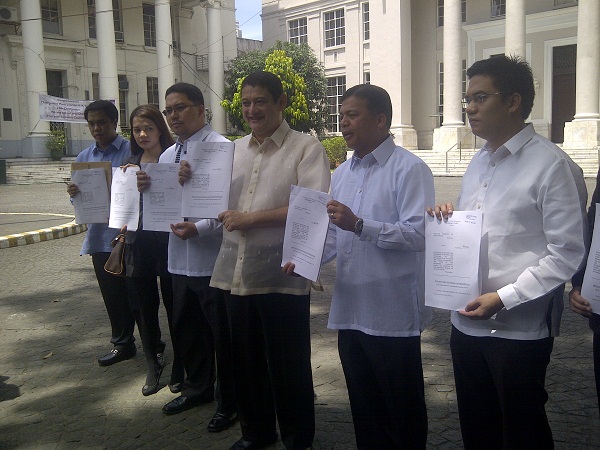
Senator Teofisto Guingona III is accompanied by lawyer Alex Avisado and several others in filing the 4th petition with the Supreme Court against questionable provisions of the Cybercrime Prevention Act of 2012.
MANILA, Philippines—Senator Teofisto Guingona III on Thursday called on the Supreme Court to declare as unconstitutional several provisions of Republic Act 10175 or the Cybercrime Prevention Act of 2012 because it in effect criminalizes expression of public opinion when done through information communication technology.
In a 39-page petition for certiorari and prohibition, Guingona asked the high court to stop the implementation of Sections 4 [c) 4, 5, 7 and 19 of the law and eventually nullify it for violating the 1987 Constitution.
Sec. 4 (c) [4] of the law criminalizes libel, not only on the Internet, but also on “any other similar means which may be devised in the future.”
Sec. 6 raises by one degree higher the penalties provided for by the Revised Penal Code for all crimes committed through and with the use of information and communications.
Sec. 7 provides that apart from prosecution under the assailed law, any person charged with violation of the law the offender can still be prosecuted for violations of the Revised Penal Code and other special laws.
Article continues after this advertisementGuingona said these laws violate the equal protection clause of the Constitution and the law against double jeopardy.
Article continues after this advertisementHe explained that if a libel is committed by means of writing, lithography, engraving, radio, phonograph, painting, theatrical exhibition, cinematographic exhibition or other similar means as mentioned under the Revised Penal Code, it will only carry a penalty of six months and 1 day to four years.
But if the same contents are posted using information communication technology, the offense will carry a penalty of six years and 1 day to 12 years.
“This should not be allowed. A law, to be valid, must apply to all members of the same class. Persons committing libel are similarly situated, whether using a computer system or not. As such, there is no justification for the difference in the imposition of penalties under the two statues. Being unduly discriminatory to members of the same class, certainly [this] should be struck down for being violative of the constitutional guarantee against equal protection law,” Guingona’s petition stated.
He added that Section 7 also violates the rule on double jeopardy.
“If an act is punished by a law and an ordinance, conviction or acquittal under either shall constitute a bar to another prosecution for the same act.”
In this case, however, Guingona said Section 7 allows simultaneous prosecution under the Revised Penal Code
Another provision questioned by Guingona is Sec. 19, which authorizes the DOJ to block access to computer data when such data “is prima facie found to be in violation of the provisions of this Act.”
“There is no need to file a case in court, as the determination of sufficiency of evidence is vested entirely upon the Department of Justice…As a result of this overwhelming exercise of power by the DOJ, a person is effectively deprived of access to his own computer data without first being given an opportunity to be notified,” the petition stated.
Guingona compared the new law with the Anti-Money Laundering Law where, for a suspected bank account to be frozen, the order must come from a judge but in RA 10175, only the DOJ determines whether there is a need to block access to a computer data.
Under the Anti-Money Laundering Law, Guingona said freezing of a bank account by a judge is only for 20 days while under RA 10175, blocking access to a computer data is perpetual.
“Taking all these highly questionable provisions altogether, it can be reasonably expected that the general public would now be under the impression that expression of public opinion with the use of information communication technology is now already a criminal offense under the Cybercrime Act.”
“Our people, especially those in social media should not be forbidden from expressing their thoughts and opinions in cyberspace whether critical or not for fear of being labeled as cyber criminals,” the petition added.
Guingona’s petition is the fourth petition filed with the Supreme Court that sought the nullification of the same provisions of the Cybercrime Act for being unconstitutional.


