





With slower growth, China can’t play economic hero
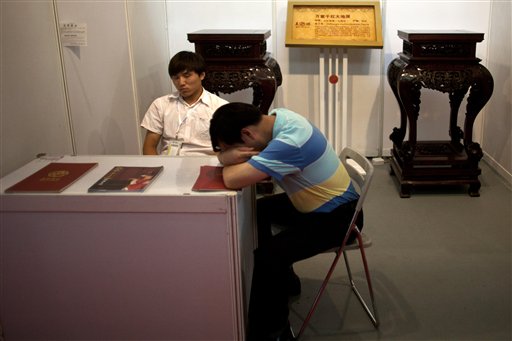
Furniture traders nap while waiting for customers during a consumer products exhibition in Beijing Friday, July 13, 2012. China's economic growth slowed to a new three-year low in the latest quarter as exports and consumer spending weakened. (AP Photo/Alexander F. Yuan)
BEIJING — China’s economic growth fell to a three-year low, and a potential recovery later this year will probably be too weak to pull the world out of its slump.
The world’s second-largest economy grew by 7.6 percent over a year earlier in the three months ending in June, its slowest since early 2009 during the global crisis, data showed Friday.
Analysts pointed to strong bank lending as a sign of a possible recovery in the second half, but slower growth in retail sales and factory output left them uncertain how fast or how vigorously the economy will improve.
“The soft landing is still on track largely as expected, but the rebound may be slightly more drawn out,” said Moody’s Analytics economist Alaistair Chan in a report.
The latest data dampen hopes China can make up for weak demand from debt-crippled Europe and the United States, which is struggling with a sluggish recovery.
“It is not certain whether or not there will be a strong upward rebound. But at least the economic growth rate will stop coming down,” said economist Xiao Li at Industrial Bank in Shanghai.
The impact of lower Chinese demand could fall hardest on Asian economies that supply industrial components to its vast manufacturing industry, as well as exporters of oil, iron ore and other commodities such as Australia and African nations. Chinese imports of steel, copper and oil have declined by volume over a year ago.
On Thursday, the Asian Development Bank cut its growth forecast for developing Asia to 6.6 percent from April’s outlook of 6.9 percent. It cited Europe’s financial crisis, the slow pace of U.S. recovery and lower growth in China and India.
In a positive sign for China, a different measure of growth showed output in the latest quarter rose 1.8 percent over the previous three-month period, up from the first quarter’s 1.6 percent. Beijing began reporting such quarter-on-quarter growth — the system used by other major economies — only last year.
June bank lending rose 16 percent over May, beating forecasts.
The economy “will begin to improve meaningfully from August onwards,” said JP Morgan economists Haibin Zhu, Grace Ng and Lu Jiang in a report.
The slowdown has raised the threat of job losses and political tension at a sensitive time for the ruling Communist Party. It is trying to enforce calm ahead of a planned once-a-decade handover of power to younger leaders late this year.
Beijing has responded to the slower growth by cutting interest rates twice since the start of June, reducing fuel prices and pumping money into the economy through higher investment by state-owned industry and more spending on building low-cost housing and other public works.
Premier Wen Jiabao, China’s top economic official, said last weekend the economy faces pressure to slow further, suggesting Beijing might be considering new stimulus measures.
“We need to see what policies the government will carry out to decide how good the economy will look,” said Industrial Bank’s Xiao.
The communist government has more leeway than the United States or Europe to implement more stimulus measures. China’s state-owned banking industry is flush with cash and avoided the financial turmoil that battered Western lenders. Government debt is relatively low.
Quarterly growth was in line with the government’s target of 7.5 percent for the year, which forecasters say China still is likely to achieve. That is far above Western levels but a marked drop from 2010’s explosive 10.5 percent expansion.
Even after growth rebounds, it is unlikely ever to return to double-digit annual rates. Communist leaders are trying to reduce reliance on exports and investment and promote cleaner, energy-efficient growth based on technology development and consumer spending, which will produce slower gains.
“After 30 years of vigorous growth, China’s economy has entered a period of transition,” government spokesman Sheng Laiyun said at a news conference. “The potential growth rate will drop.”
Sheng rejected suggestions by some analysts that the slowdown might be deeper than reported and that Beijing ordered companies to make the economy look healthier by inflating data on electric power consumption, a key industrial indicator.
“I want to say right here they are wrong,” Sheng said.
June retail sales growth declined to 12.1 percent adjusted for price changes, down from the previous month’s 13.8 percent. Growth in factory output edged down to 9.5 percent from May’s 9.6 percent.
In a potentially bad sign for China’s foreign suppliers, June import growth fell by half from May’s level to 6.3 percent as factories facing weak orders cut back on raw materials purchases.
China’s rapid economic growth has decelerated steadily for eight quarters, the longest slowdown since the government began reporting such data in 1992, according to Yu Bin, a Cabinet researcher. He said the previous record was six quarters.
The slowdown is due in part to controls imposed in 2010-11 to cool overheating and inflation fueled in part by Beijing’s huge stimulus in response to the 2008 crisis. Chinese leaders reversed course last year and began easing controls after global demand abruptly plunged.
“It is often forgotten that this recent slowdown has been an orchestrated one” to cool inflation, said Cameron Peacock, a market analyst for Australia’s IG Markets. “Mission accomplished. China now has the room to re-stimulate its economy.”
Beijing is moving cautiously after its 2008 stimulus pushed up inflation and spurred a wasteful building boom. Authorities say curbs on building and home sales to cool surging housing prices will remain in place, even though pumping up the slumping construction industry offers a quick way to boost growth.
Some parts of Beijing’s response to the slump threaten to set back efforts to reduce reliance on exports and government investment and to nurture more self-sustaining growth driven by domestic consumption. Wen said this week that sustaining investment should be China’s priority, an acknowledgement that consumption is rising more slowly than planned.
Investment picked up in June, with spending on factories, real estate and other fixed assets rising 23.2 percent, up from the previous month’s 20.1 percent.
China’s relative strength conceals severe pain in some industries. Some retailers say monthly sales have fallen by as much as half this year and the Chinese shipbuilding industry association says May orders were down by almost half from a year earlier.
___
Associated Press researcher Zhao Liang contributed to this report.


