
Quantcast
Latest Stories

Palm fronds are not amulets, says bishop
By ,

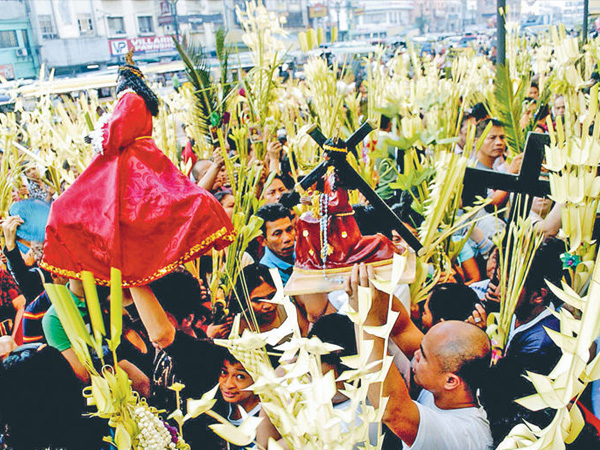
PALM SUNDAY Priests bless the palm fronds carried by churchgoers in Quiapo, Manila, on Palm Sunday, which marks the beginning of Holy Week. ARNOLD ALMACEN

The blessed palm fronds, or palaspas, are not meant to be used as anting-anting (amulet). Nor are they to be used as feeds for fighting cocks, or to cast a spell on the objects of your love.

Manila Archbishop Luis Antonio Tagle gave this admonition to the Catholic faithful on Palm Sunday, which marked the start of the Holy Week.

“Let the palm fronds be a reminder that Jesus Christ is coming and we must accept Him in our hearts, our homes and in our country,” Tagle said before the start of the 7 a.m. Mass at San Fernando de Dilao Parish Church in Paco, Manila.

In more earthly terms, Palm Sunday augured  for good weather around much of the country, with the weather bureau predicting blue skies, especially over  Metro Manila and southern Luzon.

In his brief remarks before the start of the service, Tagle said he was aware that some people had become superstitious about the palm leaves that were being blessed at the end of Palm Sunday Masses.

The Holy Week commemorates the suffering of Jesus at the hands of the Jews, His crucifixion and His eventual resurrection on the third day, celebrated on Easter Sunday. Palm Sunday, on the other hand, marks Jesus’ triumphant entry to Jerusalem while riding on a donkey, with people waving tree branches as He made His way into the city.

“The palm fronds are not for use as anting-anting. Also don’t use them as feeds for roosters before the start of cockfights … I know some people do that,” Tagle said, speaking in Filipino.

“Don’t also use them for kulam (voodoo) and as charms to entice the objects of affection … That’s not the way to use the palm fronds,” he said.

He hoped that as Catholics waved their palm leaves and had them blessed, they would realize the greater meaning of what they were doing, which was to accept wholeheartedly the Man that God had sent to save the world from sins.

“I hope when we get to our homes, these palm leaves would remind us that we welcome Christ in our hearts, in our homes and in our country,” he said.

In another Mass recently, Tagle had encouraged the faithful to “master the disciplines of dying” during the season of Lent so that they could be reconciled with God and that their relationships with other people be mended.

He said the three ways of “dying” and being reconciled with God could be done through alms-giving, fasting and prayer.

“Let us perfect the art of dying—dying to self—so that new life will come to us. If you do not want and you refuse to die to self, you will never ever experience new life in Christ,” he said.

Weather forecast

In Quezon City, the Philippine Atmospheric, Geophysical and Astronomical Services Administration (Pagasa)  predicted most of the  country would have a fairly good weather in the next five days, no low pressure area being seen to mar the Holy Week observance.

For the past week, moderate to heavy rains caused by the tail end of the cold front had plagued the capital and surrounding provinces.

In its weather advisory, Pagasa said no low pressure area had been sighted in Philippine waters.

However, the eastern seaboard might see downpours in the afternoons and early evenings, owing to the cold front, which generates masses of clouds and strong wind.

The effects of that weather system could be felt in Luzon, where chances of rains and gale are high, Pagasa said.

“Fishing boats and other small seacraft are advised not to venture out into the sea while larger sea vessels are alerted against big waves,” Pagasa said.

Visayas and Mindanao could also see isolated rain showers in the afternoons or evenings due to the easterlies, it said.

Down to earth

Elsewhere in the country, the Lenten message from the Church sounded more down to earth.

Bishops and priests in the Visayas called on President Benigno Aquino III to heed the call of poor Filipinos for him to regulate the price of oil products and basic commodities.

In a Lenten statement, the Visayas Clergy Discernment Group (VCDG) echoed the appeal of Pope Benedict XVI for governments to “safeguard and value the human person, who is the source, the focus and the aim of all economic and social life.”

The VCDG said independent research institutions had reported that oil companies had “overpriced” oil products by as much as 43 percent.

It said the government had also earned P48 billion in revenues annually, or P239.6 billion in the last five years, from the 12-percent value-added tax (VAT) imposed on oil products.

“We thus call on the Aquino administration to manifest that it is indeed concerned with the well-being of the Filipino people by taking steps to alleviate their sufferings, such as by regulating the oil industry, so that oil companies will be stopped from overpricing the price of oil; by removing the VAT on oil; and by instituting price control over basic commodities,” Jaro Auxiliary Bishop Gerardo Alminaza, VCDG head convenor, said in a statement.

The removal or suspension of VAT on oil products is among the measures being pushed by various legislators, transport industry leaders and business groups to alleviate the impact on the people of the continued increase in oil prices. With a report from Nestor P. Burgos Jr., Inquirer Visayas

Originally posted: 7:13 pm | Sunday, April 1st, 2012


Follow Us

Follow us on Facebook Follow on Twitter Follow on Twitter


Recent Stories:

Complete stories on our Digital Edition newsstand for tablets, netbooks and mobile phones; 14-issue free trial. About to step out? Get breaking alerts on your mobile.phone. Text ON INQ BREAKING to 4467, for Globe, Smart and Sun subscribers in the Philippines.

Tags: Catholic Church , Catholic faithful , faith , Lent , Manila Archbishop Luis Antonio Tagle , Palm Sunday , Palm Sunday mass , Religion , Roman Catholic , San Fernando de Dilao Parish Church , talisman , Tradition , ‘anting-anting , ’ Holy Week

  • Rey Baltazar C. Tolentino

    To Ryan and all Catholics.

    Okay I want to follow-up our discussion here. It seems this is what you are saying when you said ‘tradition also mean teaching but it is actually mean ‘handling down’ or ‘process of handling down the teaching’. I think this is what you are saying.

    Dei Verbum states:

    ‘But in order to keep the Gospel forever whole and alive within the Church, the Apostles left bishops as their successors, “handing over” to them “the authority to teach in their own place.”(3) This sacred tradition,….’

    This ‘authority to teach in their own place’ is the tradition you are referring in our previous discussion.That is the ‘thing’ that was hand-over.

    Do I get it right?

    • http://profiles.google.com/forestking19 Ryan Barcelo

      No. Tradition is NOT the ‘authority to teach in their own place’. Tradition is the act or the process or the means of handing down the teaching (ie. Revelation/Word of Christ). 

      Truly, the Apostles “handed over” their authority to teach to their successors – the Bishops. Somebody had to take their place for the perpetuity of the Gospel. This handed over authority is different from Revelation, which the Word of Christ or the teaching. Divine Revelation is handed down in the Church from one generation to another by “words and letters.” In this process of handing down, growth and development occurs under the guidance of the Holy Spirit. 

      Revelation (or the Word of Christ) is like a plant planted in the fertile soil (the Church). Like a plant it grows and develops. It may differ in some respects as it was when planted but it is the same plant. As I have been telling you, Revelation (ie. Word of Christ) has the potential of organic growth and development. These are part of its nature. These are not imposed by the Church. Revelation naturally and organically grows and develops in the Church, guided by the Holy Spirit. 

      I hope you get it now. 

      • Rey Baltazar C. Tolentino

        To an ordinary man like me, the meaning of tradition is simply ‘the transmission of customs or beliefs from generation to generation. In this simple definition, it is the custom or belief that has been transmitted from person to person. But it
        seems to you (Catholics), it is different.  You said tradition is the act or the process or the means of handling down the teaching.

        What is that thing handled-down by Apostle to Catholics? Your answer will be ‘tradition’. In short, it is act or process or means that was given to you by Apostles.

        Do I get it now?
         
        Question: How is this ‘act or process or
        means’ hand-over to you by the Apostles?

      • http://profiles.google.com/forestking19 Ryan Barcelo

        I agree with your definition. Indeed, Tradition is the “transmission of belief” or the transmission (to pass) of Divine Revelation from one generation to another. Im sorry if i confused you. My intent was to simplify this concept to make it easily understandable.

        Again, that “thing” that is being transmitted from one generation to another in the Catholic Church is the living Divine Revelation or the Word of Christ.

        Do you get it now?

      • Rey Baltazar C. Tolentino

        Yes, I think so. I will post it above.

        BTW: I posted a new topic in Phatmass (I was inactive in that forum for more than , maybe,  2 or 3 years) regarding this issue. I tried to ask for your permission. I thought I already posted my request but I found out it is still in ‘pending request’ status on this site.

      • http://profiles.google.com/forestking19 Ryan Barcelo

        Go ahead.

  • Rey Baltazar C. Tolentino

    Ryan,
     
    It is written in Dei Verbum the following statement:
    ———
    ‘Therefore the Apostles, handing on what they themselves had received, warn the faithful
    to hold fast to the traditions which they have learned either by word of mouth
    or by letter (see 2 Thess. 2:15), and to fight in defense of the faith handed on once and for all….’
     —————-
    How do you define the word ‘traditions’ in above phase? If not…..

    (This is the other definition of tradition from dictionary)
    a doctrine believed to have divine authority though not in the scriptures, in particular:
    • (in Christianity) doctrine not explicit in the Bible but held to derive from the oral teaching of Jesus and the Apostles.

    Are we together here?

    • http://profiles.google.com/forestking19 Ryan Barcelo

      In this case, “traditions” mean teachings.

      As I have said in my previous post, Tradition may mean the teaching. But, properly, if you will allow me to borrow your definition, Tradition is the “trasmission of belief”.

      Well catechized Catholics will not encounter any difficulty in determining when Tradition means a teaching or a process of transmitting REvelation. We can easily determine that in Church documents.

      Again, Tradition may mean either the teaching or the proccess of transmitting Revelation. It depends on the usuage of the term.

      BTW, your dictionary definition of Tradition is defective as far as the Catholic Church is concerned. Remember that the Bible IS actually Tradition. The Bible is the Written Tradition of Divine Revelation. In the Catholic Church you cannot say: Traditions are doctrines not explicit in the Bible but are believed to have divine authority as it came from the oral teachings of Jesus and the Apostles. This statement is defective. It tries to suggest that the Tradition refers exclusively to oral tradition and that the Bible is not tradition.

      At this point, apparently, we still do not agree.

      • Rey Baltazar C. Tolentino

        Therefore, the meaning of ‘tradition’ in this paragraph of is oral and written teachings (traditions). Do I get it right?

      • http://profiles.google.com/forestking19 Ryan Barcelo

        Yes. You are right this time.

  • Rey Baltazar C. Tolentino

    Ryan,

    To me this is what you are trying to say from the very beginning.

    The tradition (Oral and Written) that was given to you (Roman Catholic Church) by the Apostles is the ‘Word of Christ’. Now, this ‘Word of Christ’ is living and therefore it is growing although it does not necessary mean there is any addition to the former given tradition (Word of Christ) because it is the nature of that ‘Word’ or ‘Tradition’ to grow.

    Do I get it?

    • http://profiles.google.com/forestking19 Ryan Barcelo

      Yes. You get it now. But, I prefer to use “Divine Revelation” rather than “Word of Christ” because the former is the phrase used in Dei Verbum.


Copyright © 2013, .
To subscribe to the Philippine Daily Inquirer newspaper in the Philippines, call +63 2 896-6000 for Metro Manila and Metro Cebu or email your subscription request here.
Factual errors? Contact the Philippine Daily Inquirer's day desk. Believe this article violates journalistic ethics? Contact the Inquirer's Reader's Advocate. Or write The Readers' Advocate:
c/o Philippine Daily Inquirer Chino Roces Avenue corner Yague and Mascardo Streets, Makati City, Metro Manila, Philippines Or fax nos. +63 2 8974793 to 94
Advertisement

News

  • DENR forms special teams to fight illegal logging in Western Visayas
  • Police stumped by dud grenades thrown at Cotabato eatery
  • Seoul press doubtful over North Korea dialogue offer
  • Waterspout damages 38 houses in Polomolok
  • US kidnap case hero not endorsing free burgers
  • Sports

  • Arellano ready to make noise in coming NCAA season
  • FEU’s Romeo ‘suspended indefinitely’, says coach
  • Arellano banks on strong start to thrash JRU
  • Santos accepts offers for Neymar; player deciding
  • Indy 500 could be better than 2012′s epic race
  • Lifestyle

  • Healthy gorilla born to 1st time parents at US zoo
  • US teen takes Danish supermodel to prom
  • Ninoy Aquino’s birthday is ‘Day of Reading’
  • You can’t sink in the Dead Sea
  • In New York, Filipino costume and set designer Clint Ramos wins Obie Award
  • Entertainment

  • Bands, skateboarders kick off Makati Circuitfest 2013
  • Stone Temple Pilots sue ex-frontman Scott Weiland
  • Cannes: Dern a leading man again in ‘Nebraska’
  • Demi Lovato is a work in progress
  • Stars’ ‘shameful’ secrets revealed
  • Business

  • Court of Appeals stops field trials of genetically modified eggplant
  • GDP on track to meet 6-7% target
  • Stocks continue to decline
  • BSP chief says capital flight to spare PH
  • Imports contracted in Q1
  • Technology

  • A new way for Filipinos to connect on social media launched
  • Statement of Smart Communications
  • Yahoo takes big leap with $1.1B deal for Tumblr
  • Poll: More US teens turn to Twitter; Facebook old
  • Tips to avoid becoming an identity theft victim
  • Opinion

  • Measuring poverty incidence
  • Brillantes’ tantrums
  • Pointed questions for the Comelec chair
  • Social enterprise as innovative business model
  • Perennial irony
  • Global Nation

  • Seamen may file complaints at sea
  • Rescue of Russian mountaineer from Mt. Mayon proved costly
  • PCG report on grounded US ship due
  • Fil-Am staffers and students join UC Medical Center strike frontline
  • Kids make art to help rescue other kids from neglect
  • Marketplace
    Advertisement
    Federland
    Federland
    © Copyright 1997-2013 INQUIRER.net | All Rights Reserved