





1 RFID sticker now usable for all Luzon tollways


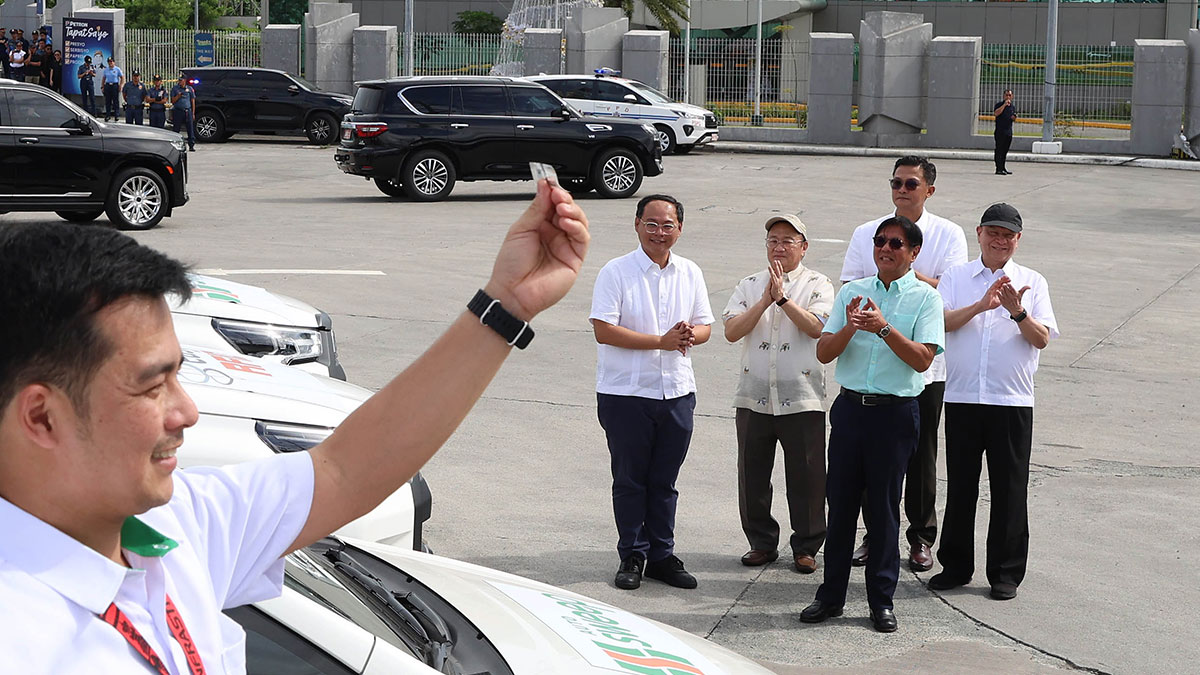
LONG-NEEDED SOLUTION: President Ferdinand Marcos Jr., Metro Pacific Tollways Corp. chair Manuel Pangilinan, San Miguel Corp. president Ramon Ang, acting Transportation Secretary Giovanni Lopez and Toll Regulatory Board chief Jose Arturo Tugade launch the ‘One RFID, All Tollways’ system on Tuesday, October 21, 2025. — Photo by Marianne Bermudez
MANILA, Philippines—After years of planning and delays, the government on Tuesday finally unveiled a program aimed at addressing motorists’ desire for seamless, cash-free travel through any of the expressways in Luzon and Metro Manila, using a single RFID (radio-frequency identification) tag and a single account.
“We are listening to the concerns of our fellow Filipinos. That’s why we studied the problem and found a good solution,” President Ferdinand Marcos Jr. said in a speech on Tuesday during the launch of the “One RFID, All Tollways” system at the South Luzon Expressway (SLEx) in Calamba City, Laguna.
“From now on, only one RFID sticker is needed for all toll expressways across Luzon,” the President said, addressing toll-paying motorists. “You no longer have to worry about whether you’re using the right account or if you’ve loaded it.”
The group and fleet account for the new system, however, will be launched next year.
Marcos said the “interoperability” of the Electronic Toll Collection (ETC) and cash payment systems for expressways was made possible because of the “continued trust, commitment, and flexibility of government partner concessionaires, operators, and ETC/RFID providers.”
‘Part of the solution’
“Years of consultation and cooperation with the Department of Transportation and the Toll Regulatory Board (TRB) have finally led us to a unified system that responds to the real needs of our motorists,” he added.
Marcos also expressed gratitude to San Miguel Corp. (SMC) and Metro Pacific Investment Corp.—whose subsidiary units operate the 15 expressways in Luzon — led by tycoons Ramon Ang and Manny Pangilinan, respectively, “for being part of the solution.”
Under the old system, motorists needed to switch from Autosweep to Easytrip and vice versa when passing through the expressways, causing inconvenience to travelers during account loading and payment.
But the One RFID, All Tollways program allows motorists to subscribe to only one RFID provider and use the RFID balance to pay for tolls in any of the Luzon expressways.
Autosweep is for expressways operated by SMC Tollways, namely Muntinlupa-Cavite Expressway (MCX), Naia Expressway (NAIAx), SLEx, Skyway, Southern Tagalog Arterial Road (Star Tollway), and Tarlac-Pangasinan-La Union Expressway (TPLEx).
Meanwhile, Easytrip is for expressways under Metro Pacific Tollways Corp., namely Cavite-Laguna Expressway (CALAx), Manila-Cavite Toll Expressway (Cavitex), C-5 Southlink, North Luzon Expressway (NLEx), NLEx Connector, and Subic-Clark-Tarlac Expressway (SCTEx).
First phase in 2017
The plan for the interoperability of the ETC and cash payment systems in different expressways started in 2017, following the signing of a memorandum of agreement between government agencies and private toll operators.
Its first phase, implemented in December 2017, allowed Autosweep RFID stickers to be readable at toll gates of MPTC-operated expressways.
It took six years, in January 2023, for Easytrip RFID tags to be readable at SMC expressways.
While both phases are optional, they also require motorists to maintain and reload both Autosweep and Easytrip accounts.
The third phase to implement the One RFID, All Tollways program was supposed to be implemented in June or July last year.
The TRB, however, cited the need to overhaul the code system for the delay in the interoperability operation of the two RFIDs.
Voluntary registration
The registration for One RFID, All Tollways is free and voluntary, giving motorists the choice whether to adopt the new system or to stick to the current two-card system.
“We aim for seamless travel from north to south here in Luzon. Reduce unnecessary stress. Reduce unnecessary delays,” Mr. Marcos said.
“This reform in the RFID system is part of our broader goal to make our infrastructure more modern, connected, and responsive to the needs of every Filipino,” he added.
New subscribers and existing subscribers of either Autosweep or Easytrip, whose accounts are in good standing and with no negative balance, may enroll to the One RFID, All Tollways program. The load balance from the RFID tag that a motorist chooses not to use may be transferred to the sticker that will be retained.
Detailed instructions may be accessed through the RFID service provider’s website. Among the requirements that a vehicle owner needs to submit are a sales invoice for new cars or an official receipt and certificate of registration, a deed of sale (for preowned cars), and a valid driver’s license.
Single e-wallet
Earlier in March, the TRB said it was working on fully implementing the cashless system within the year, in addition to finally enabling interoperability or use of a single e-wallet for toll payments in all expressways.
The directive to fully operate the “No RFID, No Entry” rule in expressways and tollways has been implemented since 2024. Fines for vehicles with invalid RFID tags or insufficient load balance were supposed to take effect on Aug. 31 last year, but it was moved to January and then March this year.
On February 21, then Transportation Secretary Vince Dizon said he had instructed the TRB to postpone the implementation of the program, originally set to launch by March 15, to ensure first that all toll plazas were ready.
Complaints against the RFID collection system have been mounting over the previous year.
In March 2024, then House Deputy Majority Leader and now Sen. Erwin Tulfo warned that Congress would summon officials of NLEx to explain why RFIDs of vehicles could not be read at the toll gates, resulting in traffic congestion during that year’s Holy Wednesday.
In August 2024, then Sen. Grace Poe said that the RFID should undergo a test of reliability following complaints from motorists that the devices at the tollways could not read the RFID stickers.— With a report from Inquirer Research


