





Visual treat: Total lunar eclipse to be seen in parts of PH on Sept. 7-8


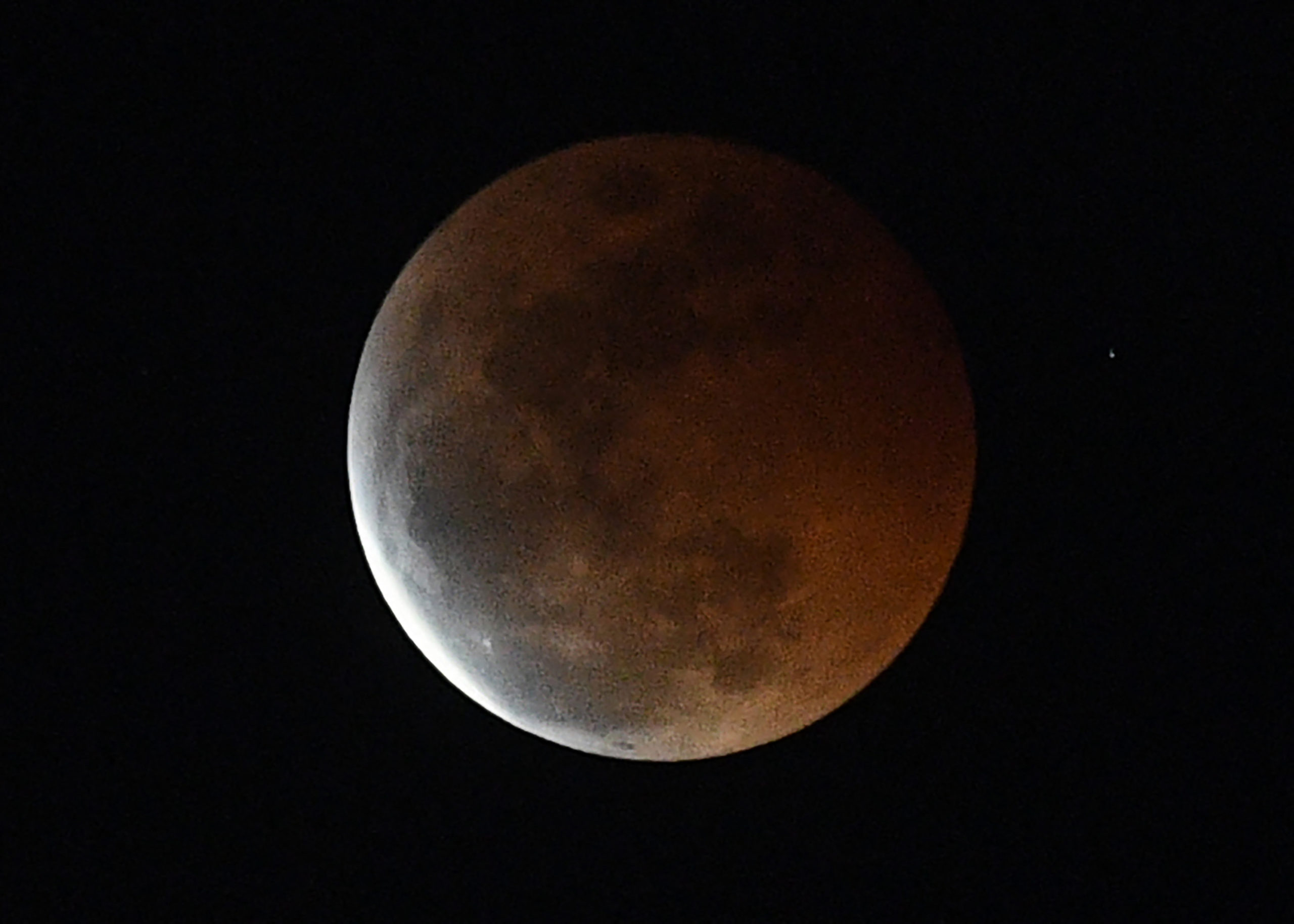
The blood moon is seen during a total lunar eclipse in Manila on November 8, 2022. (Photo by Ted ALJIBE / AFP)
MANILA, Philippines — A total lunar eclipse will be visible in Manila and other parts of the country on Sept. 7 and Sept. 8, the Philippine Atmospheric, Geophysical and Astronomical Services Administration (Pagasa) said on Tuesday.
The total lunar eclipse, which will last for approximately one hour, 22 minutes, and 54 seconds, will also be completely visible over East Africa, Asia, and Australia.
“Weather permitting, the public is encouraged to observe the Moon directly overhead in the late evening of Sept. 7, 2025, and early morning of Sept. 8, 2025,” Pagasa Administrator Nathaniel Servando said in a statement.
Easy to observe
A total lunar eclipse “is very easy to observe,” he said, adding that “a modest pair of binoculars will provide an excellent view of the moon’s surface, but it is not required.”
“Unlike solar eclipses, observing a lunar eclipse is completely safe and does not require protective eyewear,” Servando said.
According to Pagasa, the penumbral phase will begin at 11:27 p.m. on Sept. 7, followed by the partial lunar eclipse phase starting at 12:27 a.m.
The moon will then enter totality at 1:30 a.m., followed by the maximum eclipse at 2:12 a.m.
The partial lunar eclipse phase will last until 2:53 a.m., while the penumbral phase will end at 3:57 a.m. The moon will then exit the penumbral shadow at 4:57 a.m.
“During the maximum eclipse, the umbral shadow cast by the Earth will obscure 100 percent of the moon’s disk. This phenomenon is commonly referred to as a “Blood Moon” due to the reddish hue the moon adopts,” Pagasa said.
It explained that this coloration occurs as Earth’s atmosphere filters and scatters sunlight, allowing only the red wavelengths to reach and illuminate the lunar surface.
READ: Total lunar eclipse on November 8 visible in the Philippines, says Pagasa


