


Flood control projects work without whiff of corruption


FLOOD composite image from AFP and Inquirer files
After decades of catastrophic storms and severe floods triggered by intense monsoon rains, some parts of the Philippines prove that flood control infrastructures can hold water — when done properly and as part of a coherent masterplan.
This was pointed out by city planner and landscape architect Paulo Alcazaren, who said that flood control projects should work, especially when constructed based on a masterplan that covers the entire watershed and river system, “regardless of political boundaries.”
Every flood control project should be “constructed following the design drawing and performance specifications to the letter, without any substitutions or shortcuts in materials,” he told INQUIRER.net when asked regarding whether or not flood mitigation infrastructure works.
However, based on data from the Department of Public Works and Highways (DPWH), out of the 10,075 projects inspected as of Nov. 12, 472 were confirmed to be nonexistent, which is an increase from the previous record of 421 last month, Oct. 9.

GRAPHIC: Ed Lustan/INQUIRER.net
READ: Dizon: 421 of 8,000 flood control works in PH are ‘ghost projects’
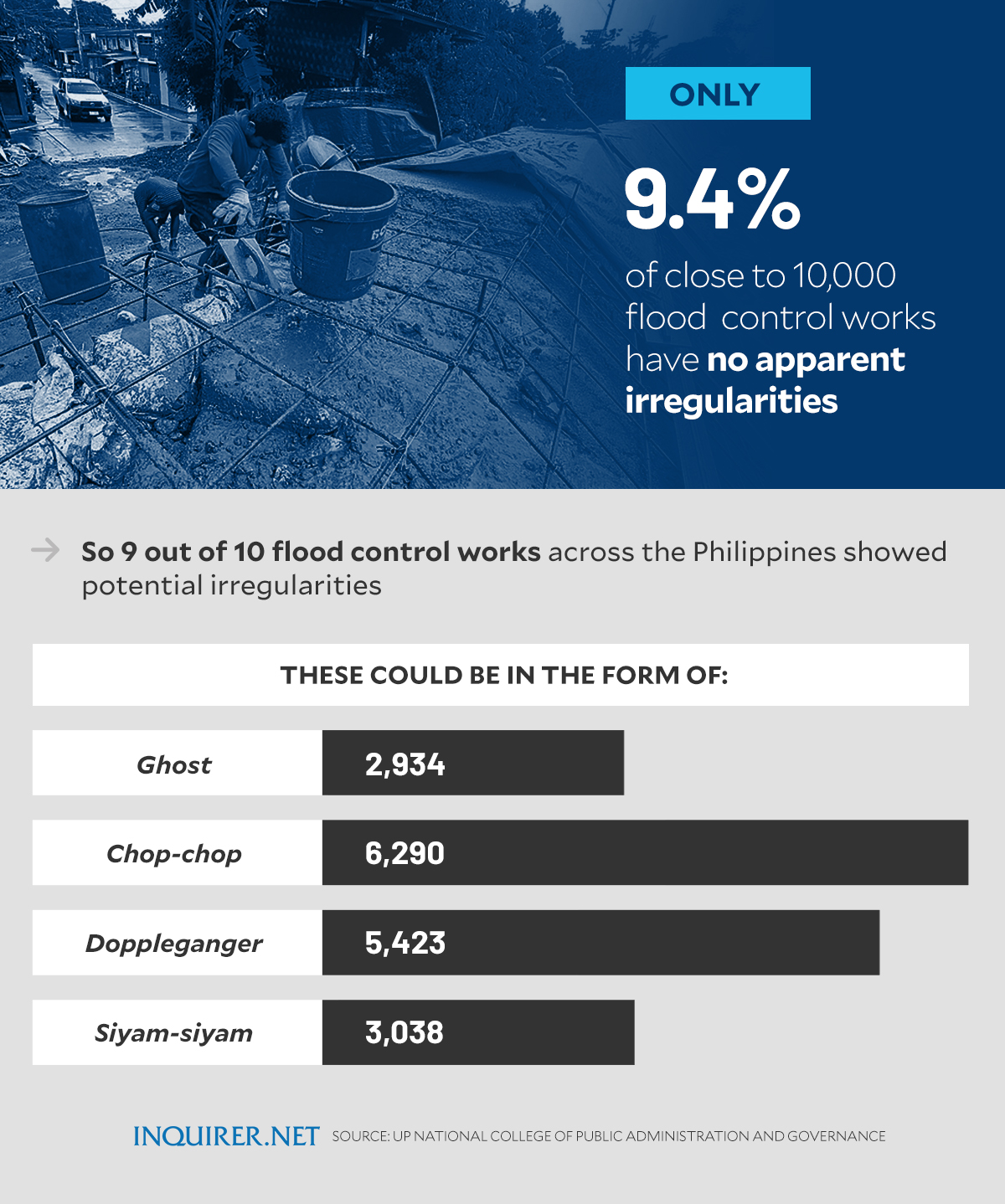
Then in an analysis made by the University of the Philippines–National College of Public Administration and Governance (UP-NCPAG) using AI and GIS, or Geographic Information System, it said that nine out of 10 flood control projects across the Philippines showed possible irregularities.
As it pointed out, these projects, scattered across 198 district engineering offices (DEOs) of the DPWH could either be “nonexistent,” “divided in several packages,” “having the same contract cost,” and “delayed beyond the reasonable deadline,” with spatial analysis indicating that a lot are located in low-risk areas.
GRAPHIC: Ed Lustan/INQUIRER.net
Last August, President Ferdinand Marcos Jr. already expressed concern on the mismatch between the country’s most flood-prone provinces and those that received the most flood mitigation projects, which, from 2022, have been allocated with P100 billion.
RELATED STORY: Billions flow to flood control, but not to save us from rising waters
The UP–NCPAG said that these possible “kamote” projects are in Metro Manila (95), Bulacan (32), and Pampanga (30), stressing “these patterns point not only to waste and deception, but to deep-seated governance failures in procurement, oversight and public accountability.”
READ: Marcos flags mismatch between flood control projects, flood-prone areas
‘No signs of irregularities’
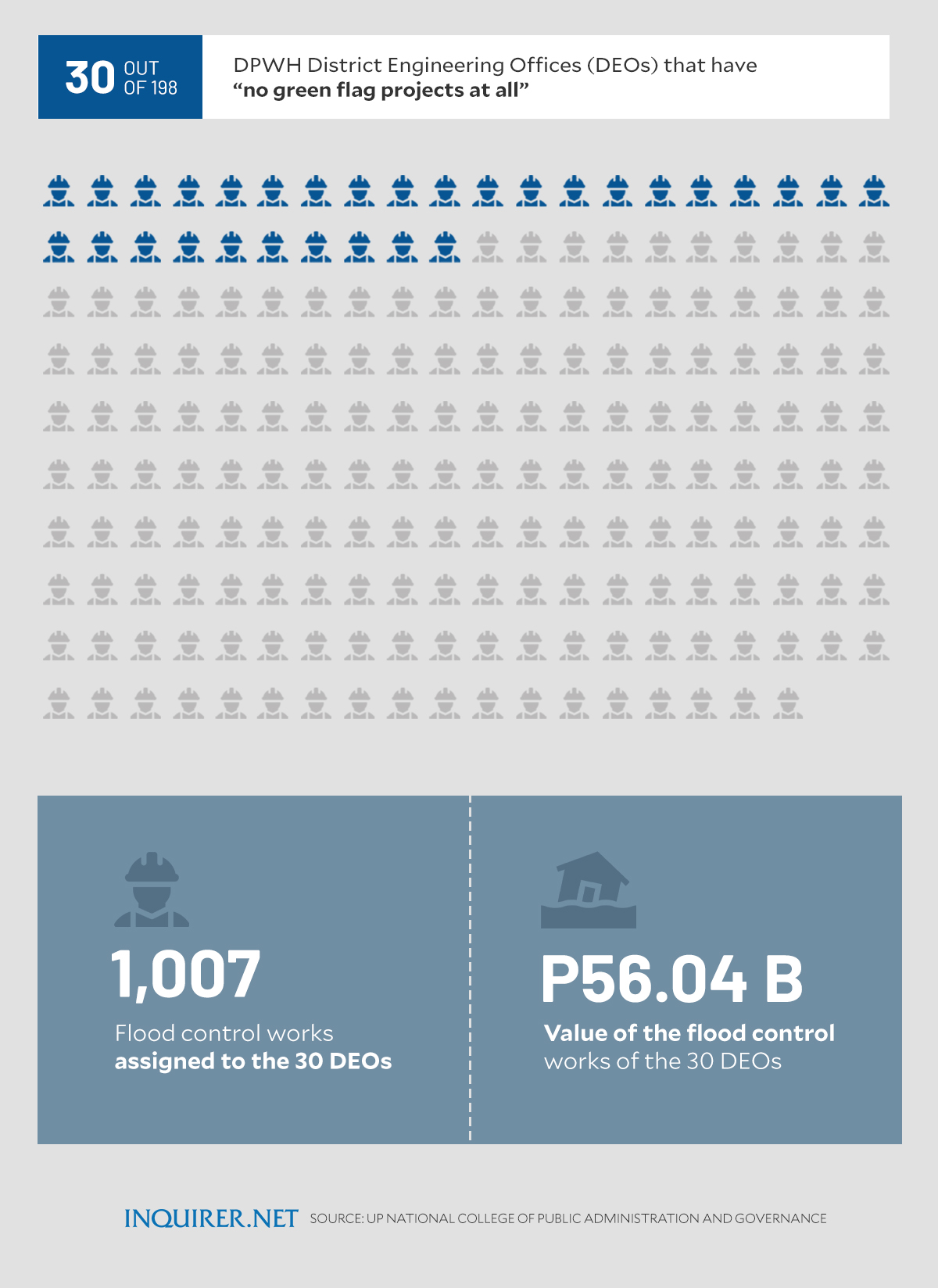
As it said, only one out of 10, or 9.4 percent of close to 10,000 flood mitigation projects, were clear of signs of irregularities, or 923 out of 9,826 projects, translating to P31.2 billion, which is way lower than the P56 billion that went to 1,007 projects across 30 DEOs that were said to have no “green flag” project at all.
GRAPHIC: Ed Lustan/INQUIRER.net
While the UP-NCPAG made it clear that being tagged as a “green flag” project does not equate to assurance of integrity or exemption from scrutiny, it listed three DEOs with at least half of projects cleared from apparent irregularities: Iligan City DEO, Palawan 1st DEO, and Cebu 2nd DEO.
READ: Much more than flood control
It pointed out, as well, that the “greenness” of a DEO tends to be related to project volume, with most of DEOs having relatively higher “green flag” compliance rates handling only less than 50 flood control projects, such as the DEOs in Iligan City (6), Palawan (18), and Cebu (12).
DEOs with higher volume of projects, in contrast, showed significantly lower compliance rates, such as Bulacan 1st DEO at 2.88 percent out of 452, Metro Manila 1st DEO at 1.30 percent out of 186, and Bulacan 1st DEO at 3.69 out of 190, the UP-NCPAG said.
RELATED STORY: Lacson: Over P180B likely lost to ghost flood control projects
Most, or 85 percent of DEOs—168 of 198—were said to have at least one “green flag” project. However, the “geographic imbalance underscores the importance of institutionalizing geospatial monitoring, data-driven validation, and risk-based auditing in infrastructure governance.”
‘They work’
Last year, the DPWH announced the completion of 5,521 flood control projects, with 5,841 river improvement, drainage, dredging/desilting, and revetment projects yet to be completed across the country, with the one in Cagayan de Oro considered as one of the significant achievements.
It said that the P12.54 billion Flood Risk Management Project for Cagayan de Oro River, which was given assistance by the Japan International Cooperation Agency (JICA) and completed in March 2024, seeks to protect an area of 614 hectares and a population of 60,900.
READ: Marcos: 15 firms corner big flood control works
Then in Iloilo City, former mayor Jerry Treñas shared how the Iloilo Flood Control Project, which started in 2007 and completed in 2011, has saved the metropolis from experiencing severe flooding like the one triggered by Typhoon Frank in June 2008 that devastated the city.
“What makes this project truly remarkable is not its scale, but its impact. It’s a five-hectare floodway and dike system stretching from Pavia all the way to the sea—designed with minimal concrete, focusing on earthworks and natural flow,” he said.
RELATED STORY: Ombudsman orders 6-month suspension of 12 officials linked to flood control mess
It was constructed through the local government, DPWH, JICA, and National Housing Authority. As Treñas said, the project “stands not only as an engineering achievement but as a symbol of what can happen when leadership, collaboration, and compassion come together.”


