





DepEd told: Consider logistics, other factors in school feeding program


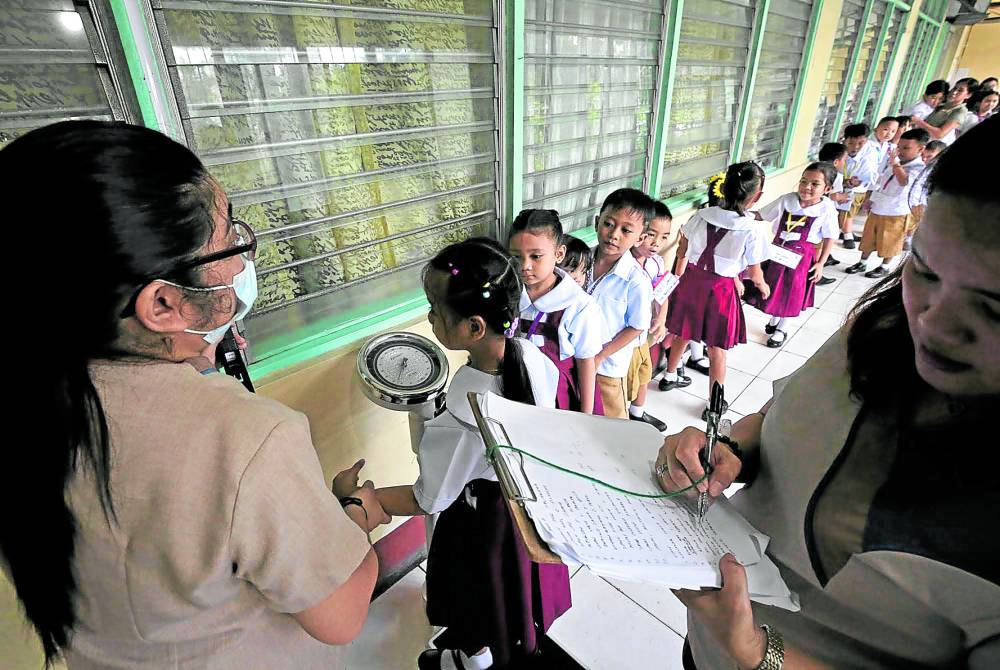
MANILA, Philippines—Lawmakers have reminded the Department of Education (DepEd) that logistics and absorptive capacity are also key issues in expanding the government’s school-based feeding program (SBFP), as efforts and funding will be wasted if the department cannot properly implement it.
At Monday’s hearing of the House of Representatives’ committee on basic education and culture, panel chair and Pasig Rep. Roman Romulo and ACT Teachers party-list Rep. Antonio Tinio asked DepEd how it intends to implement—and if it can even implement—a wider SBFP.
READ: Free meals for kinder, Grade 1 learners for 200 school days eyed in 2026
The committee was discussing numerous proposals to increase the coverage of the SBFP under Republic Act No. 11037, or the Masustansyang Pagkain para sa Batang Pilipino Act, from the current scope of undernourished kindergarten to Grade 6 (K to 6) students to all K to 6 pupils regardless of nutritional status, and possibly including stunted junior high and senior high students.
In response, Director IV Dr. Miguel Angelo Mantaring of DepEd’s Bureau of Learner Support Services said that they support the vision of an expanded SBFP, including a possible coverage of all students in public schools.
“Right now, the feeling program will be universal for K to 3, so we would just not include (Grades) 4, 5, 6. So what is your position on these proposals? If we increase the coverage to K to 6, can you still do it?” Romulo asked in a mix of English and Filipino.
“Yes, Mr. Chair […] we are in full support for the proposed amendment to RA 11037, particularly its extension of the feeding program to undernourished learners in junior and senior high school, as current data and field experience confirmed that wasted and severely wasted learners remained prevalent within secondary education, with with direct implications on attendance, concentration, and learning outcomes,” Mantaring said.
“Beyond expanding beneficiary coverage, DepEd emphasizes that the proposed amendments respond to long-standing operational and legal constraints encountered in the implementation of the SBFP as articulated in our position paper,” Mantaring added.
According to the DepEd official, one of the issues faced by the SBFP is the adoption of cash-based budgeting, which “requires obligations and disbursements to follow fiscal year timelines.”
Since school years start in June or July and run through the first semester of the subsequent year, Mantaring noted that this means funding has to be appropriated for two years. However, he said this was solved by a two-year validity period for items in a year’s General Appropriation Act.
Mantaring also noted that the agency will have a higher budget that can accommodate additional needs for an expanded feeding program.
Romulo, in response, reminded DepEd that issues are not confined to questions of whether there are funds for programs, especially since feeding all students, from K to 12, in public schools would entail addressing the nutritional needs of 26 million students.
“So that would be about 26 million students, and you are saying that aside from the fact that your only difficulty would have been that the budget is eligible from January to December, but you are allowed a two-year validity to spend it, so that’s why it works out. Other than that, there’s no problem?” Romulo asked.
“What about a school with 10,000 students with a double shift? How do you manage that? They might not be able to do anything else except do feeding programs, but you’re telling us that you can do that and you will not sacrifice quality education?” he added.
When Mantaring said that DepEd’s budget for the SBFP was increased to P28.6 billion, Romulo asked if the department has the absorptive capacity to implement the project, to which Mantaring admitted that, currently, DepEd does not.
“Mr. Chair, to further clarify, we support the vision of universal feeding and hope that this will be supplemented with a full complement budget to provide, so in our current budget, as approved recently within the Senate, our budget was increased to P28.6 billion, now allowing for our expansion to universal Grade 1,” Mantaring said.
“That is correct, but can you do it […] it’s not always funding that is the problem, but also your absorptive capacity. Can you do it?” he added.
Instead of forcing the implementation of an expanded SBFP, Romulo said DepEd can heed Tinio’s suggestion of having a “targeted increase” until the agency is “able to build” capacity.
“Please do not pursue programs just because you have funding available, because at the end of the day it might not be implemented properly; you must have a plan. How would you execute that?” he added.
Mantaring said they will submit to the committee a plan on how to implement the expanded SBFP.
Involve LGUs, too
Aside from a targeted increase in the implementation of the SBFP, Biñan City Rep. Arman Dimaguila said DepEd can delegate the rollout of feeding programs to local government units (LGUs).
According to Dimaguila, LGUs have the expertise and personnel to successfully implement the national feeding program targeted towards public school learners from daycare centers and kindergarten to Grade 12.
“It is the LGU who has the personnel, the expertise. Of course, with the assistance of the National Nutrition Council and the DOH (Department of Health) also. LGU can implement these better and community-based. Then no one will be left behind, especially in feeding,” he said.
Dimaguila said Biñan was able to successfully outsource accredited caterers for their local feeding programs, adding that some public schools wouldn’t be able to do the same on their own if the government solely relies on DepEd. —WITH REPORTS FROM HALLE DANELLE YUSON, INQUIRER TRAINEE/abc


