





Palace backs Hilbay: ICI bill needs careful study


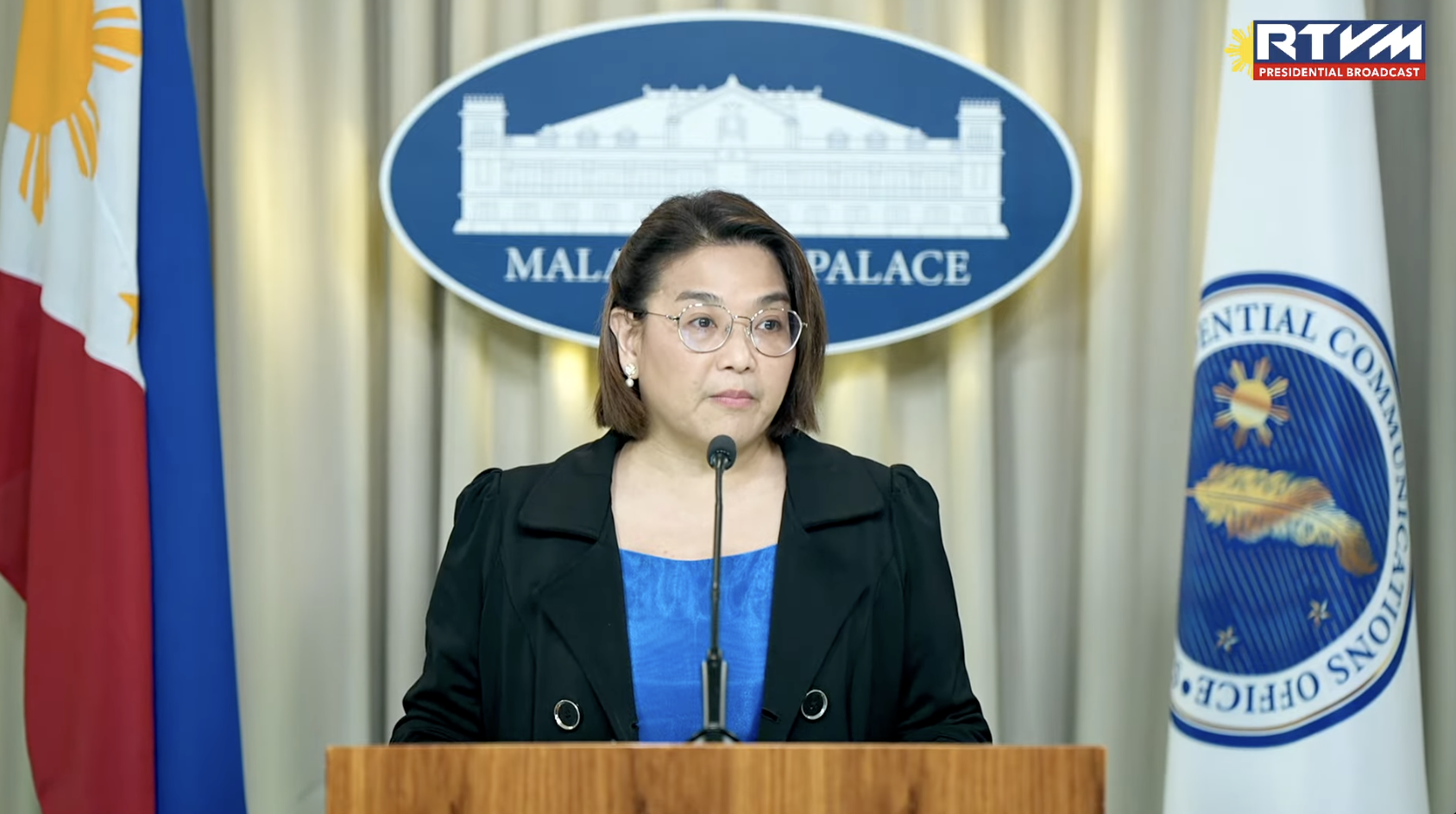
Palace press officer Claire Castro. Screenshot from RTVM.
MANILA, Philippines — Malacañang on Tuesday said the proposal to pass a law institutionalizing the Independent Commission for Infrastructure (ICI) requires careful study to avoid duplication of existing agencies’ functions, which was among the points raised in a petition recently filed before the Supreme Court.
Palace press officer Claire Castro agreed with former Solicitor General Florin Hilbay’s opinion that there was no need to pass a law to create a stronger ICI because existing institutions, such as the Department of Justice (DOJ) and the Office of the Ombudsman, already have the authority to investigate and prosecute erring public officials.
“Former SolGen Hilbay has a point,” Castro said in a press briefing. “Even from the beginning, when the President created the independent commission through Executive Order No. 94, some questioned whether its functions might overlap with those of the Ombudsman and the DOJ.”
READ: Marcos maintains ICI stands on ‘firm legal ground’
But she explained that from the President’s perspective, the ICI serves as a supporting body that can help gather documents and evidence to expedite the investigations of both the DOJ and the Ombudsman.
“So, if another independent body were to be created, it could indeed lead to redundancy—and in that sense, the former Solicitor General has a valid point,” Castro added.
According to Castro, the Palace would defer to Congress should lawmakers decide to pursue a measure institutionalizing the ICI, but stressed the need for a careful study of the proposal.
In a Facebook post on Monday, Hilbay, who served as the solicitor general during the administration of former President Benigno “Noynoy” Aquino III, said the government already has the full institutional capacity and authority to go after erring public officials, including those involved in anomalous flood control projects through the Ombudsman and DOJ.
He called proposals to create a Congress-mandated ICI to be “constitutionally ignorant and impractical.”
READ: No need for law to strengthen ICI, ex-Solgen Hilbay says
Hilbay’s remarks came as different sectors and lawmakers reiterated their calls for President Marcos to certify as urgent bills filed in both the House of Representatives and Senate by granting more powers to the existing ICI, which is limited by executive powers.
Certifying the bill as urgent allows the House and the Senate, respectively, to approve a bill on second and third reading on the same day, bypassing the usual three-day waiting period.
President Marcos was open to these legislations, particularly Senate Bill No. 1215 and House Bill No. 4453, but he has not lifted a finger to prioritize these bills. The President noted that the ICI was performing well despite its limitations.
High school teacher John Barry Tayam recently challenged the legality of EO 94 creating the ICI before the high court, saying it violated the constitutional provisions on equal protection and separation of powers.
The petition also raised the ICI’s “problematic redundancy” with existing anti-graft agencies, particularly the Ombudsman and the DOJ.
President Marcos said he expected the petitions questioning the legality of the ICI, but he maintained that his EO 94 had firm legal grounds.
“It’s not a surprise. Maybe there will be more. We’ll see. And we’ll just have to explain what it is we’re trying to do. And maybe the methodology of it is something that needs to be amended. But still, the SolGen (solicitor general) will defend our position in the Supreme Court,” he said over the weekend in South Korea.
“But I’m very confident that we are on safe legal grounds. Because before we started even thinking about organizing the ICI, I made sure that I got legal opinions from the best legal minds that I know. So the opinion that came back was favorable. So I do believe we are on firm legal ground here,” the President added.
The ICI also expressed confidence that EO 94 would pass the SC’s scrutiny and rule that it is within the powers of the president to create the commission. /mr


