





The PH budget process: Step-by-step visual guide


FILE PHOTO
MANILA, Philippines — Every flood-control dike, classroom, or bridge begins with a number — penciled into a budget proposal, debated in Congress, and tracked by watchdogs. The national budget decides not just where government funds go, but whose lives are prioritized.
Every peso in the national budget doesn’t just appear in a line item — it goes through a complex, multi-phase process involving the Executive branch, Congress, and the President.
This cycle repeats each year and determines what projects, services, and infrastructure get funded, and what gets left out. Here’s how the Philippine government turns plans into pesos:
STEP 1: The budget process begins
Each year, the national budget starts with three key phases:
- The Executive branch prepares the proposal
- Congress reviews and authorizes it
- And the President signs it into law
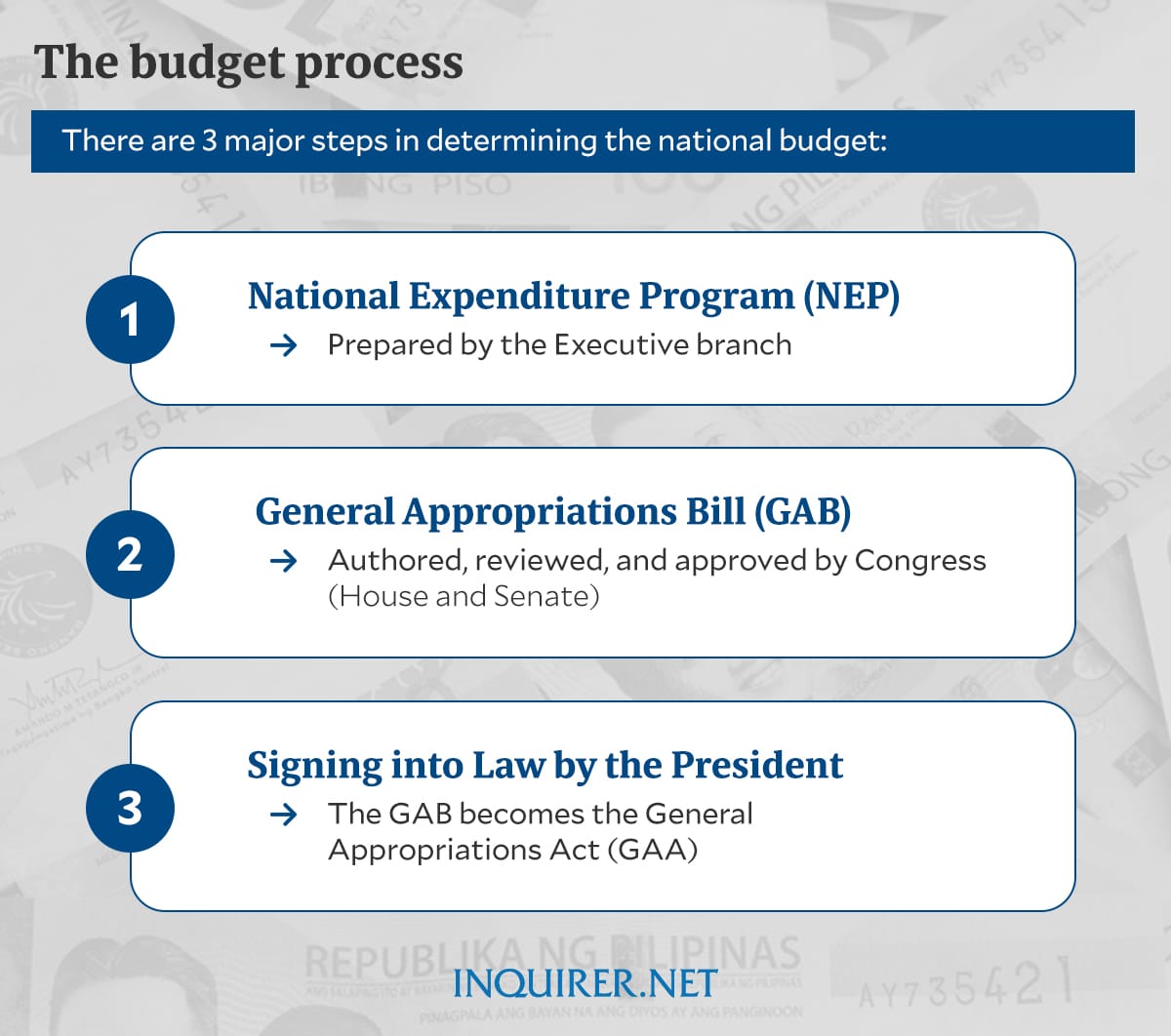
Every peso in the national budget goes through three steps: prepared by the Executive, approved by Congress, and signed into law by the President.
Every peso in the national budget goes through three steps: prepared by the Executive, approved by Congress, and signed into law by the President.
This annual cycle sets the direction for public spending and determines the government’s priorities for the coming year.
STEP 2: The National Expenditure Program (Budget Preparation)
Government agencies start by submitting their proposed budgets to the Department of Budget and Management (DBM).
These proposals are reviewed and aligned with national priorities set by the Development Budget Coordination Committee (DBCC) — a high-level group composed of the heads of DBM, Department of Finance, National Economic and Development Authority, and Bangko Sentral ng Pilipinas.

Government agencies submit funding proposals to the Department of Budget and Management, which reviews and consolidates them under the Development Budget Coordination Committee before sending the President’s proposed budget — the National Expenditure Program — to Congress.
After consolidation, the DBM submits the National Expenditure Program (NEP) to Congress. This document becomes the President’s official budget proposal, accompanied by the Budget of Expenditures and Sources of Financing (BESF) and a budget message explaining key priorities.
STEP 3: Legislative hearings
Once Congress receives the NEP, the House of Representatives and the Senate begin holding committee hearings to scrutinize the proposals.
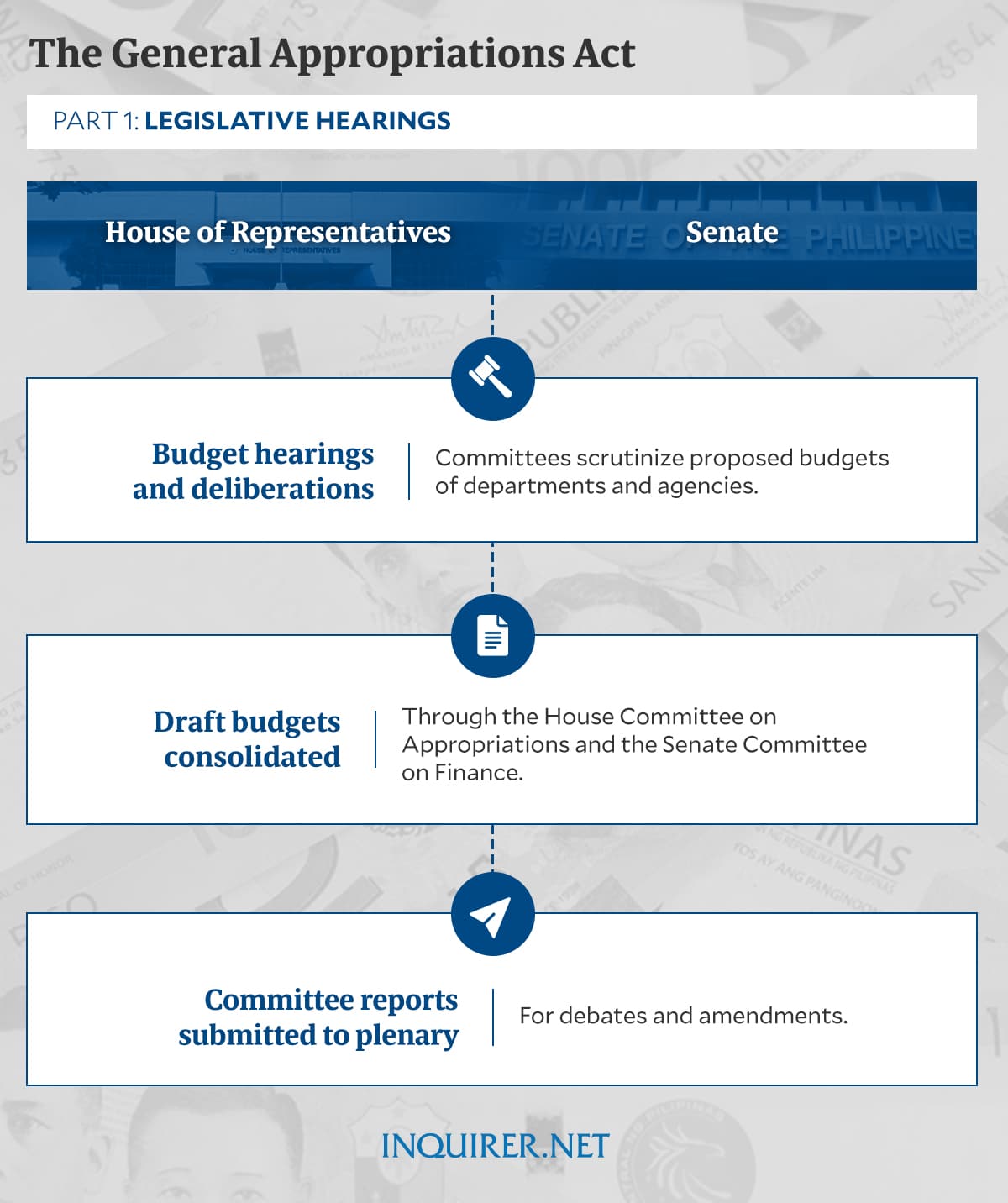
The House of Representatives and the Senate hold hearings to examine agency budgets. Committee reports from both chambers form the draft General Appropriations Bill.
These hearings, led by the House Committee on Appropriations and the Senate Committee on Finance, allow lawmakers to ask agencies about their spending plans and past performance.
The findings of these hearings are consolidated into a draft General Appropriations Bill (GAB) — Congress’s version of the national budget.
STEP 4: Plenary amendments and budget debates
After the committee level, the draft GAB goes to the plenary session, where lawmakers debate its contents and propose amendments.

Lawmakers debate the proposed budget in plenary and introduce amendments before voting, shaping which projects and programs receive funding.
During this phase, members of Congress may push for changes to include specific programs, district projects, or funding increases for certain agencies. These debates shape the final version of the bill that will move forward to the next stage.
STEP 5: Bicameral Conference Committee
When both the House and Senate have passed their respective versions of the budget, a Bicameral Conference Committee (Bicam) is convened.
This small group of lawmakers reconciles differences between the two versions of the bill — usually in closed-door meetings.

A Bicameral Conference Committee merges the House and Senate versions of the budget behind closed doors, finalizing a single General Appropriations Bill for approval.
The result is a final, unified General Appropriations Bill, ready to be ratified by both chambers. This stage has often drawn criticism for lacking transparency, especially when large last-minute “insertions” are made without public scrutiny.
STEP 6: Ratification and submission to Malacañang
Once reconciled, the final General Appropriations Bill is submitted to both the House and the Senate for ratification on third reading.

Both chambers ratify the reconciled budget on third reading and send it to Malacañang Palace for the President’s review and approval.
After approval by Congress, the bill is transmitted to Malacañang for the President’s review and signature.
STEP 7: The President’s signature
The President reviews the enrolled budget and signs it into law as the General Appropriations Act (GAA) — the country’s official spending plan for the year.
The Constitution gives the President line-item veto powers, allowing the removal of specific provisions deemed inappropriate or excessive. However, the President cannot add new items. Congress may override any veto with a two-thirds vote.

The President signs the General Appropriations Act into law, but may veto specific items; Congress can override the veto with a two-thirds vote.
Once signed, the GAA authorizes the release of funds for government programs and projects nationwide.
Where insertions happen
Insertions — or additional projects and allocations — can take place even before the budget reaches Congress.
In a Senate hearing, former Public Works Secretary Manuel Bonoan admitted that his department used a so-called “leadership fund” to accommodate project requests from lawmakers before the NEP was finalized and submitted to Congress.
Senator Panfilo Lacson flagged this as highly irregular:
“The NEP is the President’s budget proposal to be transmitted to the House and eventually to the Senate. Why are there insertions in the NEP? That I cannot really understand for the life of me.”
Bonoan, however, insisted the process was not an “insertion” but a “consolidation” of funding requests from lawmakers, agency heads, and other officials.
“This is where the list of projects is all incorporated into the NEP,” he said.
Are insertions always bad?
Not necessarily. Lawmakers argue that many insertions address legitimate needs that may have been overlooked during early planning.
Senate President Vicente Sotto III maintained that such amendments often come from local government units — for example, funding for schools, roads, or bridges in far-flung communities:
“It is within the mandate of senators to amend and determine government spending allocation. This serves as a crucial check-and-balance mechanism to ensure that public funds are spent in accordance with the law.”
Still, other officials caution against lumping all insertions together.
Former Deputy Speaker Lorenzo “Erin” Tañada III drew a clear distinction:
“Amendments are approved in plenary after following the regular process of legislation… Insertions are done outside the regular process. They are not approved in plenary.”
The bigger picture
Understanding the budget process — and where discretion and insertions can take place — is crucial for holding public officials accountable.
The national budget is more than a technical document. It reflects the government’s real priorities and who benefits from them. At every step — from proposal to signature — public vigilance helps ensure that every peso serves the people, not just politics.
Graphics by Ed Lustan/Inquirer.net. Source: Department of Budget and Management


