

Composite image from Inquirer files
MANILA, Philippines — The headline sparked concern: “₱1.7 trillion wiped out in market wealth due to corruption.” The statement, attributed to the Securities and Exchange Commission (SEC), raised alarm among investors and policymakers.
But just days later, the SEC took it back. They admitted the figure was based on a “fictitious” social media report. No such computation existed, and no such data had been verified. The damage, however, was already done.
READ: Go refutes SEC chief’s P1.7-trillion market loss claim
The controversy over so-called “ghost” flood control projects — and the widespread corruption behind them — has not only spotlighted inefficiencies in public infrastructure spending. It has also triggered what many see as a deeper and more dangerous crisis: a sharp erosion of investor confidence in the Philippine economy.
“It’s a stark reminder that corruption is a weapon of mass wealth destruction,” SEC Chairperson Francis Lim said during the Oct. Financial Executives Institute of the Philippines (Finex) conference. “When trust breaks down, capital dries up, and everyone — government, business, and the public — pays the price.”
Despite Lim’s later admission that the ₱1.7 trillion figure was based on a “fictitious” report and should not have been cited, economists and investors stress: the underlying concern is real.
READ: SEC chair apologizes for citing ‘fictitious’ report
Sentiment shock or systemic rot?
Philippine Chamber of Commerce and Industry (PCCI) Chairman George Barcelon acknowledged that the market reaction was alarming—even if the specific figure was inaccurate.
“Primarily, this is a reflection of the business sector and investors losing confidence, seeing the uncertainty that’s unfolding in front of our eyes,” Barcelon told INQUIRER.net. “It doesn’t seem that there will be light at the end of the tunnel soon.”
Barcelon said this corruption scandal has created a bad image for the country, especially among foreign investors.
“Never has there been a number that is so staggering. It’s not just a billion that we’re talking about—it’s already a trillion,” he said.
“The perception is that the whole government mechanism is involved. Otherwise, how could government agencies have lost sight of this happening under their eyes?” he added.
Market data tells a chilling story
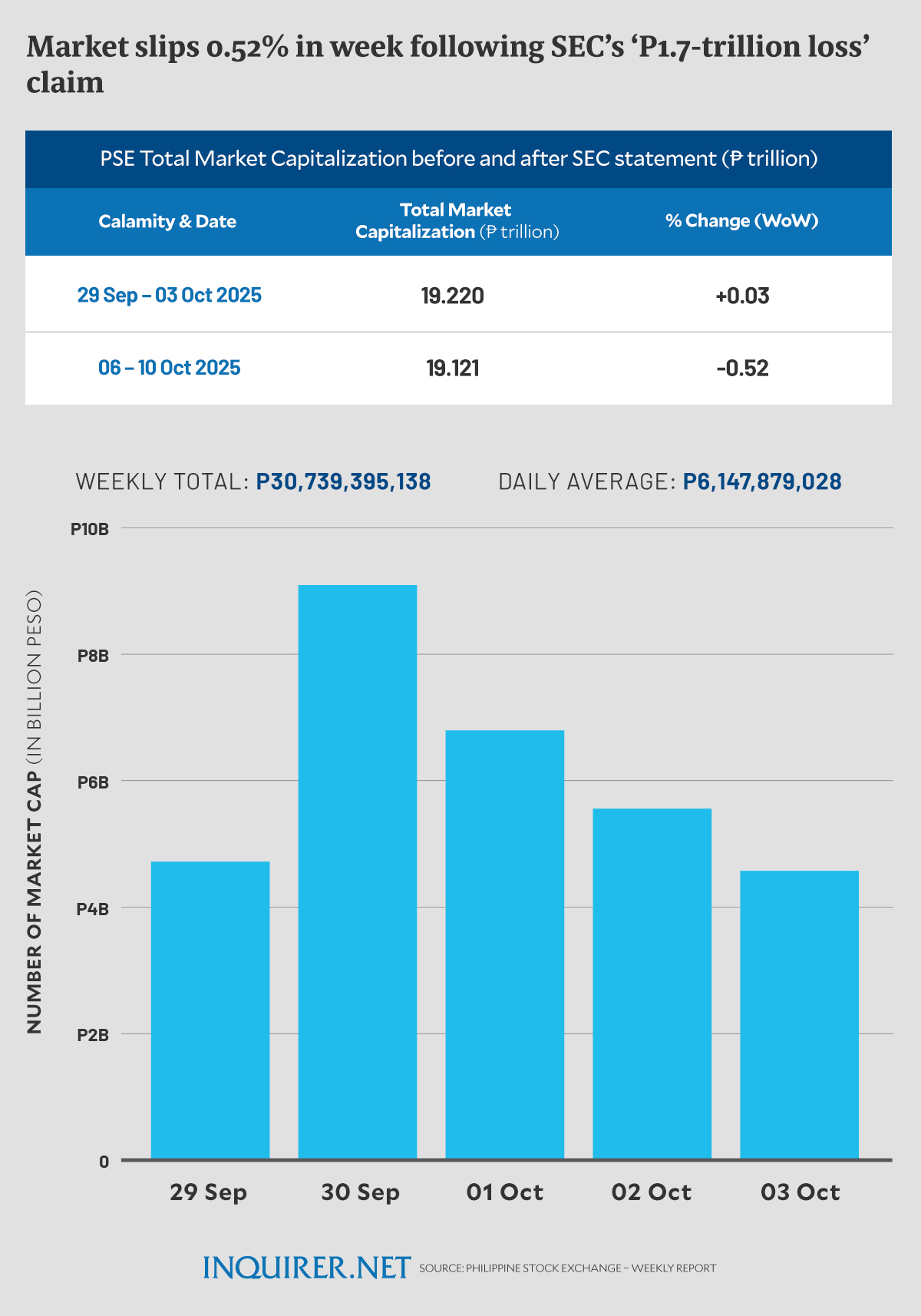
From Aug. 11 to 29, when exposés and Senate hearings on flood control anomalies intensified, the Philippine Stock Exchange (PSE) recorded a drop of around ₱186 billion in market capitalization — not the ₱1.7 trillion initially claimed, and later retracted, by the SEC.
According to PCCI Vice President for Industry and Trade Bryan Ang, this more conservative figure “is probably the more accurate number.” Still, he said, “the outlook and market sentiment are negative.”
“Stocks are more about sentiment than fundamentals,” Ang said. “If public sentiment towards the country is negative, they would rather invest in other instruments.”
PSE data shows that, in most weeks, total market capitalization moves only slightly—typically rising or falling by about half a percent to 1.5 percent, reflecting normal investor reactions to everyday economic news.
For example, from August 11 to 15, 2025, the market dipped by 1.09 percent compared to the previous week, then rebounded by 0.75 percent the following week.
However, during periods of heightened political tension — such as the Senate’s first hearings on ghost flood-control projects or shortly after the Sept. 21 anti-corruption protests — the market’s losses broke past these typical ranges. In the week of August 25 to 29, capitalization fell by 1.71 percent, or around ₱330 billion, indicating investor unease amid growing revelations of public fund misuse.


Graphics by Ed Lustan/Inquirer.net
While these losses were significantly smaller than the ₱1.7 trillion initially claimed by the SEC, the data still reflect how periods of heightened political controversy can unsettle investors. Business groups and economists have repeatedly warned that corruption-related instability, particularly involving infrastructure funds, has a real and measurable impact on market confidence.
“Maaaring paper loss ‘yan kung hindi ka nagbebenta ngayon,” explained Prof. Emmanuel Leyco, an economist and fellow at the Center for People Empowerment in Governance.
(It may be considered a paper loss if you’re not selling your stocks now.)
“Pero kung ikaw ay nagbenta, halimbawa ang presyo ng stock mo dati ay tatlong piso, ngayon ang bentahan lang ay dalawang piso, natalo ka na ng piso. Kaya’t may epekto ‘yan sa ating ekonomiya, dahil ang stock market ay naglalarawan ng kumpiyansa ng ating mga mamumuhunan.”
(But if you sell—say your shares were worth three pesos before and now only two pesos—you’ve already lost one peso. That has an impact on the economy because the stock market reflects investor confidence.)
He warned that this confidence is eroding amid what he described as “widespread corruption” and a “lack of discipline” in public spending.
“Kung ang nakikita ng mga mamumuhunan ay puro corruption… hindi na po sila masyadong namumuhunan. Ang kapital sa Pilipinas ay unti-unting umaatras,” Leyco said.
(When investors see nothing but corruption, they begin to hold back. Capital in the Philippines is slowly retreating.)
Foreign investors in wait-and-see mode
Philippine Ambassador to the United States Jose Manuel Romualdez said foreign investors have adopted a “wait-and-see” approach as corruption scandals shake investor confidence.
“Definitely, alam mo malaking epekto sa atin ‘yan,” he said in a radio interview. “[M]araming interesado… pero sabi nila teka muna, pumasok ang ‘teka, teka muna’ at makita muna natin kung anong solusyon dito.”
(Definitely, you know that it has a big impact on us. There are many who are interested… but they said, ‘hold on’—the ‘wait, wait a minute’ mindset came in, and they want to first see what the solution to this will be.
Romualdez said the Philippines risks losing substantial pledged investments if these issues are not addressed swiftly.
“Sayang nga eh, sayang na sayang. Ako ine-estimate ko, dito lang sa trabahong ginawa namin dito, we’re talking anywhere between $100B to $150B investments that will be coming in,” he said.
(It’s such a waste, really such a waste. I estimate, just based on the work we’ve done here, we’re talking anywhere between $100B to $150B in investments that will be coming in.)
“Yung ibang mga kumpanya gusto nilang mag-expand pero sabi nila again maghihintay muna sila… So talagang it’s time para ayusin ng husto ang ating sistema,” he added.
(Some companies want to expand, but they said again they will wait for now… So it’s really time to seriously fix our system.)
READ: Flooding a threat to investments in Bulacan
When asked what investors meant by their “wait-and-see” stance, Romualdez replied:
“Well, hinihintay nila. Wait-and-see. So ang ginagawa ko, ina-assure ko sila na maaayos natin ‘yan,” he said, adding that foreign investors are looking for clear signs that the government will ensure accountability and strengthen the rule of law.
(Well, they’re waiting. Wait-and-see. So what I’m doing is, I’m assuring them that we will fix it.)

Graphics by Ed Lustan/Inquirer.net
Economist Michael Ricafort echoed this view, saying the same “wait-and-see” attitude has been evident even in the local financial markets.
“Amid the political noise… instantly, at the very least, wait-and-see po ang mga investors,” Ricafort said in a radio interview.
(Amid the political noise, at the very least, investors have taken a wait-and-see stance.)
“Very sensitive po kasi yung mga financial markets, lalo na yung stock market. Yung local financial markets kasama rin doon yung currency, to some extent, yung bond market kasi sentiment driven po yan,” he added.
(The financial markets are very sensitive, especially the stock market. The local financial markets also include the currency — to some extent — and the bond market, because these are sentiment-driven.)
‘Ghost’ projects, real consequences
While the controversy centers on nonexistent or unfinished flood control projects, business leaders warn that its ripple effects reach far beyond government infrastructure spending—hitting the country’s economic reputation and, most urgently, the small businesses that form the backbone of the economy.
Ang said the flood control scandal has deepened mistrust in public institutions, particularly among micro, small, and medium enterprises (MSMEs) that were already struggling with high costs and weak post-pandemic recovery.
“They have lost trust in government. Why?” Ang said. “MSMEs, they are expecting the government to provide them financing to grow their business.”
He cited the Department of Trade and Industry’s Small Business Corporation (SB Corp.), whose limited resources mean small firms often receive only modest loans.
“Meron isang SB Corp., yung DTI, napakaliit nang nabibigay nilang tulong sa SME—₱500,000 to ₱1 million, kasi ang liit ng budget,” he said. “Tapos makikita mo may ₱1 billion na nakakalad sa isang billiard table. May ₱1 billion na sinugal sa isang casino.”
(There’s one SB Corp. under DTI, and the help they can give to SMEs is very small—₱500,000 to ₱1 million, because the budget is small. Then you’ll see ₱1 billion lying on a billiard table. Another ₱1 billion gambled away in a casino.)
READ: Ex-DPWH execs tied to flood scam lost P950M in casinos – Lacson
Ang said this fuels resentment among entrepreneurs who see billions lost to corruption while their own access to financing remains limited.
“Hindi ba dapat pinautang na lang sa SME ‘yun?” he said. “Ang problema kasi ang SME hindi siya papautangin nitong malalaking bangko kasi wala naman siyang pang-colateral eh. Doon papasok ngayon ang government—tulungan mo si SME, because government can afford to take that risk.”
(Shouldn’t that money have been lent to SMEs instead? The problem is, small businesses can’t get loans from big banks because they have no collateral. That’s where the government should step in, because it can afford to take that risk.)
He urged the government to use mechanisms such as the Maharlika Investment Fund to directly support MSMEs—by extending credit even to those without collateral.
“Maharlika should step in and [the government should] study how it can help SMEs. Lend to them even without collateral—they have no property, that’s why they’re small enterprises in the first place,” Ang said.
Beyond financing, he warned that corruption scandals like the flood control controversy make the situation even worse by discouraging investment and undermining efforts to rebuild the economy.
“All businessmen are so hurt right now,” he said. “Because they’re being harassed by BIR all the time, and every time they pay their taxes, they know where it goes. It doesn’t go to public services. The system itself allows itself to be corrupted.”
Business groups want swift reforms
For the country’s top business leaders, the corruption storm has already done more than dent the government’s image—it’s shaking investor faith at its core. The PCCI, representing thousands of firms nationwide, is urging the government to act decisively and pursue swift, visible reforms instead of drawn-out hearings that only deepen uncertainty.
Barcelon said the scandal laid bare how fragile government oversight has become. Projects worth billions, he noted, slipped through layers of supposed checks and balances.
“If COA and DPWH people were doing their job, these flood protection projects could have been stopped much earlier,” he said. “In private business, you not only have internal auditors—you have external auditors, too.”
READ: BIZ BUZZ: Enough is enough: Biz leaders join street protests


Graphics by Ed Lustan/Inquirer.net
To Barcelon, the failures go beyond negligence. They reveal a structural problem—one where unchecked budget insertions and the easy release of funds make corruption almost routine. What’s at stake, he said, is not just accountability, but the country’s reputation before the global business community.
“People abroad would ask me, ‘What’s happening to your country?’” he recalled. “They read about it in international media… and never has there been a number so staggering. It’s not just billions—it’s already trillions.”
That international scrutiny, he warned, is a signal that the world is watching whether the Philippines can still uphold fiscal discipline and justice. “At this point, dapat wala nang palusot,” he said. “Kung sino na-identify, dapat i-prosecute. There must be restitution. Otherwise, people will lose faith in how the country is being run.”
(At this point, there should be no more excuses. Whoever has been identified should be prosecuted. There must be restitution. Otherwise, people will lose faith in how the country is being run.)
Businesses losing patience with government silence
If there’s one thing the private sector agrees on, it’s that time is running out for the government to act. Business leaders say the longer corruption probes drag without visible results, the deeper public distrust grows—not only among investors but among citizens who expect answers.
Ang said the lack of urgency and transparency surrounding the government’s response has left the business community exasperated.
“All businessmen are so hurt right now,” Ang said. “The entire business sector is furious. We want swift and serious decisions made. Whoever should be jailed, should be jailed.”
He warned that the delays—from suspended Senate hearings to the selective release of information—have only fueled anger and uncertainty. The decision to pause the Blue Ribbon inquiry while releasing limited photos from the Independent Commission for Infrastructure (ICI), he said, sent the wrong signal.
“You stopped the Blue Ribbon hearing for two weeks, and now you show [us] ICI photos—but none of [the findings from the investigation] is shown to the public,” Ang said. “The public is clamoring for transparency. Whenever it’s total silence, the more people get angry.”
READ: Biz groups: Probe not just DPWH, contractors but also lawmakers
That silence, he added, has been corrosive. Without accountability, he said, investors—both local and foreign—begin to suspect that the government is managing perception, not solving the problem.
“The public is thinking that you’re selling us a story, a script, and you’re hoping to just confuse us and that one day we’ll forget,” he said. “That is never healthy for business.”
For Ang, rebuilding trust will require more than photo releases or press statements. It demands swift, public action—not another round of hearings that end without consequence.
What can be done to regain trust?
Both Ang and Barcelon offered suggestions for rebuilding confidence: allocate savings from canceled projects to tax relief, inject support into MSMEs, and prosecute those involved—swiftly.
“The government has to come in. You have ₱250 billion savings from flood control—use that to suspend VAT on electricity and water,” Ang said. “Every businessman will feel it, and so will the people. It will lighten the load of the common Filipino.”
Ang also urged the government to use the Maharlika Investment Fund proactively to restore market confidence:
“Siguro if I am government, tingnan natin ang Maharlika Fund. Ang Maharlika Fund was created using Land Bank, DBP, etc., ₱200 billion, and that money is still there. Gusto ba nilang mag-invest sa PSE to show that our government believes in the stock market?”
(If I were the government, maybe we should look at the Maharlika Fund. The Maharlika Fund was created using Land Bank, DBP, etc.—₱200 billion, and that money is still there. Do they want to invest in the PSE to show that our government believes in the stock market?)
He warned that the government’s recent moves—such as acquiring board seats in NGCP—send the wrong signal to investors.
“Because as of today, all I see is them trying to buy, them buying two board seats in NGCP. It’s reverse privatization, which, to a lot of foreigners, is actually negative. The threat right now is to privatize because the private sector is better at handling business,” Ang explained.
“Government is not there to make money. The government is there to provide services to the people. That’s where the Maharlika Fund should come in. Please, the PSE needs help. Buy local stocks,” he added.
Ang challenged officials accused of wrongdoing to waive their bank secrecy rights:
“If you claim you’re innocent, then waive your bank secrecy law. That’s the biggest and surest way to prove your innocence.”
Barcelon, meanwhile, said restoring investor trust requires leadership with conviction—not just statements.
“You have to really take the bull by the horns,” he said. “If you have to do this, do this. And hopefully, that will reflect on the general population that the government is serious about solving this issue.”
The high cost of looking away
Corruption, in the end, is not just about lost billions. It’s about lost futures.
From education, healthcare, infrastructure, to local jobs and foreign investment, every peso stolen chips away at the country’s long-term growth. Worse, it sends a message that impunity pays.
“It’s not just the monetary loss on the side of our economy. But on the other side, you can see some of the social services that are being affected. Health, education, all of that are being directly affected by money that was stolen,” said Barcelon. “And foremost is that the pride of being a citizen of the country is somehow tarnished.”
“You work so hard, you pay the right taxes—only for this. It’s really painful,” Ang stressed. “We are a rich nation if only they didn’t steal from our coffers all this time.”
“But we still have to support our government during the most difficult of times,” he added.
If the Philippines is to recover—not just from this scandal, but from the climate disasters and economic headwinds still ahead—then public trust must be restored. Not through promises, but through prosecution. Not through silence, but through sweeping reform.
Because the real cost of corruption is not just what we lose today, it’s what we fail to build tomorrow./tsb