





Fighting corruption beyond street protests: What’s next?


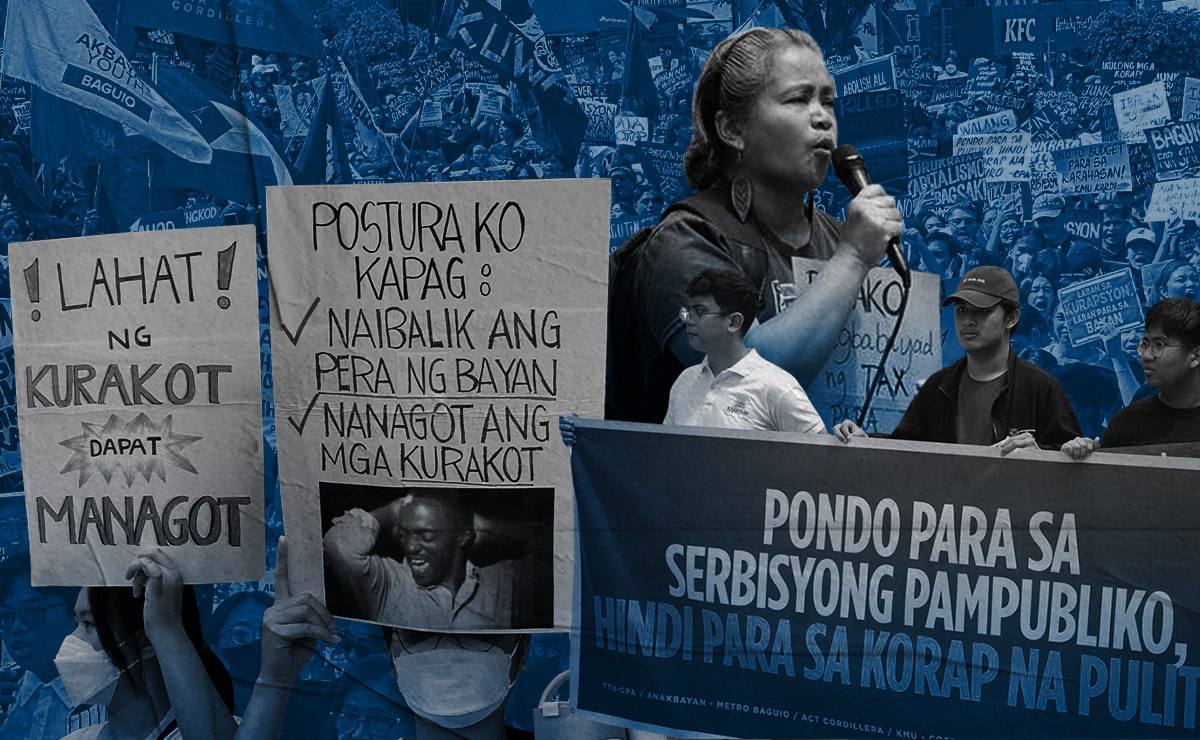
ANTI-CORRUPTION PROTEST composite image from INQUIRER File, Kabataan Partylist Cordillera and Larizza de Vera
Hundreds of thousands of people took to the streets on Sunday, Sept. 21, to condemn corruption in government, with Rizal Park in Manila and EDSA People Power Monument in Quezon City as the main venues.
As pointed out by Raymond Palatino, secretary general of Bagong Alyansang Makabayan, “the message was loud and clear in Luneta, Mendiola, EDSA, and across the country.” “The people are angry and demanding accountability.”
“The people want corrupt politicians to face imprisonment, especially the masterminds and those who hold high positions in government,” he told INQUIRER.net.
Palatino pointed out that “self-serving congressional investigations lack credibility and the so-called independent commission has yet to state that it will also look into the role of Malacañang in enabling large-scale corruption.”
READ: ‘Ilublob sa baha’: The power of Filipino humor against corruption
Even in Baguio City, Iloilo City, Cebu City, and in provinces where protests are not common, thousands of people converged to denounce corruption, which cost the economy P42.3 billion to P118.5 billion in the last two years.
READ: Tens of thousands join anti-corruption protests in Metro Manila
For Maria Ela Atienza, a professor of political science at the University of the Philippines Diliman, the rallies, attended by a diverse crowd, were not just a show of indignation and force.
“They sent a message to the government that more and more sectors, not just the organized, progressive and opposition, are against the blatant cases of corruption involving public officials,” she told INQUIRER.net.
As Sen. Kiko Pangilinan told ANC, “this is the biggest corruption case in the history of the Philippines,” with Atienza stressing how corruption was committed at the expense of public services and infrastructure works that should serve the people.
READ: Biggest flood of protests yet under Marcos
For example, the billions of funds lost to corruption from 2023 to 2025 could have been used to increase hospital beds to 56,827; nurses to 201,542; doctors to 63,596; and Barangay Health Stations to 15,711.
Rosario Guzman, research director of Ibon Foundation, explained that corruption squanders public funds that could have gone to much-needed social services.
So what’s next?
Atienza said those who attended, or at least supported the protests, “should continue pressing government officials and agencies to be serious in their investigations and prosecute anyone involved based on hard evidence.”
“Those found guilty, no matter their position, should suffer the penalties based on our laws,” she said.
For lawyer Dino de Leon, “the anger and mobilization should continue,” saying that “ this is just the start and the people must sustain it without allowing those who would like to take advantage of the situation for political gain.”
Over the weekend, pro-Duterte individuals also gathered at the Liwasang Bonifacio in Manila and Gate 4 of Camp Aguinaldo in Quezon City, calling for the resignation of President Ferdinand Marcos Jr. which would benefit Vice President Sara Duterte.
But as De Leon pointed out, “Duterte cannot be allowed to benefit from this because she is likewise dishonest, corrupt, and abusive,” stating her alleged misuse of confidential funds. Duterte has refused to address the allegations except for a blanket denial.
This was echoed by Palatino, who stated that “we are demanding the impeachment of Duterte to proceed, and the expansion of the corruption investigation to include the infrastructure projects of the previous administration.”
As for Marcos, he said “we have yet to hear him about his plans with his own pork barrel allocation, as well as his confidential and intelligence funds (CIF),” stressing that at the minimum, “he should give up his pork barrel.”
“He should also allow the audit of his CIF,” Palatino said.
Keeping the fire lit
For Rosario, the “indignation rallies in the region are no longer mere demands for transparency and accountability, but for genuine democracy—no longer for a mere change in leadership, but for a change in the system itself.”
However, security and defense analyst Jose Antonio Custodio lamented how the protests ended with no one staying behind to continue the rallies the next day.
Remember that the EDSA I and II, which brought down Ferdinand Marcos Sr. and Joseph “Erap” Estrada from Malacañang, lasted four and three days – Feb. 22 to 25, 1986 and Jan. 17 to 20, 2001.
RELATED STORY: Nun resumes protesting in street after fighting dictatorship 40 years ago
“Did the rally end, and did you go home when it ended? Are you all now safely at home posting about it and commenting on each other’s posts on the rallies?” he asked on Facebook.
“If the answers are yes to all, and no one stayed behind to continue the rally into the next day, then most likely you are setting yourself up for a big disappointment,” Custodio pointed out.
He expressed concern that “since the rally ended and there was no outpouring of sustained anger, everyone involved in the controversies will just wait it out until everything blows over and they can hammer out deals with the powers that be.”
RELATED STORY: No military unrest amid anti-corruption rallies – Palace
Pangilinan, in an interview with ANC, said the judiciary should make public the rate of corruption convictions, stressing that the “best deterrent” to corruption in government is the swift delivery of justice. At the Senate blue ribbon committee hearing, he shared data from the anti-graft court Sandiganbayan showing only 47 convictions in graft cases through the years.
For Atienza, “people should continue to push for more transparency and accountability in all government transactions and push for the passage of the long-promised transparency or public information law.”
“The people should push, as well, for the publication of SALN, or Statement of Assets, Liabilities and Net Worth of all government officials, regular lifestyle checks, and other reforms,” she said.
“There should be more and more Filipinos who should make the government transparent and accountable and remind public officials and employees that they are accountable to the people,” Atienza stressed.
Last Tuesday, Sept. 23, hundreds of students of the Ateneo de Davao University walked out of their classes to express indignation against corruption, with the school president, Fr. Karel San Juan saying that “as the president […] I support this academic walkout.”
READ: Ateneans walk out of classes in Davao City to protest corruption
“I am very proud of you,” he told the students.
“This mobilization shows your opposition and anger towards corruption, this mobilization manifests your disgust towards people who use power to get millions, billions, trillions,” he said.
People’s initiative
With how massive the crowd was last weekend, former Finance Undersecretary Cielo Magno and state auditor Heidi Mendoza laid out how Filipinos can fight against corruption beyond street protests.
READ: Church leaders’ group hails outcome of anti-corruption rallies
Both of them, speaking at the EDSA People Power Monument, proposed a People’s Initiative on important policy reforms.
Section 32, Article VI of the 1987 Constitution states that “the Congress shall, as early as possible, provide for a system of initiative and referendum, and the exceptions therefrom, whereby the people can directly propose and enact laws or approve or reject any act or law or part thereof passed by the Congress or local legislative body after the registration of a petition therefor signed by at least ten per centum of the total number of registered voters, of which every legislative district must be represented by at least three per centum of the registered voters.”
Magno and Mendoza said the initiative will include a call for the publication of SALN, passage of a Freedom of Information law, disqualification of candidates issued with final and executory Notice of Disallowance, and “citizen’s participation.”
RELATED STORY: Protest leader: We don’t have roasted cow but we have our conscience
As Mendoza pointed out, “we have to include Citizen’s Participatory Audit in all critical aspects of the budget process, as well as in procurement monitoring and inspection.”
“So that we will no longer have ‘ghost’ projects,” she said.
For Atienza, Filipinos should not just demand these.
“They can also help in monitoring the work of various agencies and officials at all levels, fact-check what government officials are saying, and engage with more people and sectors so that more and more people can connect government transactions with the quality of public services and infrastructures,” she said.


