


Ghost flood control projects spark protests in Hagonoy, Bulacan


READ: LIVE UPDATES: Sept. 21 protests vs corruption
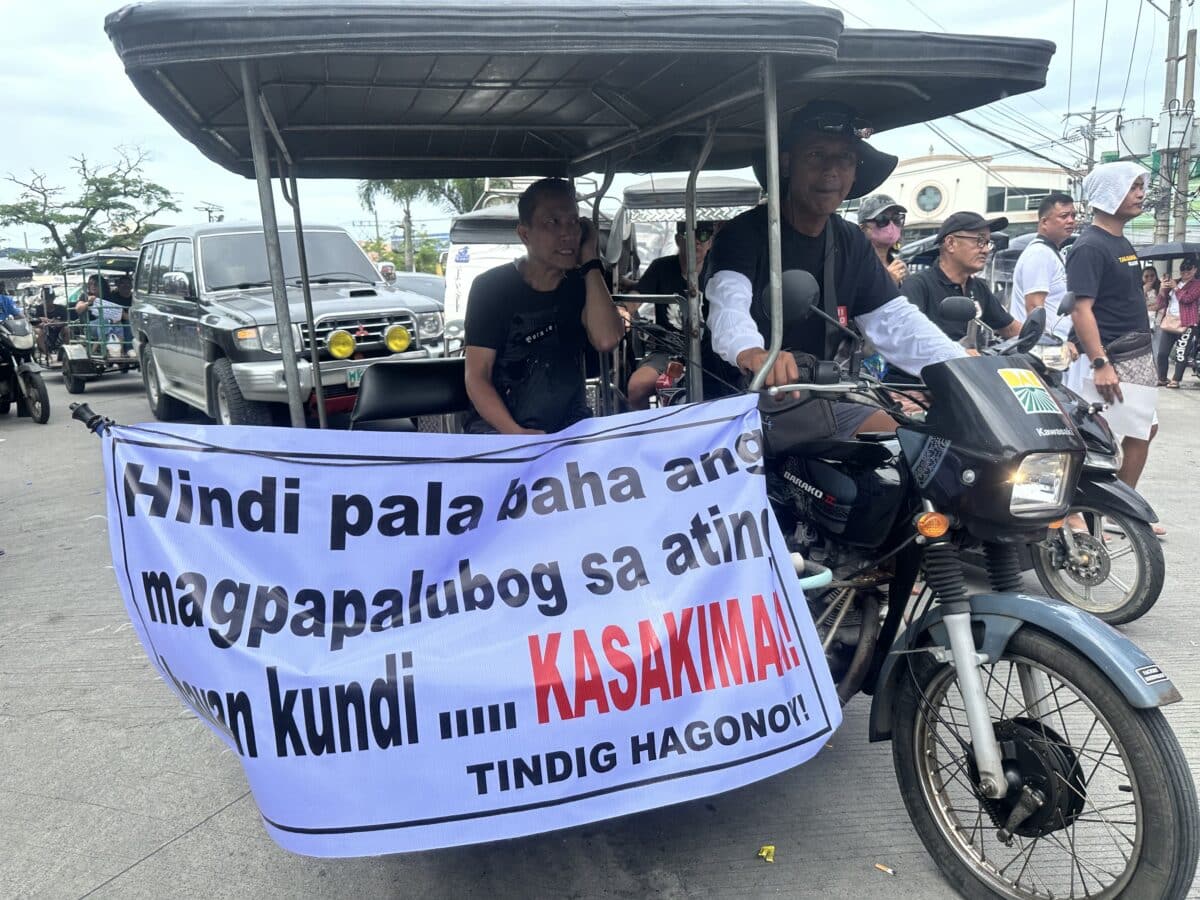
Hagonoy residents join the Tindig Hagonoy “Black Saturday” protest rally and motorcade on Sept. 20. The mass action, which began with a dawn Mass and a program at the town plaza, was held to denounce alleged corruption in multibillion-peso flood-control projects that residents say have left their coastal town submerged and suffering. (Photo by Carmela Reyes-Estrope)
HAGONOY, Bulacan — “They should be the ones to brave the daily floods brought by high tide—and they should just be fed to the oysters,” said Cynthia Yuda, a former Overseas Filipino Worker (OFW) who was forced to abandon her home in a once-posh subdivision after it had been submerged in more than three feet of floodwater for years.
Yuda was among hundreds of residents from various sectors—fisherfolk, tricycle drivers, students, youth groups, professionals, church leaders, persons with disabilities, artists, and fraternity members—who spoke during the Sept. 20 “Black Saturday” protest rally called Tindig Hagonoy.
“We don’t deserve this. We Hagonoeños are not fools. You should be the ones wading through the floods and fed to the oysters. Thieves!” she said in Filipino, addressing politicians and contractors accused of pocketing public funds meant to protect the coastal town from perennial high-tide flooding.

Hagonoy residents join the Tindig Hagonoy “Black Saturday” protest rally and motorcade on Sept. 20. The mass action, which began with a dawn Mass and a program at the town plaza, was held to denounce alleged corruption in multibillion-peso flood-control projects that residents say have left their coastal town submerged and suffering. (Photo by Carmela Reyes-Estrope)
Yuda recalled how her subdivision, Mary the Queen Homes, was once an ideal community—popular among joggers and parents taking their children out for morning sunlight.
“But because of the tides and floods, our clean and peaceful village became a nightmare. The streets are filthy, parasites abound, and our homes are constantly soaked in floodwater. Everything I worked hard for is gone. Floodwater reaches breast level; there are mosquitoes, rats, even snakes. It’s enraging. The corrupt cannot see the suffering of Hagonoeños,” she said.
“While the corrupt spend our taxes on resorts, farms, and luxury bags, the people of Hagonoy are soaked in floodwater. Our children wade through stinking waters while their children ride in high-end SUVs,” she added.
‘We fear crocodile’

Hagonoy residents join the Tindig Hagonoy “Black Saturday” protest rally and motorcade on Sept. 20. The mass action, which began with a dawn Mass and a program at the town plaza, was held to denounce alleged corruption in multibillion-peso flood-control projects that residents say have left their coastal town submerged and suffering. (Photo by Carmela Reyes-Estrope)
For fisherfolk leader Jeffrey Soriano, if there were a way to poison the “crocodiles” in government, they would not hesitate.
“In Manila Bay, we fear sharks. On land, here in Hagonoy, we fear crocodiles. In the farms, we use pesticides to protect our crops. In the fishponds, we use treatments to clean the water. If only there were something we could do against the corrupt,” he said.
Tindig Hagonoy cofounder Renato dela Cruz, a former Hagonoy Institute teacher, said their town had long been treated as a “milking cow” by corrupt officials.
From 2022 to 2025, he said, the town was allocated 42 flood-control projects worth more than P4 billion. Yet most, he claimed, were either substandard or outright ghost projects.
“If these budgets had really been spent on flood-control projects, there would be no more flooding in the town of Hagonoy. But they were stolen. Who stole them? You already know the answer,” Dela Cruz told nearly 1,000 rally participants.
He cited specific cases: a dike in Halang, San Pablo, built by Wawao Builders, which collapsed because mud and soil—not concrete or steel—were used as fillers; and a 2024 flood-control project in Carillo that was completed without a pumping station. “That project was even reloaded with funds for 2025, yet it is already a ghost,” he said.
Israel Saguinsin, a Bulacan State University professor and fellow convenor, stressed that corruption doesn’t just steal funds but robs children of a future.
“Our children cannot play in the streets or walk on the roads. Even their future is being stolen from them,” he said.
He noted that despite billions poured into flood-control projects—P637 million in Sta. Elena alone—flooding persists. In barangays across Hagonoy, allocations ranged from P40 million to nearly P500 million, but residents say not one project has spared them from the floods.
“We are used to corruption,” Saguinsin said. “Before, it was 2 percent to 3 percent. But at least, projects were built. Now, the corruption is so massive that not even one project can be used. Everything is guni-guni (make-believe).”
The other convenors of Tindig Hagonoy include former teachers Angel Reyes Cruz—who lost a foot after an infection from flood exposure—Ethel Balatbat-Sanchez, Ma. Gladys del Rosario, Iska del Rosario, and Resty Abela Egrubay.
The day began with a 6 a.m. mass, followed by a program at the town plaza. Protesters then waded through floodwaters and staged a motorcade across several barangays. Organizers vowed that it was just the beginning of a series of rallies.
Residents recalled that in the 1970s and 1980s, people who engaged in crime or corruption and later went missing were rumored to have been “fed to the lobsters and prawns” of Hagonoy. Today, protesters say, the same fate should befall modern-day thieves of public funds. /mcm


