





Azcuna: Escudero erred in citing Davide impeach case


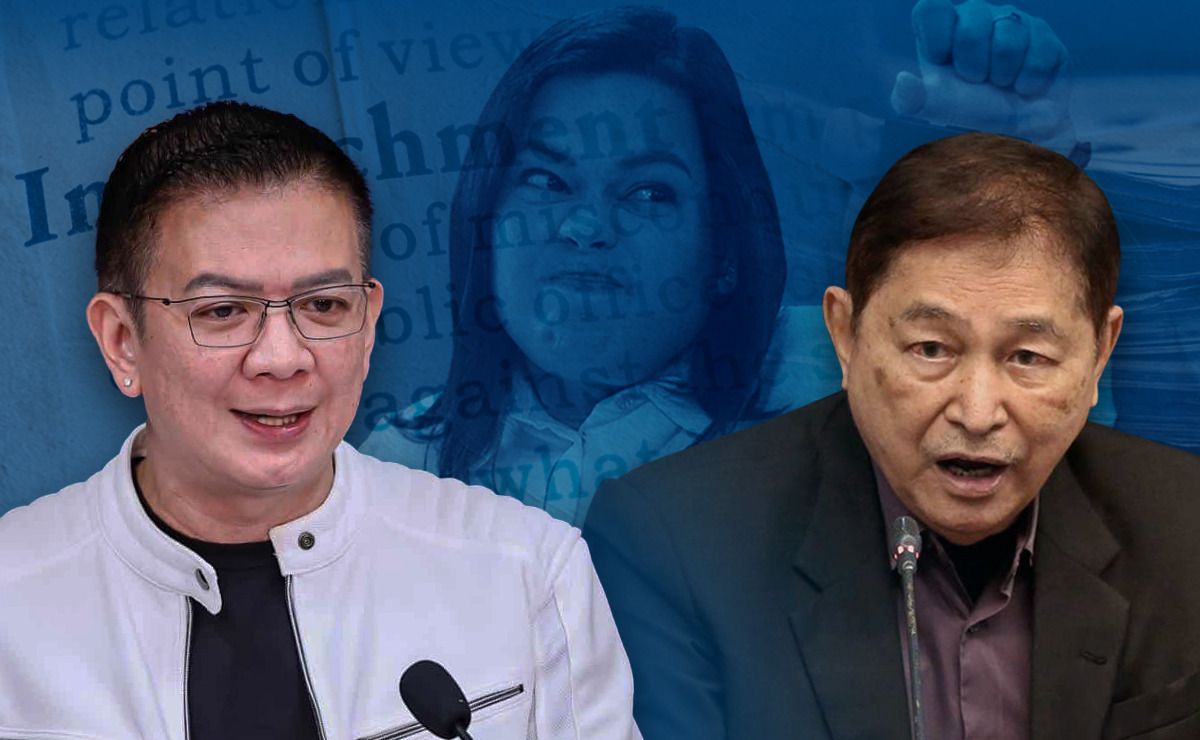
Senate President Francis Escudero (left) and Retired Supreme Court Associate Justice Adolfo Azcuna (right). Composite image from Inquirer files
Retired Supreme Court Justice Adolf Azcuna said Senate President Francis “Chiz” Escudero mistakenly cited a high court ruling to justify his criticism of former members of the tribunal who had questioned the nullification of the impeachment of Vice President Sara Duterte.
Azcuna, one of the framers of the 1987 Constitution, was reacting to remarks made by Escudero during the Senate’s Aug. 6 session, where the Senate leader defended the chamber’s decision to archive the impeachment case as he confronted criticisms from legal experts and fellow lawmakers.
In a television interview on Thursday, Azcuna said Escudero inaccurately cited the Supreme Court’s action in the attempt in 2003 to impeach then Chief Justice Hilario Davide Jr. as the supposed precedent for the court’s July 25 ruling declaring Duterte’s impeachment unconstitutional.
No TRO issued
“It’s not true that the Supreme Court issued a TRO [temporary restraining order] on the case of Davide,” he explained. “What we did was to issue a resolution calling on all the parties to maintain the status quo. It was an appeal. It was not an order.”
Azcuna, who was on the Supreme Court at the time, said the justices deliberately avoided issuing a formal injunction against the House of Representatives to prevent a full-blown constitutional crisis.
“We merely appealed to all the parties, including the House, to maintain the status quo,” he said.
In his remarks, Escudero recalled that he was a congressman in 2003 when there was an attempt to impeach Davide. He said that the situation then was similar to the current situation.
Francisco case
He claimed that the court intervened by enjoining Congress and issuing a TRO, which ultimately led to what he referred to as the “Francisco case.” The Francisco ruling clarified that the Constitution bars multiple impeachment proceedings against the same public official within one year.
“I was part of the Congress that attempted to impeach former Chief Justice Davide. Why do I say ‘attempted?’ Because we were stopped by the Supreme Court. The court enjoined us and issued a TRO, and that was the decision—that Francisco case we always cite,” he said.
He noted that both cases involved allegations of corruption and questions about the House’s sole prerogative to initiate impeachment.
Escudero questioned the motivations of former justices who are now criticizing the ruling.
“My question is simple: Where were those who are now complaining and questioning the Supreme Court’s decision? The retired justices now objecting had voted in favor back then,” he said.
“But now their position seems to have changed. So what’s the difference now? It’s clear—the name of the accused is different,” he said.
Different modes
But Azcuna said the fundamental difference was like the impeachment process itself.
The 2003 case involved the first mode of impeachment, where a complaint is filed before the House justice committee, requiring a hearing before it could proceed.
In contrast, the Duterte complaint followed the second mode, where the endorsement of at least one-third of the House members allows the complaint to proceed directly to the Senate without a hearing.
“The present case is different. It is on the second mode where the complainant is the House itself by a one-third vote,” Azcuna said.
“In this case, the Constitution doesn’t say there has to be a hearing. The Supreme Court now says there has to be a hearing. That is rewriting the Constitution—not just the rules,” he said.
‘A comprehension test’
Azcuna is one of several legal luminaries who have publicly questioned the Supreme Court’s July 25 decision, which voided the impeachment complaint against Duterte on the grounds that the House violated the one-year bar and due process.
In that ruling, the court laid down a new procedure that the House must now follow even when using the second mode of impeachment.
These include holding a hearing, attaching all evidence, and proving that every member understood the charges—requirements Azcuna and others say have no basis in the Constitution.
“This is a comprehension test, which is an insult to the minds of the legislators,” Azcuna said. “It will make filing a complaint under the second mode practically impossible.”
More warnings
Former Senior Associate Justice Antonio Carpio and Constitution framer Christian Monsod have also warned that the ruling undermined Congress’ sole power to impeach and could make the process nearly unworkable moving forward.
“The Supreme Court is saying the Constitution is unconstitutional,” Azcuna said.
Azcuna, firm in his criticisms, emphasized that the public has a right—and even a duty—to call out perceived judicial overreach.
“The power of judicial review … is part of the balancing of the Constitution. That doesn’t mean the Supreme Court is above the other co-equal bodies,” he said. “The Constitution is above them all.”
“The power of judicial review … is part of the balancing of the Constitution. That doesn’t mean the Supreme Court is above the other co-equal bodies,” he said. “The Constitution is above them all.”


