





Hosting the future: PH steps into climate justice spotlight


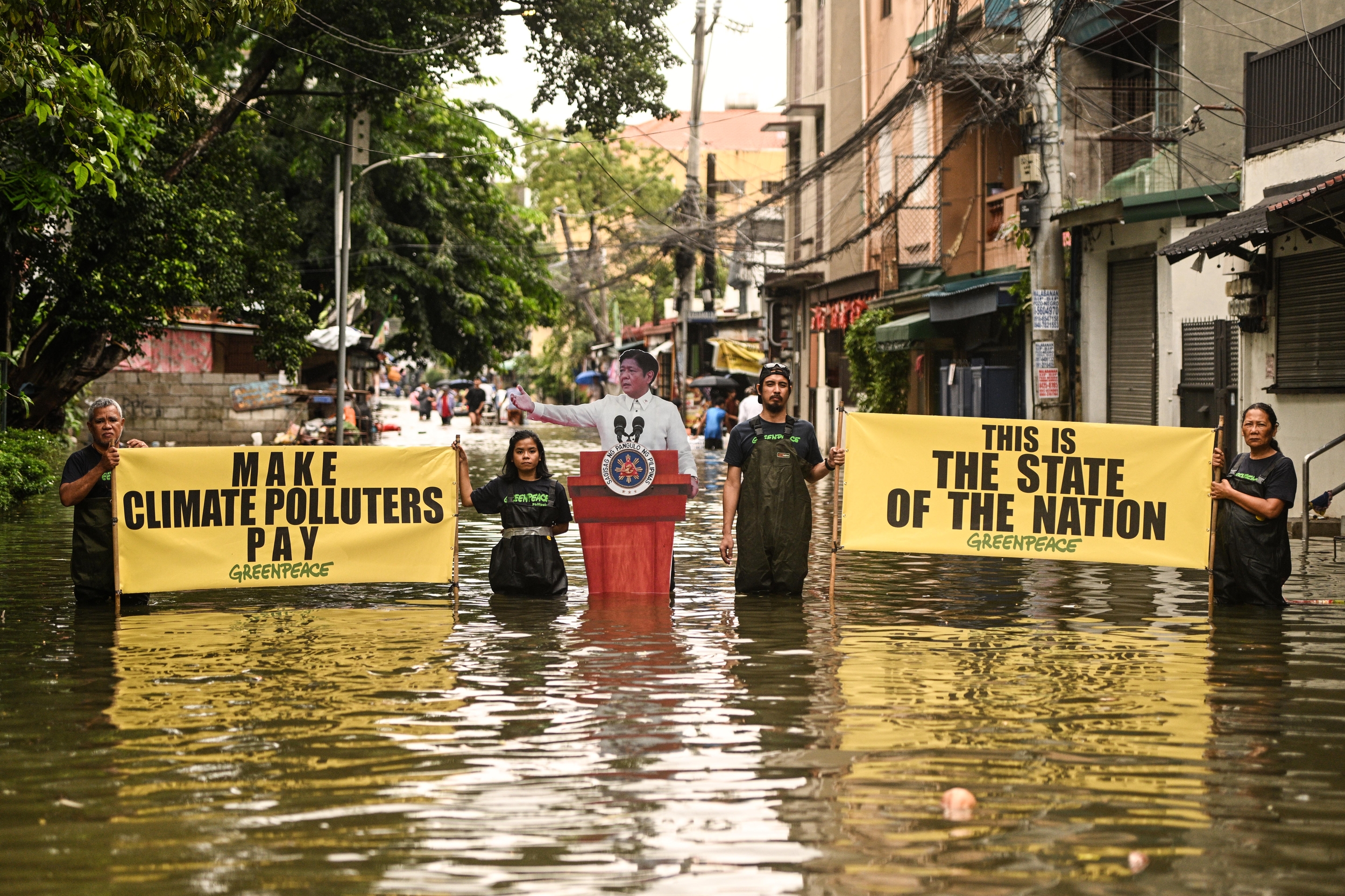
Greenpeace Philippines activists stage a protest in a flooded neighborhood in Cainta, Rizal, ahead of President Ferdinand Marcos Jr.’s State of the Nation Address, urging him to hold major climate polluters accountable. (Photo courtesy of Greenpeace Philippines)
MANILA, Philippines— In flood-hit communities across the Philippines, the scenes have become painfully familiar: soaked belongings, makeshift soup kitchens, and volunteers doing their best to help neighbors survive yet another storm.
For Jefferson Chua, a campaigner with Greenpeace Philippines who has spent years supporting relief efforts, the prevailing sentiment is “fatigue.”
“And I don’t just mean personal fatigue—it’s the collective exhaustion of communities who face the same patterns of destruction over and over,” Chua told the Inquirer.
This year’s floods, triggered by the southwest monsoon and low-pressure areas that developed into storms, again submerged homes and displaced thousands of families. One of Chua’s most vivid memories came from speaking with soup kitchen volunteers who, despite their exhaustion, stayed to feed those in need.
“Some of them laughed not because it was funny, but out of resignation,” he recalled. “One even said, ‘Ganyan talaga.’”
The same communities battered by Crising were also hit by Typhoon Carina nearly a year ago. The names change—Ulysses, Ondoy, Paeng—but the cycle of destruction remains.
“These events aren’t normal, but they’re becoming normalized because of warming oceans and intensifying storms largely driven by fossil fuel emissions,” Chua said.
Now, as the Philippines takes the global spotlight by hosting the board of the Loss and Damage Fund, the stakes are even higher.
A global spotlight
The Loss and Damage Fund was developed under the United Nations Framework Convention on Climate Change (UNFCCC) to help vulnerable nations recover from climate impacts that can no longer be avoided or adapted to.
Launched at COP27 in 2022 after decades of pressure from developing nations, the fund represents a historic step toward climate justice.
“Unlike traditional climate finance, which focuses on reducing emissions, this mechanism specifically addresses irreversible damage.
The Philippines was selected from among eight countries that submitted proposals to host the fund. The official announcement came on July 9 during the board’s second meeting, held in Songdo, South Korea.
The board, which governs the strategy and operations of the Loss and Damage Fund, is composed of 26 members: 12 from developed countries and 14 from developing nations under the UN climate framework.
The Philippines is also set to host the fund’s interim secretariat, with the next board meeting scheduled for October.
“There’s irony in it—one of the most climate-vulnerable countries now leads the board for a fund meant to address loss and damage. It must mean more than symbolism,” Chua said.

Dried land is seen at Pantabangan Dam in Nueva Ecija on April 24, 2024, as water levels drop amid drought. The remnants of the centuries-old town of Pantabangan reemerge as parts of the country face severe dry spells. (AFP)
Only 0.2% of needs funded
Despite its ambition, a 2024 policy brief by the Lowy Institute’s Indo‑Pacific Development Centre noted that the fund remains drastically underfunded. Only $700 million has been pledged globally, around 0.2% of the estimated $400 billion needed annually to address climate loss and damage.
This leaves countries like the Philippines scrambling for support as disasters grow more frequent and intense.
“Hosting gives the Philippine government a real opportunity,” Chua said. “They should push for larger contributions, faster disbursements, and accountability from climate polluters. It’s also an opportunity to strengthen other accountability mechanisms—not just this fund, but also legal and financial tools to go after those most responsible.”
In a speech during the sixth board meeting in Cebu City, Environment Secretary Raphael Lotilla, speaking on behalf of President Ferdinand Marcos Jr., said the fund must be “swift, accessible, and human-centered.”
“Year after year, we endure the harshest blows of the climate crisis,” Lotilla said. “Business-as-usual is not an option. Every delay translates to disrupted lives and lost opportunities.”
International opinion
Adding to the urgency is a recent legal opinion issued by the International Court of Justice (ICJ), which recognized the obligation of states to prevent environmental harm and provide reparations for climate-related damages.
The opinion places additional pressure on Marcos, who is expected to deliver his State of the Nation Address on Monday.
Greenpeace’s Chua said the ruling “puts pressure on Marcos to go beyond hosting meetings.”
Advocates hope the president will use his address to push for climate reparations, including support for legal and financial mechanisms to hold major polluters accountable for their historical emissions.
“[Climate] justice means reparations, compensation for the decades of suffering our communities have endured due to their emissions and inaction,” Chua said.
From resilience to frustration
Asked about a moment that stuck with him during recent relief operations, Chua recalled an image of a delivery rider on a bicycle wading through floods on a major highway.
“Before, we used to call it resilience,” he said. “Now it just feels like frustration. That image captured the vulnerability of ordinary Filipinos.”
While Chua acknowledged local improvements, such as more efficient, barangay-led food hubs, he said national systems are still being outpaced by climate change.
He also urged the government to recognize less visible forms of loss, including the mental toll on survivors and first responders, forced displacement, and the erasure of cultural identity.
“When an island in Bohol goes underwater, it’s not just land that’s lost—it’s an entire way of life,” he said. /dm


