





Literal ‘party’ from the party-list system: The case of Ako Bicol


AKO Bicol, Elizaldy Co composite image from Inquirer files
Close to two decades since Ako Bicol had been hit for having been created allegedly by then President Gloria Macapagal-Arroyo, the regional political party is once again in a storm, with one of its representatives, Elizaldy “Zaldy” Co, stuck at the center of investigations over the government’s anomalous flood mitigation projects.
But compared to how Ako Bicol overcame past disqualification cases, will the regional political party, which had topped two party-list elections, back in 2010 and 2016, emerge from the scandal and make its way through the next election in 2028?
Last week, Sept. 30, Cebu Rep. Vincent “Duke” Frasco called for an investigation into Ako Bicol, pointing out that the party-list group has been the “vehicle through which” Co, who had been one of its representatives since 2019, allegedly committed abuses, especially the supposed insertions for anomalous flood mitigation projects.
Co already resigned from the House of Representatives last week, but Frasco stressed that “accountability must extend beyond individuals,” saying that Ako Bicol still has its seats, benefits, and power “as if nothing happened.”
READ: Zaldy Co resigns; ICI sends raps to Ombudsman for study
This, however, was disputed by one of the party-list’s representatives in the 20th Congress, Alfredo Garbin, who stated that Frasco’s allegation against Ako Bicol “rests on conjecture rather than fact,” asserting that the regional political party remains “untainted” and that “justice — not political noise — will determine the truth.”
Ako Bicol’s past
As pointed out by Jean Franco, a professor of political science at UP Diliman, except for some elected parties, the party-list system has “ceased to be a meaningful path for inclusive politics.”
Looking back, election watchdog Kontra Daya already called out Ako Bicol in 2010 for having been allegedly created by Arroyo to expand her base in the House of Representatives, a claim dismissed by the group, which started as an NGO that provided assistance to victims of typhoon Reming in 2006, as well as the 2009 eruption of Mayon Volcano.
Ako Bicol, which is allegedly backed by big businessmen such as Co and his brother Christopher Co, had been slapped by disqualification cases, with some saying that it is not representing a marginalized sector.
READ: The congressman and the billions: Tracing the power of Zaldy Co
Maria Ela Atienza, also a professor of political science at UP Diliman, said it is clear that the intention of the commission that drafted the 1987 Constitution, which provided for the election of party-list representatives, was to have something that will “serve as a bridge for marginalized and progressive groups to counter the elitist parties of traditional politicians.”
GRAPHIC: Ed Lustan/INQUIRER.net
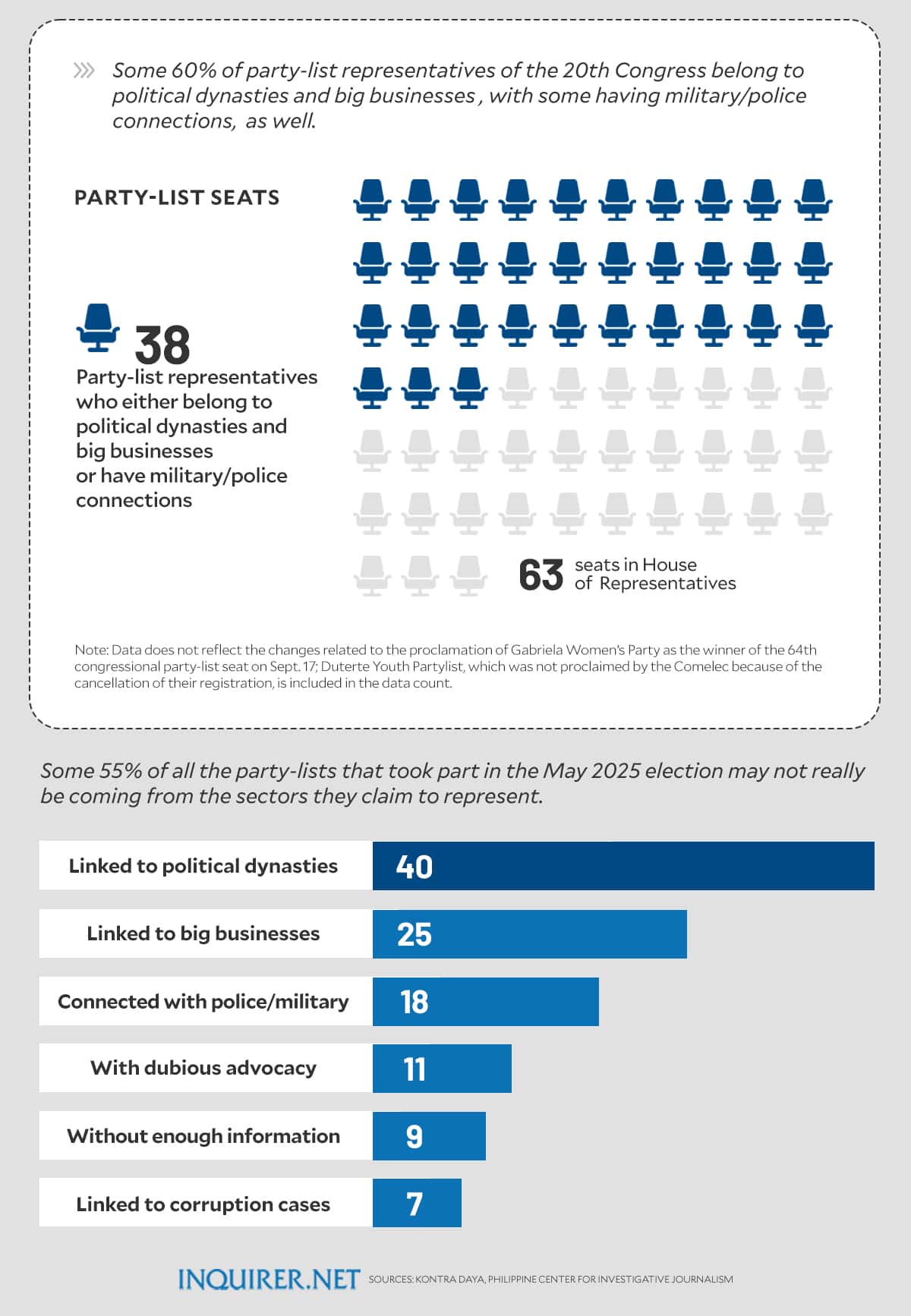
But based on data from Kontra Daya, out of all the party-list representatives holding 20 percent of all the seats in the House of Representatives, 38, or 60 percent, either belong to political dynasties and big businesses or have connections with the military and the police.
READ: 6 of 10 party-list reps don’t represent marginalized – Kontra Daya

GRAPHIC: Ed Lustan/INQUIRER.net
The analysis, which covered the immediate list of winning party-lists in the 2025 election, also revealed that 32 of the over 50 party-lists in the 20th Congress, or an overwhelming 59.3 percent, do not represent the marginalized and underrepresented sectors of the country.
The ‘business’ behind
As Frasco said, the resignation of Co should not, and cannot, erase his alleged crimes, pointing out that Co is a shareholder of construction companies that secured juicy government contracts.
He violated Section 141 (h) of the House Rules, Frasco stressed, stating that Co was a “co-conspirator in the alleged insertion of billions for projects that benefited himself and his cohorts.” “Resignation spared Co from sanction by the House [of Representatives], but it also exposed the weakness of our system.”
Since 2010, a Co has always been one of Ako Bicol’s representatives, with Christopher serving for nine consecutive years until 2019, when Zaldy succeeded him and served together with Garbin and former Rep. Jil Bongalon.
Christopher established the Hi-Tone Construction and Development Corporation, while Zaldy co-founded Sunwest Inc., which are both in the list of contractors that were identified by President Ferdinand Marcos Jr. to have cornered 20 percent of flood mitigation projects since 2022.
READ: What billions look like: Visualizing the staggering scale of flood control corruption
Based on a report by the Philippine Center for Investigative Journalism, companies linked to the Cos, including FS Co Builders and Supply, secured 149 projects from 2022 to 2025, or P15.7 billion worth of government contracts.
READ: Firm tied to Zaldy Co named in DPWH complaint sent to competition body
Since 2022, Co had been the chairman of the House Committee on Appropriations, succeeding Benguet Rep. Eric Yap. However, in his resignation letter, which was sent to House Speaker Faustino “Bojie” Dy III, he denied deliberately allowing last-minute insertions in the national budget in exchange for kickbacks.
SC decision
As early as 2010, the credibility of Ako Bicol has already been challenged, with disqualification cases filed, with the one in 2013 reaching the Supreme Court as the Commission on Elections (Comelec) disqualified the regional political party, as well as 12 more.
This, because Ako Bicol allegedly violated Republic Act No. 7941, or the Party-List System Act, which provided for the promotion of “proportional representation,” especially for Filipinos “belonging to the marginalized and underrepresented sectors, organizations and parties, and who lack well-defined political constituencies.”
However, as the Supreme Court (SC) remanded the case to the Comelec together with a new set of guidelines, Ako Bicol was allowed to take part in the election, securing two congressional seats with almost 800,000 votes.
As the SC pointed out, the party-list system is not reserved for the “marginalized and underrepresented” or for parties that lack “well-defined political constituencies,” indicating that party-list groups no longer need to come from marginalized sectors.
READ: When reputations collapse like buildings
But over a decade later, Ako Bicol is in a storm once again, a scandal which Sol Iglesias, an associate professor of political science at UP Diliman, said, “exposes the decrepit nature of the party-list system,” lamenting how it was “rendered meaningless for marginalized sectoral representation” by the decision made by the SC.
This is why Congress is now filled with traditional politicians, like Zaldy Co, she said.
Backdoor
Atienza said the party-list system has been “used by traditional politicians, political dynasties, and wealthy groups to push their interests in the House of Representatives,” pointing out that the system “has really been corrupted.”
She stated the existence of party-lists that claim to represent drivers but are actually managed by rich transport franchise holders, and even groups that are said to represent OFWs but are controlled by operators of recruitment agencies. There are those that claim to speak for construction workers but are managed by construction companies.
READ: Zaldy Co in the eye of the flood control super typhoon
While this may seem just fine, Atienza explained that “genuine party-lists of marginalized sectors and progressive groups struggle to compete with these moneyed and influential party-lists that can afford patronage and celebrity endorsements for their campaigns.”
“As a result, even the party-list system — the small space meant for marginalized and progressive groups — has been hijacked by the mighty and the influential,” she said, echoing Franco, who lamented how money is used to “create or co-opt party-lists so that they can have another space to monopolize entry to the political sphere.”
READ: Marcos: Resignation not the end for officials in flood works mess
The case of Co and Ako Bicol, Atienza said, should trigger a reform so that the system can finally and really amplify the voices of the genuine sectors in the House of Representatives.
Franco pointed out that there is really a need for the system to be reviewed and amended “so that it can serve its original purpose, which is to provide space for those without money and connection to enter politics.”
As for Iglesias, if the passage of an anti-dynasty law, once and for all, would be the only legislative outcome of the investigations into corruption-ridden infrastructure projects of the government, as well as the people-led protests across the country, then “that would be a good start.”/tsb


