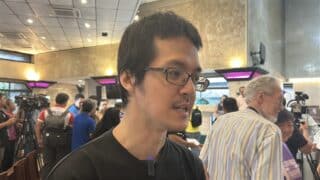
ASEAN?s Most Outstanding Scientist and Technologist awardee is a Filipino dean from the University of the Philippines.
Dr. Caesar Saloma was honored for his significant work in photonics and signal processing. He was cited for his efforts that ?have resulted in the development of novel and cost-effective techniques in optical signal recovery and retrieval.?
His work was undertaken in collaboration with colleagues and students at the National Institute of Physics (NIP).
Together with Dr. Vincent Ricardo Daria and Jelda Jane Miranda, the dean of the college of Science secured a United States patent for a cost-effective and non-invasive method of identifying microscopic defects in integrated circuits (IC).
Considered a major breakthrough in the semiconductor industry, the technique allows for accurate identification of circuit defects by producing a high-contrast image map of the semiconductor and metal sites.
The triennial award or held every three years was created by the ASEAN Committee on Science and Technology in the early 1990s to recognize scientists and technologists from ASEAN countries whose achievements have been acknowledged locally and internationally.
The ASTW is intended to promote science and technology development in the region by creating greater awareness of S&T, developing an S&T culture, and providing a medium for participation and collaboration in regional S&T programs.
The science teacher is the first and only ASEAN scientist to receive the Galileo Galilei Award in optics from the International Commission for Optics.
Saloma has been a recipient of various other awards, including the 2007 Metrobank Foundation Outstanding Teacher Award (Higher Education Category), the 2006 UP Diliman Gawad Chanselor para sa Natatanging Guro, and the Gawad Chanselor Hall of Fame in two separate categories, the Pinakamahusay na Mananaliksik, and the Pinakamahusay na Nilathalang Pananaliksik.