





Land scarce Singapore looks underground for space


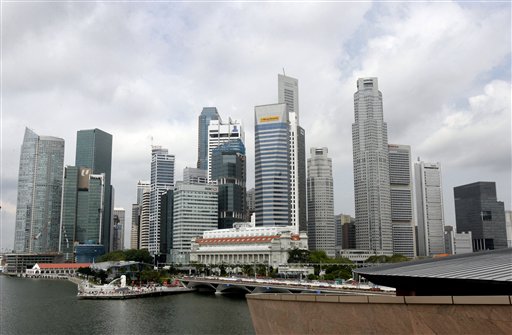
This July 14, 2009 file photo shows the skyline of Singapore’s financial district. Already one of the most densely populated countries in the world, tiny land scarce Singapore is projecting its population to swell by a third over the next two decades. To accommodate the influx, its planners envisage expanding upward, outward and downward. The population target of 6.9 million people, an increase of 1.3 million from the present, is contentious in a country where rapid immigration has already strained services such as public transport and contributed to a widening wealth gap. AP
SINGAPORE—Already one of the most densely populated countries in the world, tiny land scarce Singapore is projecting its population to swell by a third over the next two decades. To accommodate the influx, its planners envisage expanding upward, outward and downward.
The population target of 6.9 million people, an increase of 1.3 million from the present, is contentious in a country where rapid immigration has already strained services such as public transport and contributed to surging home prices and a widening wealth gap. It sparked a rare protest last week, with some 3,000 people gathering in a park that’s the only approved area for demonstrations.
Singaporeans, whose forebears mostly hailed from southern China, fear their falling birth rates combined with the relentless immigration will reduce them to a minority in their own country. Adding a new dimension to their complaints is the idea that planners want underground living to leap off their drawing boards and become a solution to overcrowding.
State media is already championing the idea. In September, the Straits Times newspaper characterized underground living as the “next frontier” for Singapore. It said Singaporeans may one day “live, work and play below ground in vast, subterranean caverns that make today’s underground malls look like home basements.” The Building Construction Authority, which oversees a new agency responsible for surveying underground, said it could become reality by 2050.
The public’s reaction has included derision and disbelief.
“Why pull me down,” said Patricia Bian-Hing, a retired 87-year-old businesswoman. “The only time I will go underground peacefully to live will be in my coffin.”
But experts are calling for an open mind about the possibility.
“Singaporeans are dismissing this prospect because it is new, not because it is unworkable or implausible,” said Jeffrey Chan, an assistant professor of architecture at the National University of Singapore.
“Astronauts who live in space stations, despite the abundance of direct sunlight have to live in shade most of the time, and they are only debilitated from the lack of gravity, not light,” he said. “Hence, I think if there are any biologically-imposed constraints, psychologically or real, these biological constraints can be overcome through new habits or technologically.”
With about 675 square kilometers (261 square miles) of land, Singapore is only 3.5 times the size of Washington DC and has limited options for increasing its space. Land reclaimed from the sea already accounts for a fifth of its landmass and Singapore’s appetite for imported sand for reclamation has caused tensions with neighboring countries concerned about coastal erosion. But its ruling People’s Action Party, in power since 1959, sees a bigger population as crucial to its goal of transforming Singapore into what it calls a leading world city.
The government’s new plans call for releasing land for housing and industry by closing golf courses and military training grounds and paving over some of the island’s nature reserves. That along with reclamation will free some 5,200 hectares (52 square kilometers, 20 square miles) of land to help accommodate an additional 700,000 homes and new shops and factories over the next 20 years. The projected increase in available land lags far behind the planned population increase so projects to put industry and other activities underground are already advancing on several fronts despite the technical challenges and significantly higher costs of subterranean construction.
“Going underground is one option for Singapore as it frees up surface land,” said David Tan, assistant chief executive officer of Jurong Town Corporation, Singapore’s main development body.
The JTC is studying construction of an underground science complex beneath an existing science park that’s used by biotechnology and pharmaceutical companies. Projected to cost 50 percent more than a similar facility above ground, it would go down 30 storeys — 80 to 100 meters — and house laboratories, offices and a data center.
The corporation has already overseen construction of a massive underground oil bunker in rock caverns that freed up a surface area equivalent to six petrochemical plants. The island also saved 300 hectares of space by putting an ammunition bunker underground.
A possibility explored for several years is an underground extension of Singapore’s Nangyang Technological University after a 1999 study by the government and the university found at least part of the area beneath the campus could be turned into rock caverns. Planners envisage four underground levels that could accommodate lecture theatres, cinemas, libraries, offices, laboratories and car parking.
“If we think about it, there are already underground spaces here in Singapore and throughout most major metropolitan regions,” said Erik L’Heureux, an architecture professor NUS.
“We already have underground train stations and malls, and there are already many buildings here that take advantage of spaces below ground so the real questions are how much time will one spend underground, what goes on there, and how far down from natural light and fresh air.”
For the Singapore for Singaporeans camp, the space squeeze has only highlighted the costs of the government’s population and economic policies. Its efforts to attract high-skilled professionals in finance, science and other industries it wants Singapore to be known for has resulted in nature sanctuaries and cemeteries being overrun by golf courses and luxury condominiums.
“Ultimately it will be Singaporeans who will suffer,” said Rachel Mun, a 33-year old sales assistant. “As it is, Singapore is already bursting with people and things we once depended on like transportation, have become exhausted because of the influx of commuters.”


