





Obama, Congress in last push to avert ‘cliff’


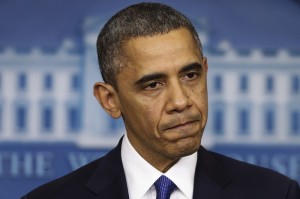
President Barack Obama pauses as he speaks to reporters about the fiscal cliff in the Brady Press Briefing Room at the White House in Washington, Friday, Dec. 21, 2012. (AP / Charles Dharapak)
WASHINGTON — President Barack Obama and members of Congress prepared for one last try to avert across-the-board tax increases and spending cuts known as the fiscal cliff, as the U.S. Treasury Department warned that it will begin taking action to prevent the government from hitting its debt limit.
Treasury Secretary Timothy Geithner said Wednesday in a letter to congressional leaders that the department will use accounting measures to save approximately $200 billion. That could keep the government from reaching the debt limit — which is embroiled in the fiscal cliff talks — for about two months.
The move comes as Obama and the Republican congressional leadership resume negotiations that hit a stalemate last week over how to avoid the fast approaching fiscal cliff, which some economists warn could cause another recession after it takes effect in the new year. Obama decided to cut short his Hawaii vacation for an overnight flight expected to get him back to the White House on Thursday. But Congressional officials said Wednesday they knew of no significant strides toward a compromise over a long Christmas weekend, and no negotiations have been set.
Obama has sought to include an increase in the borrowing limit in the talks. But House of Representatives Speaker John Boehner and other Republican leaders have demanded concessions in return.
The Senate is due in session Thursday, although the immediate agenda includes other matters. The House has no plans to convene, following last week’s rebellion in which conservatives torpedoed Boehner’s legislation to prevent scheduled tax increases on most, while letting them take effect on million-dollar wage earners.
Obama insists that no tax cuts be extended for anyone earning over $400,000 per year.
Geithner said the negotiations over tax and spending policies make it difficult to predict how long he can delay reaching the borrowing limit. The absence of a specific timeframe may be intended to pressure Republicans to allow a debt limit increase in a potential budget deal.
For now, Treasury will take several steps to delay reaching the limit. Geithner said it will stop selling Treasury securities used by state and local governments to support their own sales of tax-exempt bonds. That will keep the department from accumulating more debt.
And the department will stop investing in government retirement funds.
The two sides may strike a short-term agreement before New Year’s that postpones spending cuts until spring. And even if New Year’s passes with no deal, businesses and consumers would not likely panic as long as some agreement seemed imminent. The $671 billion in tax increases and spending cuts could be retroactively repealed.
Also, the impact of the tax increases would be felt only gradually, with most people receiving slightly less money in each paycheck.
“The simple conclusion that going off the cliff necessarily means a recession next year is wrong,” says Lewis Alexander, an economist at Nomura Securities. “It will ultimately depend on how long the policies are in place.”
The borrowing limit is the amount of debt the government can pile up. The government accumulates debt two ways: It borrows money from investors by issuing Treasury bonds, and it borrows from itself, mostly from Social Security revenue.
In 2011, Congress raised the limit to nearly $16.4 trillion from $14.3 trillion. Three decades ago, the national debt was $908 billion. But Washington spent more than it took in, and the debt rose steadily — surpassing $1 trillion in 1982, then $5 trillion in 1996. It reached $10 trillion in 2008 as the financial crisis and recession dried up tax revenue and as the government spent more on unemployment benefits and other programs.
In August 2011, the rating agency Standard & Poor’s stripped the U.S. government of its prized AAA bond rating because it feared that America’s dysfunctional political system couldn’t deliver credible plans to reduce the federal government’s debt. S&P decried American “political brinksmanship” and concluded that “the differences between political parties have proven to be extraordinarily difficult to bridge.”
A year and a half later, the two political parties are still as deadlocked as ever.
Despite S&P’s warnings and the political stalemate, investors still want U.S. Treasurys. Given economic turmoil in Europe and uncertainty elsewhere, U.S. government debt and U.S. dollars look like the safest bet around.
That is why the interest rate, or yield, on 10-year Treasury notes has fallen from 2.58 Aug. 5, 2011 to 1.75 percent Wednesday.


