





Changing climate, changing governance
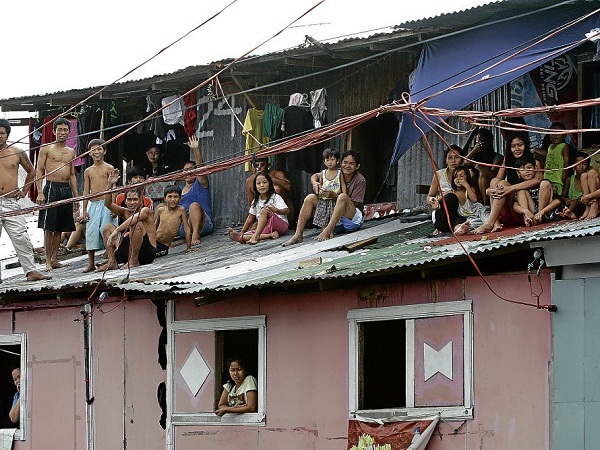
THE TOPNOTCHERS. Entire families in flood-prone areas rush up to the roofs of their house to beat the rapidly rising waters in these frightful times of climate change. This extended family on Araneta Avenue is on top of everything while waiting for their rations and rescue (whichever comes first). NIÑO JESUS ORBETA
(Senator Legarda is Chair, Committee on Climate Change United Nations Regional Champion for Disaster Risk Reduction and Climate Change Adaptation for Asia-Pacific)
The Camotes Island in Cebu, a tropical paradise blessed with sugary white sand and pristine, crystal clear waters, has become a model for disaster risk reduction and management, with one of its municipalities, the town of San Francisco, winning the 2011 United Nations Sasakawa award for Disaster Risk Reduction.
With the goal of sustainability for their farming and fishing communities, the townsfolk established the Purok system as a way to build capacity for local action. This traditional method of self-organization within villages helped communities to understand and develop the discipline needed in proper waste management and disaster prevention. It also encouraged voluntary contribution to a fund for emergency preparedness and responsiveness.
The residents are vigilant in implementing segregation at source—strictly enforcing their no trash segregation-no collection policy, recycling, composting and the collection of payment for carbon taxes, which are based on the amount of domestic waste produced from day to day.
To rehabilitate their watersheds, the local government initiated the Two Million Trees project, which aims to plant two million endemic or native trees by 2015. A tour around Danao Lake, one of the areas for tree planting, leads one to rediscover native trees such as tugas, ipil, buyos, nagtalisay and talamban.
Camotes Island’s program is considered, among neighboring provinces, as an example of building resilience through good governance.
In Surigao del Norte, the third class municipality of Hinatuan has been implementing an effective Solid Waste Management program since 2008.
Led by their mayor, consultations with the people revealed the need for an effective waste management program that would support local compliance of the law.
Through the program, the townspeople of Hinatuan cleaned clogged canals, cleaned their surroundings and seawater, as well as regulated plastic use and reduced greenhouse gas emissions.
Zero Basura Olympics
Four years after, proper waste disposal is now a way of life for the people in this town, contributing greatly to disaster preparedness in the event of a natural hazard. Compost, which is a by-product of processing waste, also encouraged households to grow backyard gardens resulting in improved food security.
In 2010, the municipality of Hinatuan won the nationwide Zero Basura Olympics.
Clearly, if Hinatuan and Camotes Island can effectively enforce our environmental laws, there is no reason for a town, city or province to say that it cannot be done.
Their success stories encourage us to not wait for the next disaster to strike, but instead act decisively, now.
We must assess our respective work in reducing flood risk, if we are really making any headway amid the ‘new norm’ we experience in this era of climate change. We must implement immediately the Climate Change Act and Disaster Risk Reduction and International Strategy for Disaster Reduction.
The nation’s capital needs a comprehensive recovery and rehabilitation plan that will reduce people’s vulnerability and increase the resilience of all sectors to floods. We must strengthen flood control projects, relocate informal settlers living along riverbanks and esteros, and undertake drainage improvement and watershed projects in selected locations. We have to always ensure that esteros, waterways, and drainages are not clogged with waste materials. Moreover, we must educate Filipinos on the importance of waste segregation and provide effective waste disposal methods.
It is imperative for the government to submit to the discipline of disaster and climate risk-sensitive development planning. The national government budget for 2013 must anticipate and can withstand the impacts and economic stress brought about by stronger typhoons, heavier rains, prolonged droughts and other extreme weather events.
When the floodwaters subside, we must restore normalcy in people’s lives with a stronger sense of hope and confidence for the future.
While we rebuild the lives of our people in disaster-stricken areas, it may be good to reflect that a similar disaster is likely waiting to happen in hundreds of other places in our country, maybe known already to us.
Our region, Asia, is the world’s most disaster-prone region. People in Asia are four times more likely to be affected by disasters caused by natural hazards than those in Africa; and 25 times more likely than those in Europe or North America, based on a UN report.
In the Philippines, the number of documented disasters from natural hazards surged 50 percent last year, making our nation the world’s most disaster-hit country in 2011.
In international climate talks, we have persistently called for climate justice, urging industrialized countries to commit deep cuts in their greenhouse gas emissions and to financially and technologically support climate change adaptation work in vulnerable nations, who have the least responsibility for having caused the climate crisis and have the least capability to deal with its impact.
Today, over half a million Filipinos, so-called “climate refugees” that were displaced by the monsoon rains have suffered irreparable damage on their homes and possessions, adding to the 3,995 families still residing in temporary shelters seven months after Tropical Storm “Sendong.”
We will see more of this situation, perhaps even worse, if we do not stop dealing with disasters on an ad-hoc basis. We have to strengthen initiatives for disaster resilience that have been taking roots in pioneering local communities, their dynamic leaders driving and pushing these initiatives into certain success.
Ultimately, the best choice we have is to make our nation disaster-resilient to free us, once and for all, from the exhausting and costly cycle of rebuilding our communities every single time nature unleashes its wrath.
Let us be the change we seek.


