





Marine sanctuary to save rare double-barrier reef


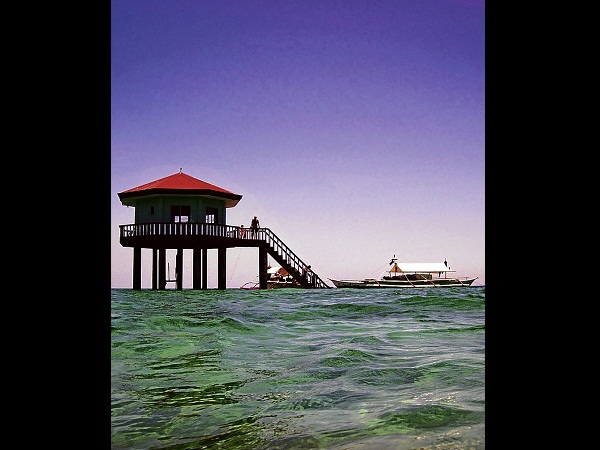
INSIDE Minantaw Marine Park Sanctuary is the guardhouse, which also serves as a visitors’ learning center. CRIS EVERT LATO
LAPU-LAPU CITY—Fisherman Gilbert Alcoser grew up thinking that if he could not catch fish with nets, he should use dynamites.
Following unquestioningly what his father, Capriano, had told him on the island-barangay of Caubian, an hour away by boat from Lapu-Lapu City, he was unfazed even when some of his neighbors were killed or lost their hands due to dynamite fishing.
“It was normal. It just happened,” Alcoser said. What scared him though was when fish catch was low; he must earn enough money to support his wife and three children.
“We did not realize that we were depleting our rich marine resources because of dynamite fishing. It is alarming because the majority of us are fishermen and we support our families with this job,” said Alcoser, 34, president of United Fishers of Caubian or Nagkahiusang Mananagat sa Caubian (Namaca).
In 2007, Namaca sought help in restoring the dying marine ecosystem. This led to the establishment of Minantaw Marine Park Sanctuary (MMPS), one of the initiatives in conserving the Danajon Double Barrier Reef (Danajon Bank).
At that time, members of Project Seahorse Foundation for Marine Conservation (PSF) were already moving around Bohol and Mactan, educating fisherfolk about the importance of marine conservation.
Critical fishing area
“We were campaigning for the conservation of the Danajon Bank, which is a critical fishing ground for thousands of fishers from the provinces of Cebu, Bohol, Leyte and Southern Leyte,” said PSF social development officer Rosemarie Apurado.
The Danajon Bank is the only double-barrier reef in the Philippines and one of only three reefs of this kind in the Indo-Pacific region. It is home to over 200 species of coral reefs, thousands of invertebrates, over 500 fish species, and hectares of sea grass and mangroves.
It is 130 kilometers long and has a total area of 272 square kilometers. It represents 1 percent of the country’s total coral area, with the Caubian area as the largest (143 sq km).
“You can just imagine the richness of marine biodiversity, but very few people know about the Danajon Bank,” PSF biologist Hazel Panes said.
Since the 1950s, fishermen have been practicing destructive fishing methods in the bank, resulting in coral deaths that led to declining fish catch, PSF social development officer Rosemarie Apurado said.
The foundation reported that since 1995, the rate of depletion and destruction of coral reefs had been estimated at
10 percent a year, increasing to 30 percent a decade later.
Marine sanctuary
In 2008, PSF, Namaca, the local government of Lapu-Lapu and Chevron Philippines Inc. (CPI) established the 214.6-hectare MMPS.
“We have a terminal in Lapu-Lapu City and we know that there is an ongoing campaign to save the reef,” said Donald Campbell, Chevron’s global manager-downstream and technology of the public and government affairs.
Chevron donated P3.5 million to establish MMPS, the first multiuse marine protected area in the country.
The sanctuary has four zones: regulated fishing (62 ha), seaweed farming (55 ha), sustainable use (37 ha) and strictly no-take or core (50 ha).
A guardhouse also serves as a visitors’ learning center. Facts about the Danajon Bank and its rich marine environment can be found in the center.
More visitors
Raissa Bautista, CPI manager for policy, government and public affairs, said the project partners were encouraging more visits to MMPS. Most of the visitors are from resorts, social development organizations from Mindanao, local government units from Zamboanga and Mandaue City, and Mactan Export Processing Zone, she said.
“The vision for MMPS is to become a well-managed dive destination so that nearby villagers can have an alternative source of livelihood. The Danajon Bank’s true value lies on the preservation of its marine habitats for ecotourism,” Bautista said.
Panes said the foundation had been given assurance of the continuous rehabilitation of the reef with the presence of MMPS. Commercially valuable species, such as rabbit fish, crabs, squids and seaweeds, are gradually returning, she said.
“We are seeing the effects now more than four years since it was established,” Panes said.
Namaca members serve as fish wardens to ensure that illegal fishing activities in the area are stopped. According to Romeo Matbagon, chair of Barangay Caubian, community members now report offenders to police authorities, even if they are relatives or close friends.
“We have to do what is right. Otherwise, we will run out of food and livelihood. Personally, I’d rather cut family ties than exploit our resources. We, as fish wardens, are doing this for ourselves, our children and our future,” Matbago said.


