





Egypt votes for president to succeed Mubarak
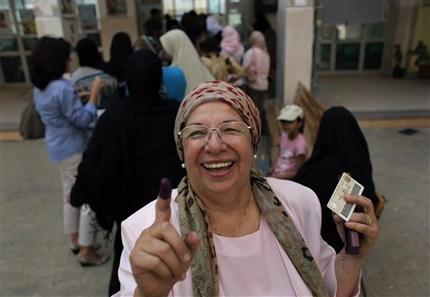
An Egyptian woman shows her ink-stained finger after voting, while others line up in front of their polling station during the first day of the presidential runoff, in Cairo, Egypt, Saturday. Egyptians voted Saturday in the country's landmark presidential runoff, choosing between Hosni Mubarak's ex-prime minister and an Islamist candidate from the Muslim Brotherhood after a race that has deeply polarized the nation. (AP Photo/Nasser Nasser)
CAIRO — Egyptians on Saturday voted to choose between a conservative Islamist and Hosni Mubarak’s ex-prime minister in a presidential runoff once billed as the country’s long-awaited shift to democracy but now clouded by pessimism over the future.
Whoever wins after two days of voting, Egypt’s military rulers will remain ultimately at the helm, a sign of how Egypt’s revolution has gone astray 16 months after millions forced the authoritarian Mubarak to step down in the name of freedom.
“We are forced to make this choice. We hate them both,” said Sayed Zeinhom at Cairo’s Boulak el-Dakrour, a densely populated maze of narrow dirt alleys and shoddily built houses. Mahmoud el-Fiqi, waiting with him at a polling center, offered, “Egypt is confused.”
The race between Ahmed Shafiq, a career air force officer like Mubarak, and the Muslim Brotherhood’s Mohammed Morsi, a US-trained engineer, has deeply divided the country after the stunning uprising that ousted Mubarak after 29 years in office, and left many disillusioned about the elections’ legitimacy.
Many voters felt that the choice no longer even mattered after a court ruling this week effectively ensured that the military generals who have ruled since Mubarak’s ouster will continue to be in power.
The generals took over legislative powers after Egypt’s highest court on Thursday ordered the dissolution of the parliament elected just six months ago, and the military made a de facto declaration of martial law, despite earlier promises to hand over power to the new president by July 1. With no constitution or parliament, the president’s powers are likely to be determined by a military with power to arrest civilians for crimes as minor as traffic obstruction.
To the activists behind the 18 days of mass protests that toppled Mubarak’s regime, the election seemed a cruel joke, that crushed their dream of a new Egypt – free, democratic and rid of all traces of the old system.
“The revolution will continue and restore the right of those who died in the uprising,” said Ziad el-Oleimi, an iconic figure of the anti-Mubarak revolt in which nearly 900 protesters were killed. “This election is essentially for the selection of a new dictator.”
That frustration gave rise to a movement among some to either boycott the election or cast invalid ballots.
Contractor Mohammed Ahmed Kamel, a resident of the poor Cairo district of Warraq, crossed out both Shafiq’s and Morsi’s names in protest on his ballot. “We don’t want Islamists and we don’t want old regime,” he said.
In most polling stations observed by The Associated Press, voter turnout appeared light, with lines considerably shorter than in the first round of elections. There were no official turnout figures, and in districts known to be strongholds for both candidates, voters came out in force and braced the long waits and heat.
Few voters showed the sense of celebration visible in previous, post-Mubarak votes: anxiety prevailed. Some said they felt bitter that their “revolution” had stalled, feared that whoever wins protests will erupt, or were deeply suspicion that the political system was being manipulated.
Others said they were voting against a candidate as much as for a favorite. Anti-Shafiq voters said they wanted to stop a figure they fear will perpetuate Mubarak’s regime; anti-Morsi voters feared he would hand the country over to Brotherhood domination to turn it into an Islamic state.
With the fear of new authoritarianism in the future, some said they were choosing whoever they believed would be easiest to eventually force out with new protests.
“We are afraid Egypt will turn into a religious state. Even though Shafiq is not the best one, we want him to maintain the civil state,” said Marsa Maher, a Christian housewife.
Mustafa Abdel-Alim, a bank employee with a mark on his forehead sometimes seen on Muslims from repeated prayer, said he wanted to keep out the Brotherhood. “If we elect Morsi … we won’t get rid of them for 100 years,” he said.
Many voters are angry at the Brotherhood, which was the big winner in the parliament elections, gaining nearly half the seats, but was later accused of trying to monopolize authority. After Thursday’s court ruling, others were angered by what they saw as the military’s power grab.
Brotherhood supporter Amin Sayed said he had planned to boycott the vote, but changed his mind after the court ruling.
“I came to vote for the Brotherhood and the revolution and to spite the military council,” he said in Imbaba, a Cairo stronghold of Islamists. “If Shafiq wins, we will return to the streets.”
Shafiq, an admirer and a longtime friend of Mubarak, has campaigned on a platform of a return to stability, something that resonated with many Egyptians frustrated and fatigued by more than a year of deadly street protests, a faltering economy and surging crime.
Morsi marketed himself as a revolutionary who is fighting against the return of the old regime, promising guaranteed freedoms and an economic recovery, while softening his Islamist rhetoric in a bid to reassure liberals, minority Christians and women.
The balloting, which continues Sunday, will produce Egypt’s first president since the ouster of Mubarak, who is now serving a life sentence for failing to prevent the killing of some 900 protesters during the 18-day uprising that toppled his regime. The winner will be only the fifth president since the monarchy was overthrown nearly 60 years ago.
The election is supposed to be the last stop in a turbulent transition overseen by the military generals. But even if they nominally hand over some powers to the winner, they will still hold the upper hand over the next president. The generals are likely to issue an interim constitutional declaration defining the president’s powers. They will hold legislative powers, and they will likely appoint an assembly to write the permanent constitution, preserving a political role in the future.
Days before the vote, the military-appointed government also gave military police and intelligence agents the right to arrest civilians for a host of suspected crimes, which many saw as a de facto declaration of martial law. Already, the generals have been blamed for mismanaging the transition and they stand accused of killing protesters, torturing detainees and hauling at least 12,000 civilians before military courts since January 2011.
Using diplomatic language to convey Washington’s concern about the latest development in longtime ally Egypt, US Defense Secretary Leon Panetta emphasized to Field Marshal Hussein Tantawi, Egypt’s military ruler, “the need to ensure a full and peaceful transition to democracy.”
In their phone call Friday, Tantawi, Mubarak’s defense minister of 20 years, confirmed the military’s intention to transfer power to a democratically elected government by July 1, according to the US Defense Department.
Unlike in earlier post-Mubarak votes when Egyptians were confident the balloting would be free of interference, many this time said they expected tampering.
“I don’t think Shafiq `could’ win, I think he `will’ win,” said Nagwan Gamal, a 26-year-old engineering lecturer at Cairo University who voted for Morsi. “I think there will be corruption to ensure that he wins, though I think a lot of people will vote for him.”
There were no immediate reports of significant violations at the polls. But several voters became alarmed by a rumor that they were being given pens with disappearing ink so that their ballots wouldn’t count.
Gamal and others underscored a widespread belief that the ruling military wants to ensure a win by the president of its choosing. The military has said it does not back either candidate. There were scuffles and even a shootout between supporters of the two candidates in several places around the country.
For many, there was a sense of voting fatigue. Egyptians have gone to the polls multiple times since Mubarak’s fall on Feb. 11, 2011 – a referendum early last year, then three months of multi-round parliamentary elections that began in November, and the first round of presidential elections last month.
“My name is Saber, which means `patient’, but my patience is gone,” said Karim Saber, a 30-year-old driver who said he was saving to get married.
“The man before (Mubarak) did not do anything and whoever is succeeding him won’t do anything,” he said at a coffee house in the Basateen suburb south of Cairo. “I don’t know what the solution is. I feel suffocated.”
Outside a polling center at the Cairo suburb of Shubra el-Kheima, Sameh Mohammed declared: “I am not voting for either. They are all thieves and liars and cooperating with the military.”
Mohammed, who now washes cars after his factory closed following the revolution, lashed out at the military, but said he doesn’t trust the Brotherhood either. He had voted for Morsi the first round.
“They are all gambling with our lives,” he said.
School teacher Mohammed Mustafa said he was voting to try to stop the return of the old regime.
“We lost this country for 30 years, and we are not ready to lose it again,” he said.


