





Munching on monkey’s heel


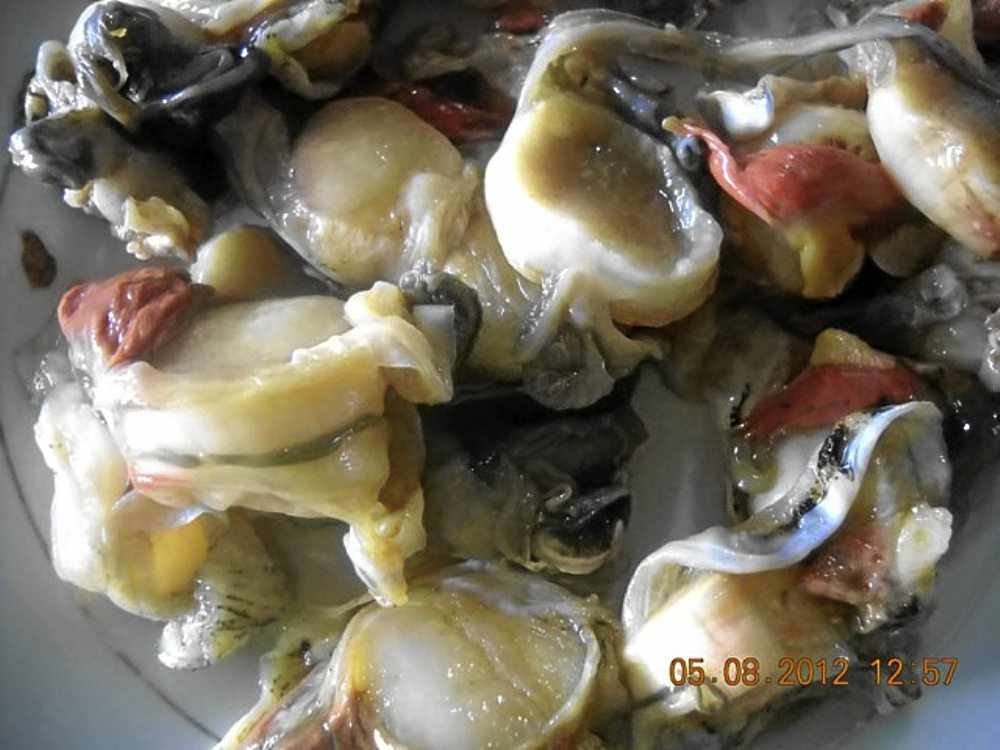
MONKEY’S heel doesn’t look anything like what its name suggests it came from. ROMEL ORIBE/CONTRIBUTOR
Thanks mainly to Facebook, Surigao del Sur has finally gone mainstream as a three-in-one tourist destination. But there’s more to this sun-kissed province known as “Shangri-La by the Pacific” than its famous troika of Britania Islands, Enchanted River and Tinuy-an Falls.
One must not forget that Surigao del Sur is also famous for seafood that it’s even tagged as a place where crab is a delicacy, not a mentality. This feature now seems to take a back seat because budget tourists must go from one natural marvel to another on a single day.
Woe to them because they don’t know what they’re missing! Think not of crabs, prawns, lobsters and common shellfish as one can get them anytime, anywhere. Think instead of the exotic and rare tikud amo.
Literally monkey’s heel, tikud amo is not usually displayed in food counters of diners along the now-concreted highways of Surigao del Sur. Instead, it’s sold like contraband, served only when demanded by customers in-the-know.
Doguiles’ masterpieces
Ivy Doguiles, owner of Erve’s Fastfood in Lianga, serves tasty tikud amo dishes whose secret recipes she inherited from her Lolo Moises, who had been preparing and eating this traditionally considered aphrodisiac long before it gained prominence at the turn of the new millennium.
Like her lolo (grandfather) before her, Doguiles has three masterpieces—kinilaw, stewed and boiled tikud amo.
Tikud amo is a rock oyster with a calcified, rough and spiny shell. Its whitish-gray outer shell is connected to its pearly white inner shell by a thin black ligament so striking that it looks like it’s placed there purposely for effect. Inside, its soft and creamy tan body is configured to look exactly like a monkey’s heel, thus the allusion.
In her research titled, “Preliminary Study of Tikud Amo on its Potential as an Oyster Culture Species,” Gemma Asufre, a researcher from Surigao del Sur State University, wrote that, interestingly, tikud amo is unknown in the International Species Nomenclature Database.
New species?
Though it is observed to have similar characteristics as the widely cultivated oyster species such as the Cassostrea iredalei and C. edilus, the flesh of tikud amo differs in color and morphologic descriptions. Asufre thus concluded that it’s a new species as no information describing its biological features could be found.
By Surigao del Sur standard, tikud amo is expensive. A small serving costs P90; raw, it sells at P350 a kilo. Such is the price because tikud amo is not gathered in shallow waters but in Lianga Bay whose depth tests the endurance of one’s lungs and eardrums, Doguiles said.
And owing to the nature of this bivalve which attaches one shell to a solid surface and remains fixed in place, a diver does not chisel it off as it’s difficult and time-consuming; instead, he pries open the shell with a knife, collects the meat and swims back to surface before his lungs burst. (This also explains the rarity of the empty shell that usually comes bigger than a regular guyabano.) A diver has to plunge at least five times to amass a kilo of tikud amo.
Endangered divers
According to Doguiles, in Lianga town, it’s not the number of tikud amo that’s endangered but the divers. Because it’s not always available, it’s easy to understand why one has to get lucky to have a taste of this cuisine said to trigger increased level of sex hormones.
Gourmands already addicted to this mollusk declare that its delicate, toothy texture doesn’t overwhelm the palate the wrong way. And the best way to eat it is to munch on and savor the salty liquor from parts that are chewy but not exceedingly chewy as tikud amo’s less tender relatives, the cuttlefish and the octopus. However, it’s the portion that is sweet, milky and crunchy that sets it apart from other staple seafood of its kind.
All three of Doguiles’ pièces de résistance have the same wonderful fusion of flavors heightened by some parts gummy and other parts crispy quality of the meat. And because common practice dictates that shellfish is best eaten raw, it’s her kinilaw that’s to-die-for.
Tourists’ itinerary
Any gastronome will know from the get-go that Doguiles’ kinilaw is delectably different because she doesn’t use the traditional nipa palm vinegar for her marinade, though it has the usual condiments. Though Doguiles would admit, if prodded, that she uses tuba, one could sense there’s more to her kinilaw than mere coconut wine.
When visiting Surigao del Sur, tourists with adventurous palates must include in their travel plan stopping over at Erve’s Fastfood where tikud amo fares are served plainly.
“I don’t bother so much about presentation. I just make sure I have the freshest tikud amo that I cook with little fuss, letting the flavor of the ingredients do all the work,” Doguiles said, aping the words of her lolo.
No monkey business there, just plain culinary truth.


