





PH launches ‘clean’ nuclear tourism
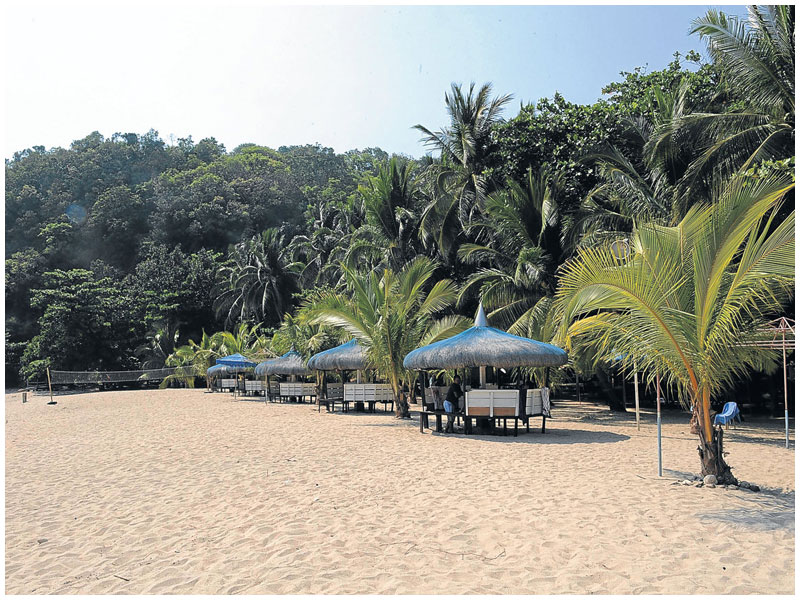
TURTLE BEACH This sandy beach is a turtle sanctuary which has been turned into a resort that can hold 45 guests visiting the Bataan Nuclear Power Plant in Morong, Bataan. Now, tourists can visit this remote turtle sanctuary then venture into the heart of the mothballed nuclear power plant. AFP
Morong, Bataan—In a fresh but ambiguous take on ecotourism, travelers in the Philippines can visit a remote turtle sanctuary and then venture into the heart of a nearby nuclear power plant in Morong, Bataan.
If tourists feel too weary to make the three-hour bus drive back to Manila after their unique day of sightseeing, they can stay at a guesthouse overlooking the pristine waters of the West Philippine Sea (South China Sea) at the atomic site’s private beach.
This tour-with-a-difference is part of the government’s latest effort to make use of the idle Bataan Nuclear Power Plant (BNPP)—one of the country’s most expensive and troublesome burdens.
“This will be the only tourist-friendly nuclear power plant in this part of the world,” Dennis Gana, spokesperson for state-owned National Power Corp. (Napocor) that runs the site, said over a lunch of barbecued tuna steaks and chicken at the beach.
“You don’t see a nuclear power plant every day. Especially a nuclear reactor… so I think for most people it would be very thrilling,” Gana said.
Built nearly three decades ago under the rule of dictator Ferdinand Marcos Sr. for about $2.3 billion, the plant has never produced a watt of energy and continues to cost taxpayers more than $10,000 a day to maintain.
Uranium was actually trucked into the site in 1984 and, for nuclear power advocates, the switch was at that point tantalizingly close to being turned on.
But the plant’s fate was doomed in 1986 as Marcos was overthrown in the Edsa People Power Revolution and global fears over atomic energy spiked with the Chernobyl nuclear disaster in Ukraine.
Critics of the BNPP venture had also insisted the plant was built too close to earthquake fault lines, and that it was madness to entrust such a dangerous venture as nuclear energy to the corrupt Marcos regime.
Nuclear option
Nevertheless, despite safety concerns over nuclear energy rising again amid the ongoing crisis at Japan’s tsunami-ravaged Fukushima plant, Napocor and some politicians still dream of reviving the Philippines’ only atomic power option.
“We are not saying we should go nuclear 100 percent, we are saying we should include nuclear in the power mix,” Gana said.
A bill seeking to get the plant running is pending in Congress, although even Filipino nuclear advocates concede there is little chance of it becoming law during President Aquino’s administration, which runs until 2016.
Gana said promoting the Bataan site for tourists, which began after the Fukushima plant melted down in March, was aimed not only at raising money to pay for the Philippine site’s maintenance budget but also to show it was safe to revive.
“Because of what happened in Fukushima, this facility has been dragged into the nuclear issue. We have to show the difference between this and Fukushima and why what happened there wouldn’t happen here,” he said.
In this light, Napocor is aiming to attract local and foreign students to tour the Bataan plant.
Day-tour itinerary
Local authorities in conjunction with Napocor have also recently begun including the plant on a day-tour itinerary of the area that takes in the turtle sanctuary, branding the trip perhaps a little ambitiously “ecotourism.”
For an entry ticket into the plant of just P20, tourists get a tour of the enormous concrete structure that sits 18 meters above the ocean on a mountainside.
The first part of the tour involves a PowerPoint presentation that explains the safety features of the plant, including its apparent ability to withstand a 9-magnitude earthquake.
Visitors are also assured there is no uranium at the site—the nuclear material was sold in 1997 at a huge loss of $35 million.
One of the most remarkable stops on the tour is on a steel bridge just a couple of meters from the reactor, the rods for which are still wrapped in the plastic that they came with when they were installed.
From the reactor, tourists walk along submarine-like passages into the control center, which similarly has barely been touched since the 1980s.
Obsolete technology
What was once state-of-the-art equipment—a computer the size of a desk, analog phones, dot matrix printers—stands as a monument to how quickly technology becomes obsolete.
Gauges showing how much energy the 620-megawatt plant is producing sit, as they always have, on zero.
And while rust has corroded other parts of the BNPP, Cora Balduyot, a chemical engineer who works permanently on site and helps to take the tourists, said getting the plant working again was possible.
She pointed to a 2009 study by a South Korean power firm that said the plant could become operational again within four years—although it would cost $1 billion to upgrade.
Swim and lunch
After the tour of the plant, visitors can go for a swim or have lunch at the 356-hectare site’s private beach, where hammocks hang under trees and goats roam the hillsides above.
The former environment monitoring station on the beach has also been turned into a guesthouse that can hold 45 guests, and the accommodation is cheap.
One of the smaller rooms, which can sleep seven people, can be rented for just P2,700 a night.
Antinuclear environment group Greenpeace International has embraced the tour packages and similarly labeled them “ecotourism,” but for the opposite reasons.
“Greenpeace supports the decision to finally turn the BNPP into something more practical: a monument to remind people of the inherent dangers of nuclear power,” said Manila-based Greenpeace campaigner Francis dela Cruz.
Despite the differences over the merits of nuclear power, Dela Cruz agreed with Napocor’s Gana that visiting the plant was a fascinating experience and it could prove an unlikely tourism hit.
“How many people can put a photo on Facebook of themselves taken from the middle of a control room of a nuclear power plant?” Dela Cruz said. AFP


